Glucosamine for a Dog Struggling With Stairs at Night: What the Evidence Actually Supports
A vet-informed look at why nighttime stair trouble shows up in aging dogs, what glucosamine and related joint ingredients are shown to do, and how to set realistic expectations.
Glucosamine may help a dog struggling with stairs at night by supporting cartilage and easing stiffness after rest.
On this page
Glucosamine may help a dog struggling with stairs at night by supporting cartilage and easing stiffness after rest. That’s the short version. The longer version starts with a scene a lot of owners will recognize.
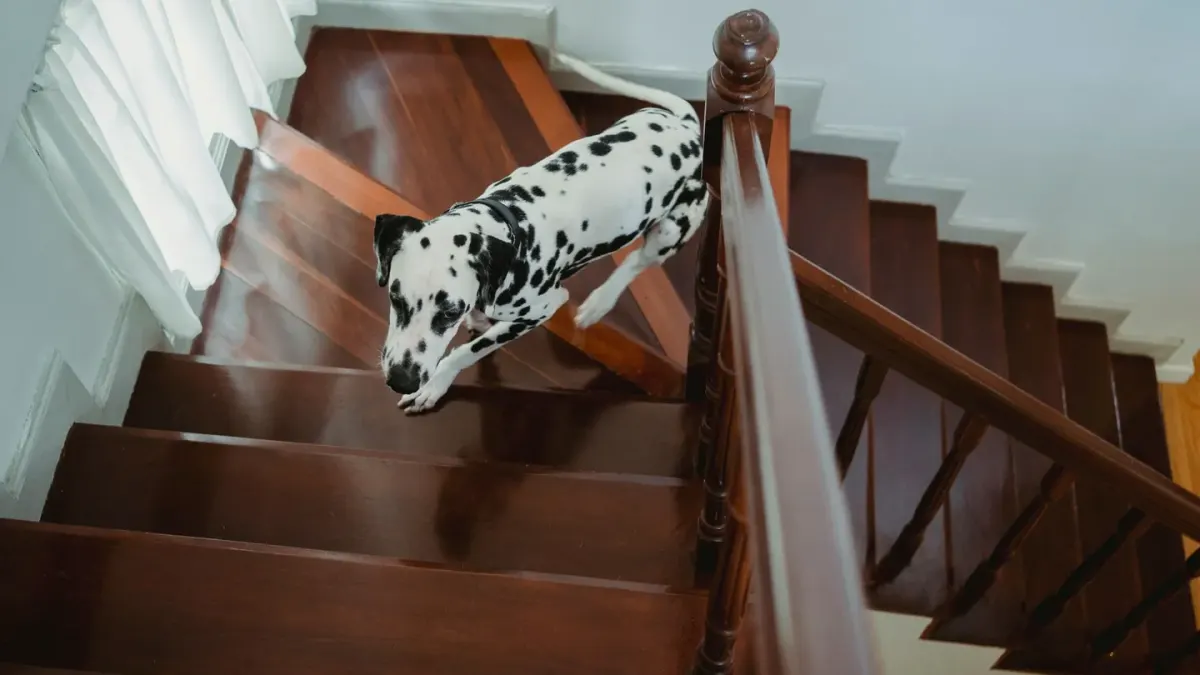
Around eleven at night, a twelve-year-old retriever named Beau stops halfway up the stairs. He isn’t in obvious pain. He just stands there a beat too long, front paws committed, back end unsure, before he gathers himself and finishes the climb. His owner notices it happens almost only at night, after he’s been curled up on the living room floor for hours. During the day, on a walk, he moves fine.
That pattern is the tell. A joint that has been still for a while tends to stiffen, and once movement resumes, it takes a few strides to loosen back up. Stairs ask a joint to bear weight through a full range of motion immediately, with no warm-up, which is exactly where stiffness shows first. Translating that into plain terms: think of the joint’s fluid and cartilage as needing to circulate before they work smoothly, the same logic that shows up in acupuncture and TCM thinking about stagnation easing once movement is restored. None of that requires an injury. It’s consistent with ordinary, cumulative joint wear.

What glucosamine is actually shown to do
Glucosamine is one of the two most studied joint-support ingredients for dogs, alongside chondroitin. The mechanism isn’t mysterious: glucosamine is a building block cartilage cells use to make and repair the cartilage matrix. A review in the Journal of Veterinary Medical Science found that glucosamine hydrochloride can help prevent experimentally induced cartilage degradation in vitro, meaning it showed a protective effect on cartilage cells under laboratory conditions.
That’s meaningfully different from a claim that glucosamine reverses existing arthritis or eliminates pain outright. It’s structure/function support: helping maintain the raw material cartilage needs, not repairing a joint that’s already worn down. For a dog like Beau, that means glucosamine is a reasonable thing to try alongside other management, not a stand-in for a diagnosis.
Why glucosamine rarely travels alone
Most joint formulas pair glucosamine with chondroitin and, increasingly, green-lipped mussel, because each ingredient is studied for a different piece of joint chemistry. Chondroitin has been linked to healthy synovial fluid, the lubricating fluid inside the joint capsule. Research published in Frontiers in Veterinary Science found that chondroitin supports healthy synovial fluid homeostasis, which is the balance that keeps joint fluid doing its job as a cushion and lubricant.
Green-lipped mussel brings a different angle: it contains omega-3 fatty acids and glycosaminoglycans, and animal research published in Nutrients found that mussel-derived compounds alleviated paw swelling and reduced markers of inflammation, including TNF-α and IL-17, in a rodent model. That’s inflammation-focused evidence rather than cartilage-building evidence, which is why the two ingredients are often used together instead of interchangeably. If you want a deeper walk-through of how these ingredients fit together across a whole label, The Complete Guide to Dog Joint Health and Mobility breaks it down section by section.
Setting a realistic timeline
Owners looking for a fast fix are often disappointed, and that disappointment is usually a timing problem, not an efficacy problem. Glucosamine and chondroitin work by supporting ongoing cartilage and joint-fluid chemistry, not by blocking pain signals the way an NSAID does. Most veterinarians suggest giving a joint supplement four to eight weeks of consistent daily use before judging whether it’s helping. Track something concrete during that window: how many stairs a dog manages before hesitating, how long it takes to loosen up after rising, whether nighttime pauses shorten. Vague impressions are hard to trust; a simple log isn’t.

Dosing matters more than most owners assume, and label-reading is its own skill. If you’re comparing products, How to Read a Dog Joint-Support Supplement Label walks through what the ingredient list and guaranteed analysis can and can’t tell you, and the companion label disclosure checklist is worth running any product past before you buy.
When nighttime stair trouble is more than stiffness
A dog who merely hesitates is different from a dog who yelps, refuses stairs entirely, or starts favoring one leg. Sudden, sharp changes point toward something a supplement won’t address: an acute arthritis flare, a soft-tissue injury, or in some cases a neurologic issue affecting the hind end. Any of those calls for a veterinary exam rather than a longer trial of glucosamine. A joint supplement is meant to support ongoing mobility, not stand in for diagnosis when the pattern changes abruptly.
For most dogs, though, the slow, night-specific hesitation on stairs is a familiar and manageable pattern. Glucosamine, paired with chondroitin and sometimes green-lipped mussel, has real laboratory support for the roles it’s asked to play. Give it time, track the actual behavior you’re trying to change, and treat a sudden shift in that pattern as your cue to call the vet rather than wait it out.
Frequently asked questions
Why does my dog struggle with stairs mainly at night?
Joints that have been resting for hours tend to be stiffer once a dog gets moving again, and evening is often when a dog has been lying down the longest. That stiffness, not a sudden new injury, is the usual explanation for a dog who manages stairs fine at midday but hesitates after dark.
How long before glucosamine makes a difference?
Most owners and veterinarians look for a change over 4 to 8 weeks of consistent daily dosing, since glucosamine works on cartilage chemistry gradually rather than acting like a fast-acting pain reliever.
Does glucosamine replace a vet visit for stair avoidance?
No. A joint supplement is structure/function support, not a diagnosis or a treatment for a specific disease. A dog who suddenly refuses stairs, yelps, or limps needs a veterinary exam to rule out arthritis flares, disc disease, or an injury.
Sources
- Chondroitin sulfate and synovial fluid homeostasis in joint and mobility research — Frontiers in Veterinary Science
- Glucosamine hydrochloride and experimentally induced cartilage degradation: a review — Journal of Veterinary Medical Science
- Green-lipped mussel extracts and inflammatory markers in joint tissue — Nutrients