How Long Should a Dog's Walk Be?
How long a dog's walk should be depends on joint load, conditioning, and age more than any fixed clock time — a vet nutritionist explains the mechanism and where joint-support ingredients actually fit.
How long a dog's walk should be depends less on the clock than on joint load, age, and conditioning.

On this page
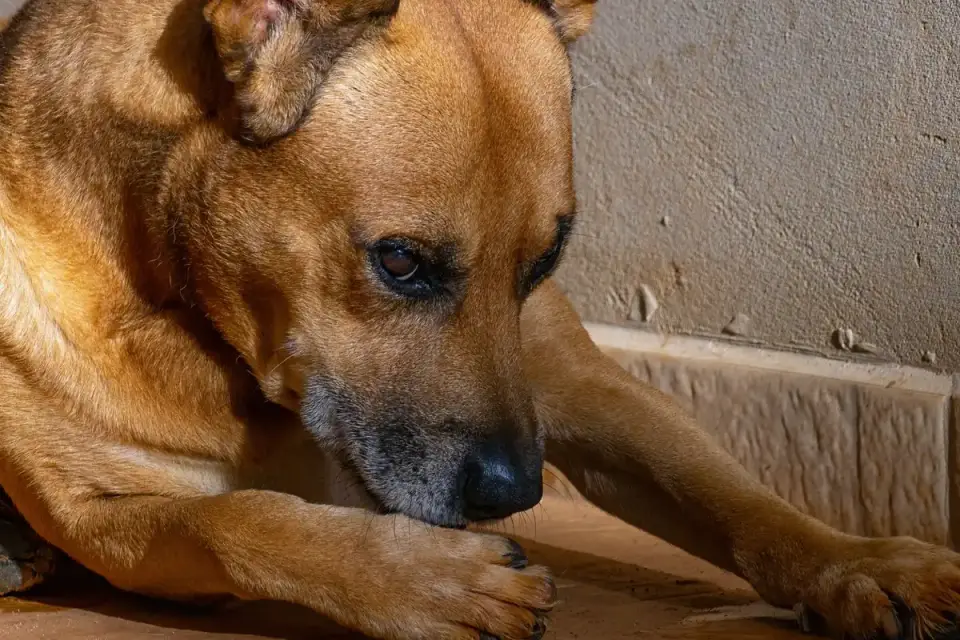
A twelve-year-old Labrador named Gus used to get a forty-minute loop around his owner’s block every evening, rain or shine, because that was “his walk” and had been for a decade. When his owner brought him in because he’d started sitting down twice on the way home, the walk itself wasn’t the problem — the fact that nobody had adjusted it in three years was. Gus still wanted to go. His hips just couldn’t clear forty minutes of pavement anymore, and nobody had noticed until he told them the only way a dog can: by stopping.
That’s the question underneath “how long should a dog walk be” — it isn’t really about minutes. It’s about whether the walk still matches the joint the dog is walking on.
The mechanism, not the stopwatch
Cartilage and synovial fluid respond to load in a fairly predictable way: moderate, rhythmic loading nourishes cartilage by cycling synovial fluid through the joint space, while repetitive high-impact or prolonged loading on a joint that isn’t conditioned for it accelerates wear on the cartilage surface. A young, structurally sound dog can absorb a lot of that load without consequence. A dog with early hip laxity, an unstable stifle, or simply a decade of cumulative wear on the elbows cannot. The “right” walk length is the length that keeps loading in the first category rather than the second, and that number is different for a six-month-old Border Collie puppy, a three-year-old conditioned Vizsla, and Gus.
As a rough starting frame, most healthy adult dogs do well with something in the neighborhood of 30 to 60 minutes of daily walking, split across one or two outings, with working and sporting breeds tolerating more and toy or brachycephalic breeds typically needing less. Puppies should be built up gradually rather than given adult-length walks on growth plates that haven’t closed. None of that is a hard ceiling — it’s a starting point you adjust against the dog in front of you.
What I actually watch for in the exam room
In my practice, I don’t set walk length by a formula on a handout. I set it by what the dog’s body tells me over the following 24 to 48 hours, and I ask owners to watch the same things. A Cavalier King Charles Spaniel I worked with, seven years old and about 18 pounds, had owners who walked her 45 minutes twice a day because that was the schedule that fit their commute — she was stiff getting up from her bed most mornings, worse on cold days, and reluctant to take the stairs to their bedroom by week’s end. We didn’t cut the walking; we split it into three shorter outings and added a five-minute warm-up pace before any faster stretch. Within about three weeks her owners reported she was taking the stairs again without hesitation and wasn’t stiff at the base of the day. That’s one dog’s response, not a study result, but it’s the pattern I see often enough to trust the underlying logic: total minutes matter less than how the load is distributed across the day and how the joint recovers overnight.
The markers worth tracking are concrete: does the dog sit down or lag on the way home when it didn’t used to; is the first fifty feet after a nap stiffer than it was a month ago; is jumping onto the couch or into the car becoming a two-attempt event; has stool or appetite changed alongside activity, which can flag pain-driven appetite suppression rather than a walk-length problem at all. Any one of those is a signal to shorten the walk, not push through it.
Where joint-support ingredients fit — and where they don’t
Walk length and joint-support supplementation get treated as separate topics, but for a dog whose walk load is increasing — a growing puppy, a senior dog you’re trying to keep active, a working or sporting dog carrying more mileage — the two questions are connected. Glucosamine and chondroitin are among the most-studied joint-support ingredients for dogs. Mechanistically, chondroitin has been studied for its role in supporting healthy synovial fluid homeostasis, per a 2026 paper in Frontiers in Veterinary Science, which is directly relevant to a joint absorbing repeated loading from daily walks. Glucosamine HCl has similarly been shown to help prevent experimentally induced cartilage degradation in vitro, according to a review in the Journal of Veterinary Medical Science — an in-vitro finding, not a guarantee of the same effect in a living, walking dog, but a real mechanistic basis for why the ingredient is used at all.
Green-lipped mussel has a different kind of evidence behind it. In a rat model, mussel-derived compounds alleviated paw swelling and reduced serum levels of inflammatory markers including TNF-α and IL-17, according to research published in Nutrients. That’s an anti-inflammatory mechanism worth knowing about, but it’s an animal model of induced arthritis, not a clinical trial in walking dogs, and I don’t let owners round it up into more than it is.
Here is the strongest counterargument, and I take it seriously: a healthy young or middle-aged dog on a well-matched, gradually built walking routine likely gets more durable joint benefit from correct conditioning, weight management, and surface choice than from any supplement on the market, and plenty of dogs never need one. I don’t disagree with that. Where I land differently is for the dog whose walk load is already increasing faster than its joints are conditioning for it — the senior dog you’re trying to keep mobile, the working dog logging real mileage, the post-injury dog rebuilding tolerance. In that specific, evidence-bounded case, an ingredient with a real mechanistic basis is a reasonable adjunct to the walk plan, not a replacement for getting the walk plan right first. That’s the distinction I keep coming back to: weigh what a supplement can realistically do for a dog’s mobility and recovery against what the walk itself is actually asking of the joint, and don’t let the supplement substitute for adjusting the walk.
If you’re building or adjusting a walking routine for a small or toy breed specifically, the joint-loading considerations are different enough from a large-breed dog’s that they deserve their own plan — see our Exercise Ideas for Toy and Small Breeds guide for that breakdown. And if you’re already looking at a joint supplement alongside the walk plan, it’s worth knowing what a defensible label actually discloses before you buy one — our Dog Joint-Support Supplement Label Disclosure Checklist walks through that.
The scene I keep coming back to
I think about Gus a lot, honestly, because his case wasn’t dramatic — nobody missed an emergency, nothing ruptured. His owner had just kept the same forty-minute loop going out of habit long after his hips had quietly changed underneath it. We shortened his walk to two shorter outings on softer ground, kept the total time close to what he’d had before but changed how it was distributed, and added a joint-support ingredient with a plausible mechanistic basis given how much loading his elbows and hips were already carrying. He was still going out twice a day. He just wasn’t paying for it by hour three. What changed wasn’t the number of minutes in the abstract — it was matching the walk to the joint that had to carry it.
Practical next step
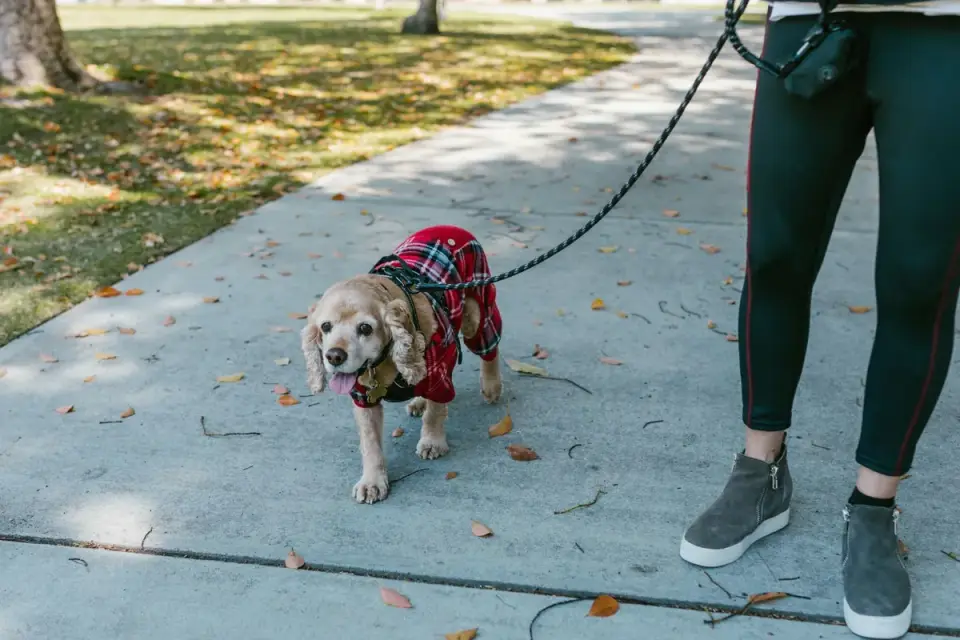
Don’t start from a number. Start from a baseline: how your dog moves the first fifty feet of a walk, how it moves the last fifty feet, and how it moves the next morning. Set the current walk length against that baseline for a week, then adjust in small increments — five to ten minutes, or one added short outing — rather than jumping straight to a textbook range. If your dog’s walk load is genuinely increasing (a senior dog, a working dog, a dog rebuilding after injury), that’s the point to have an honest conversation with your veterinarian about whether a joint-support ingredient with real mechanistic evidence behind it belongs in the plan — as an adjunct to a well-matched walk, not instead of one.
Frequently asked questions
Is a 30-minute walk enough for a dog?
For many small-to-medium adult dogs, 30 minutes can be enough, but it depends on breed energy level, age, and joint health — a working or sporting breed usually needs more, while a senior dog with joint changes may need it split into shorter outings instead of extended.
Can a dog be walked too long?
Yes. Repetitive, prolonged loading on a joint that isn't conditioned for it — a growing puppy, an arthritic senior, a dog recovering from injury — can outpace what the cartilage and surrounding tissue can comfortably absorb, even if the dog seems willing to keep going.
Do joint supplements replace the need to adjust walk length?
No. Ingredients like glucosamine, chondroitin, and green-lipped mussel have real mechanistic evidence behind them, but they're an adjunct to a well-matched walking routine, not a substitute for shortening or restructuring a walk that's become too much for a dog's joints.
Sources
- Protective effects of turmerosaccharides rich extract of Curcuma longa L. in osteoarthritic dogs — Frontiers in Veterinary Science
- Glucosamine Hydrochloride and Cartilage Degradation: A Review — Journal of Veterinary Medical Science
- Blue Mussel, Green Mussel, and Mussel Oil Extracts in an Arthritis Model — Nutrients