Recognizing the Early Stress Signals in Dogs
A veterinary guide to the subtle, early stress signals dogs show before a full-blown reaction — what to watch for, what to rule out, and what actually helps.
Stress signals in dogs are usually small and easy to miss long before the growl, lunge, or shutdown you notice.
On this page
Most owners I see don’t come in because their dog looked stressed. They come in because their dog finally did something — snapped at the mail carrier, froze at the vet’s door, wouldn’t eat for two days. By the time it’s obvious, the dog has usually been telling you for weeks.
I ask owners to picture the dog’s face and body the way I do in an exam room, moment by moment, not the story they’ve built around “he’s just being difficult.” That reframe is where the real work starts.
What I actually look for before the obvious signs
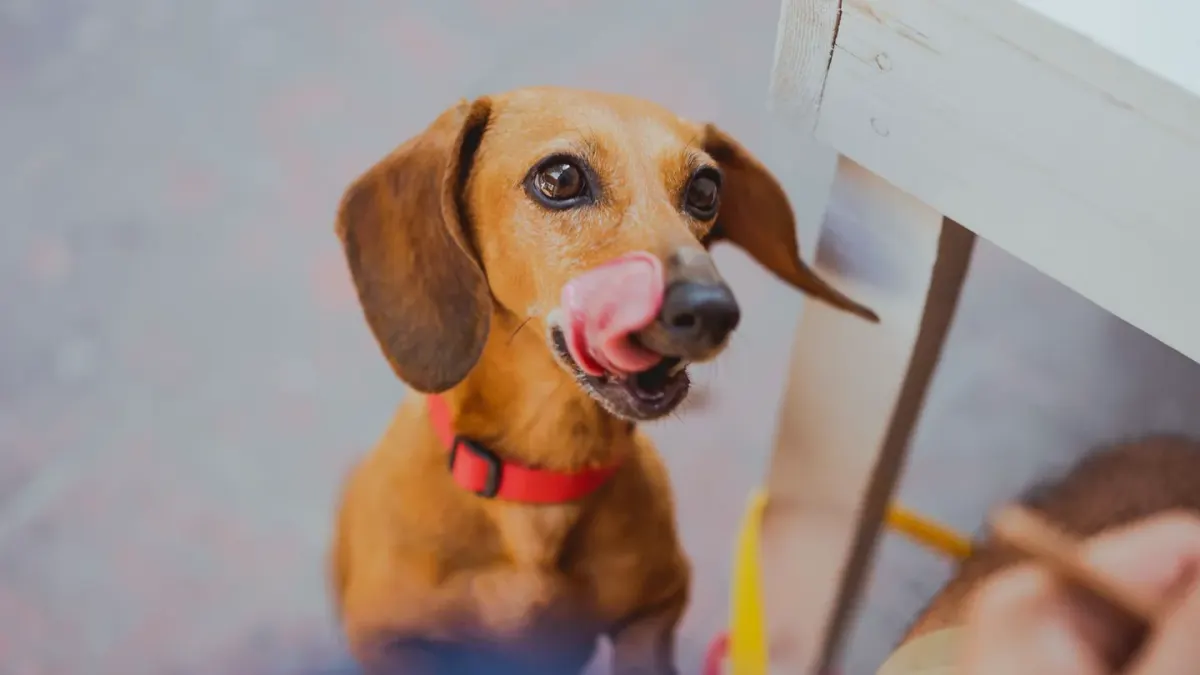
A stressed dog rarely announces itself. It leaks information first, in the kind of details owners describe to me almost verbatim once I point them out. Lip licking with no food around. A single yawn that isn’t tied to sleepiness. Ears set slightly back and low rather than pinned. Whale eye — that sideways glance where you see the white crescent of the eye without the head turning. A tail carried lower and stiffer than usual, even if it’s still wagging. Weight shifted onto the back legs, as if the dog is quietly deciding whether to leave.
None of these on their own means much. A dog can yawn because it’s tired. What matters is the cluster, and whether it shows up reliably in a specific context — the vet waiting room, the delivery truck, a particular guest.
I had a nine-year-old beagle mix named Otis in for a wellness visit last spring, about twenty-six pounds, whose owner mentioned almost as an aside that he’d started “sighing a lot” on car rides. When I watched him on the exam table, he held still and let me palpate every joint without flinching, but his ears stayed pinned the entire visit and he licked his lips every time the door opened. His owner had chalked it up to age. What she was actually describing, once we walked through it together, was a dog broadcasting low-grade stress in a place he’d never fully relaxed in — three years of visits, same pattern, and nobody had named it until that appointment.
Where the signs escalate, and why the order matters
The early signals matter because they sit at the front of a continuum, not because they’re a separate category from the more dramatic ones. Lip licking and a lowered tail can progress, over minutes or over months of repeated exposure, into pacing, panting when it isn’t hot, excessive drooling, or refusing to move at all — what some owners describe as their dog going “statue-still.” From there you can get displacement behaviors like sudden scratching or shaking off as though wet, and eventually the more obvious warnings: a hard stare, a stiff body, a growl.
Here’s the piece I try to get across to every owner: the growl is not the problem. The growl is the dog finally using the loudest tool it has because the quieter ones didn’t work. If you only start managing stress once you see a growl or a lunge, you’re intervening at the end of the sentence instead of the beginning.
Some of this escalation is also physical, not purely behavioral, which is why ruling out what isn’t just behavior belongs in the same conversation as reading body language. Pain, GI upset, and sensory decline in older dogs can all produce a stress presentation that looks behavioral on the surface.
Where calming support fits, and where the evidence is thin or strong
Owners often ask me, once they’ve identified a stress pattern, whether a supplement can take the edge off while they work on the underlying trigger. My honest answer is: sometimes, modestly, and it depends on the ingredient.
L-theanine has the most direct human clinical signal of the ingredients I get asked about, though the picture is narrower than marketing suggests. A recent review found benefit “except for one study on psychotic anxiety (SMD = 0.54; 400 mg/day for 8 weeks),” according to a systematic review published in Molecular Psychiatry — a dose and population that don’t map cleanly onto dogs, but the underlying calming mechanism is plausible enough that I don’t dismiss it.
Ashwagandha, specifically the standardized KSM-66 extract, has a more consistent evidence base behind it. A systematic review in Cureus “analyzed multiple RCTs and concluded that ashwagandha has a moderate positive impact on stress reduction and cognitive performance.” That’s still human data, but it’s a stronger signal than most calming ingredients on the market can point to.
Chamomile is the one I’m most cautious about recommending on evidence alone. A review in Biomedicines notes plainly that “for the remaining species, evidence is derived mainly from preclinical studies or traditional use.” That doesn’t mean it’s useless — chamomile has a long history in calming formulations — but I won’t tell an owner it’s clinically proven for dogs when the paper itself says otherwise.
None of these ingredients replace management. They may help take the edge off a dog that’s already leaning stressed; they don’t fix a trigger the dog encounters five days a week.
What actually changes the pattern
Supplements are the smaller half of the conversation. The bigger half is changing what the dog experiences.
That usually starts with identifying the specific trigger rather than treating “stress” as one big undifferentiated thing. A dog stressed by strangers approaching on walks needs a different plan than a dog stressed by being left alone, and conflating the two wastes months. If the pattern shows up specifically around people approaching on leash, it’s worth reading through why dogs bark at strangers on walks before assuming it’s generalized anxiety. If it shows up mostly when the dog is alone, the distinction between boredom and separation anxiety changes what I’d recommend first.
Once the trigger is named, the next step is almost always distance and exposure management before anything else — keeping the dog under threshold long enough that the early signals stop firing constantly, then building tolerance gradually. I walk owners through a version of this in counter-conditioning a leash-reactive dog step by step, and the same logic applies well beyond leash reactivity: find the distance or duration where the dog can still notice the trigger without leaking stress, and work from there.
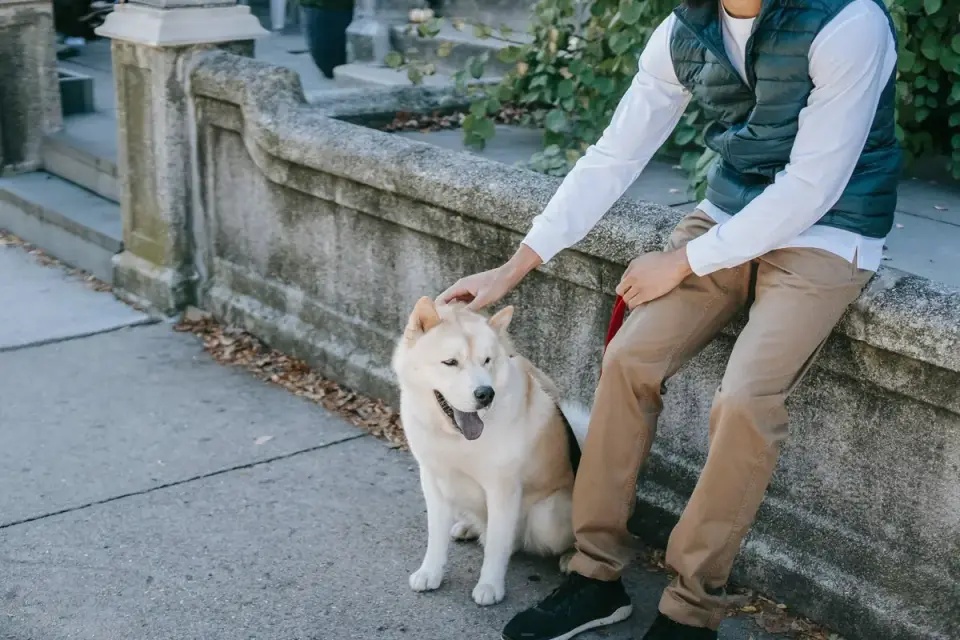
I think about a client’s ten-month-old border collie mix, Peaches, close to forty pounds, who’d started freezing on the porch every time a skateboard passed the house — stiff body, tail tucked, refusing to come inside on her own. The owner’s first instinct was to find a calming chew and hope it fixed things within the week. We didn’t start there. We started by identifying that skateboards specifically, not bikes or strollers, were the trigger, then working from a distance where Peaches could see one pass without freezing. Over about five weeks of short, deliberate sessions, the freezing at the actual trigger distance dropped off, and only then did we talk about whether a calming ingredient made sense as one more layer during the transition period.
Where I land with owners
If you take one thing from this: don’t wait for the growl. The lip lick, the low ears, the sudden stillness — those are the dog telling you something is already too much, and they’re the easiest point to intervene. A supplement with reasonable evidence behind it, like KSM-66 ashwagandha, might take the edge off while you do that work. It won’t do the work for you.
So what would it look like if you started logging your own dog’s small signals for a week, before the next obviously stressful moment arrives?
Frequently asked questions
What is the very first sign of stress in a dog?
Lip licking with no food nearby, a single unexplained yawn, and ears set slightly back and low are usually the earliest, most easily missed signals — well before pacing, panting, or growling show up.
Can a stressed dog show no obvious signs at all?
Some dogs "shut down" instead of escalating outwardly — going unusually still, avoiding eye contact, or withdrawing to a corner. That stillness is still a stress signal, not calm behavior, and it's often the one owners miss most.
Sources
- Chamomile and Anxiety: A Review of Preclinical and Traditional Evidence — Biomedicines
- Ashwagandha and Stress Reduction: A Systematic Review of RCTs — Cureus
- L-Theanine and Anxiety: A Systematic Review — Molecular Psychiatry