When Is It Too Hot to Walk a Dog? The Pavement Test Vets Actually Use
A vet nutritionist explains the hand test, the real temperature thresholds, and which dogs need a stricter cutoff before you leash up on a hot day.
Too hot to walk your dog is less about the thermometer than about what your palm feels on the pavement itself.
On this page
A twenty-two-pound French Bulldog named Biscuit came into my clinic one August afternoon after his owner had taken him on what she described as “just a normal fifteen-minute loop around the block” at 2 p.m. He was seven years old, a little overweight, and had never had a problem on his usual morning walks. This time he stopped mid-block, wouldn’t move, and started panting hard enough that his owner carried him the last hundred yards home. His pads were pink and tender for two days afterward, and his breathing didn’t settle until she’d run cool water over him and sat with him in front of a fan for twenty minutes. Nothing about that walk looked dangerous from the porch. The air was 88°F, not triple digits, and the sidewalk was ordinary gray concrete, not blacktop. That’s the case that convinced me most owners are watching the wrong number.
Here’s the verdict I give clients: if you can’t hold the back of your hand flat on the pavement for ten seconds without pulling away, it’s too hot for your dog’s paws, full stop — and if the air is 85°F or higher with no shade in the forecast, skip the midday walk regardless of how the sidewalk feels underfoot. That second part matters because pavement damage and heat stroke are two different emergencies with two different thresholds, and treating them as one number is how dogs like Biscuit end up in an exam room.
The Hand Test I Actually Use With Clients
The simplest tool here isn’t an app or a chart — it’s your own hand. According to the AKC, veterinarian Dr. Jerry Klein recommends placing your hand flat on the pavement for ten seconds; if it’s too hot for you to keep it there, it’s too hot for your dog’s paws. The AKC also notes that once air temperature hits roughly 85°F without a chance for the ground to cool, pavement often crosses into unsafe territory, and that asphalt measured at 86°F air temperature has been recorded reaching 135°F at the surface.
That gap is the part owners consistently underestimate. Dog paw pads are tougher than bare human skin, but they’re not immune to contact burns, and blistering can start well before the surface feels unbearable to a human standing on shoes.
Why the Sidewalk Runs So Much Hotter Than the Air
Dark, dense surfaces absorb radiant heat all day and release it slowly, which is why blacktop and dark concrete can sit 40 to 50 degrees above the air temperature by mid-afternoon. Grass, dirt, and light-colored concrete stay dramatically cooler because they reflect more light and hold less thermal mass. This is also why a walk that felt fine at 9 a.m. can turn dangerous at 2 p.m. even if the air temperature has only climbed a few degrees — the surface has had hours to bake.
Route choice matters as much as the clock. A shaded gravel path or a grass median can be walkable at an hour when the asphalt two blocks over is already unsafe.
When Heat Stops Being Discomfort and Becomes an Emergency
Paw burns are painful, but heat stroke is the failure mode that actually kills dogs, and it can happen without a single blister. Per VCA Animal Hospitals, a body temperature above 103°F is considered abnormal, and temperatures above 106°F without prior illness are most commonly tied to environmental heat exposure; the range where organ failure becomes a real risk sits around 107°F to 109°F. Dogs cool almost entirely by panting, which is a far less efficient system than human sweating, and that gap widens fast once humidity climbs and evaporation slows down.
I’ve had owners tell me their dog “seemed fine” right up until it wasn’t — glassy eyes, a wobble in the back end, gums that went from pink to brick red over the span of a single block. That’s not a dog pushing through discomfort; that’s a dog whose cooling system has already started to fail, and it doesn’t reverse itself just by heading indoors and waiting.
The Dogs Who Need a Stricter Cutoff
Not every dog gets the same margin for error. Brachycephalic breeds — pugs, French Bulldogs, Boston Terriers, English Bulldogs — carry restricted airways that make panting a far less efficient cooling strategy, and the AKC and VCA Animal Hospitals both flag them as facing elevated risk even at moderate temperatures. Heavier dogs, thick-coated breeds, and older dogs with pre-existing heart, airway, or joint disease also lose ground faster once the mercury climbs.
That last group is where my own lane — joint health — actually overlaps with heat safety, and it’s worth spelling out rather than glossing over. A senior dog managing hip or elbow arthritis is often already walking a shorter, slower loop to protect stiff joints; heat compounds that by making the dog want to stop moving altogether, which isn’t a bad instinct on a 95-degree afternoon but can turn into stiffness the next morning if the dog goes from full activity to none. For dogs in that position, owners frequently ask me whether a joint supplement is worth adding alongside a modified summer schedule. I tell them the honest answer: glucosamine and chondroitin are among the most studied joint-support ingredients for dogs, and there’s a real evidence base behind specific mechanisms — glucosamine HCl has been shown to help prevent experimentally induced cartilage degradation Journal of Veterinary Medical Science: in vitro, and chondroitin has research support for helping Frontiers in Veterinary Science: support healthy synovial fluid homeostasis. Green-lipped mussel powder has separate evidence behind it too — in rodent models, mussel-derived compounds alleviated paw swelling and reduced markers like TNF-α and IL-17, according to a Nutrients review. None of that changes the heat math for that day’s walk, but it’s a reasonable piece of a year-round plan for a dog whose joints are already the limiting factor. If you’re evaluating a joint product for that kind of dog, our guide on the Dog Joint-Support Supplement Label Disclosure Checklist is a useful next stop before you buy anything.
Small and toy breeds carry their own heat math, mostly because their higher surface-area-to-body-mass ratio means they gain and lose heat faster than a Labrador covering the same ground — a dynamic covered in more depth in our piece on Exercise Ideas for Toy and Small Breeds.
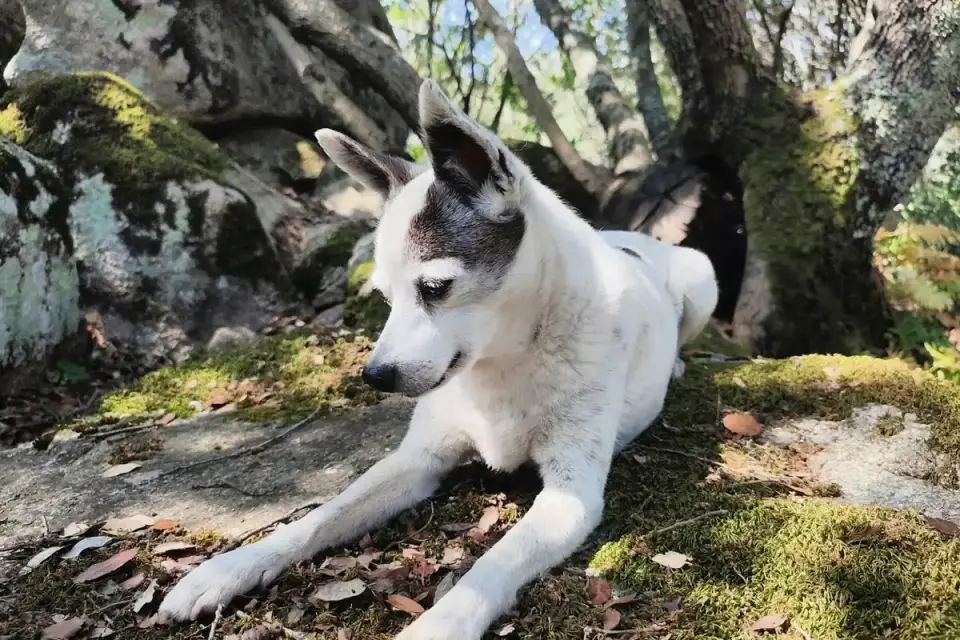
I think about a twelve-year-old Labrador I worked with a few summers back, sixty-eight pounds, moderate hip arthritis, whose owner had shifted his walks to 6 a.m. after two rough afternoons in July. Within about three weeks she noticed he was more willing to take the stairs to the bedroom at night, something he’d started avoiding, and his post-walk gait looked less stiff when he stood up from a nap. I want to be careful here: that’s one dog’s timeline, not a controlled outcome, and I can’t tell you the walk-timing change caused the stair improvement rather than the cooler mornings simply being easier on an arthritic hip generally. But it’s the kind of pattern that makes me take the heat-and-joints overlap seriously rather than treating them as unrelated seasonal notes.
A Practical Rule for Timing the Walk
Skip the guesswork and use this order of operations before you leash up on a warm day:
- Check the air temperature first. At 85°F or above with no shade in the forecast, plan for early morning or after sunset instead of midday.
- Press the back of your hand to the actual route surface for ten seconds. If you can’t keep it there, choose grass, dirt, or a shaded path instead.
- Watch your dog’s breathing and gum color during the walk, not just at the end — heavy panting that doesn’t ease when you slow down is a signal to stop and cool off, not push through.
- Shorten the walk further for brachycephalic breeds, seniors, overweight dogs, and dogs with existing joint or heart conditions, since their cooling margin is smaller than a healthy adult dog’s.
- Keep water available and offer a shaded stop partway through rather than waiting until the dog is already struggling.
Where This Leaves Owners
The thermometer on your phone isn’t lying to you, but it isn’t answering the question you’re actually asking either. Pavement temperature and heat-stroke risk both deserve their own check, and neither one is optional once summer settles in. My working rule stays the same year to year: hand on the pavement for ten seconds, air temperature and humidity as the second filter, and a lower bar entirely for the brachycephalic, the senior, and the arthritic dogs already working with a smaller margin. As more owners walk dogs later into the evening and earlier in the morning to dodge daytime heat, I expect the hand test to become as automatic as checking the leash — a habit worth building before the first hot week of the year rather than after a scare like Biscuit’s.
Frequently asked questions
Is there one exact temperature that's always too hot to walk a dog?
Not a single number. Use two checks together: air temperature at or above roughly 85°F with no shade ahead as a signal to shift your walk time, and a ten-second hand test on the actual pavement, per the [AKC](https://www.akc.org/expert-advice/health/dog-paws-hot-pavement/), to judge paw-burn risk on that specific surface.
What are the first signs of heat stroke versus normal panting on a hot walk?
Heavy panting that doesn't ease when the dog slows down, gums shifting from pink to brick red, wobbliness, or a body temperature climbing toward 103°F and beyond are warning signs, according to [VCA Animal Hospitals](https://vcahospitals.com/know-your-pet/heat-stroke-in-dogs) — that's a reason to stop and cool the dog down immediately, not push through the last block.
Do senior dogs with arthritis need a different heat cutoff than younger dogs?
Generally yes. Dogs already managing joint disease, along with brachycephalic breeds, overweight dogs, and thick-coated dogs, lose their cooling margin faster, so a stricter time-of-day cutoff and shorter walks make sense even on days a younger, healthy dog would tolerate fine.
Sources
- How to Protect Dog Paws From Hot Pavement, Sidewalks — AKC
- Heat Stroke in Dogs — VCA Animal Hospitals
- Protective effects of turmerosaccharides rich extract of Curcuma longa L. in osteoarthritic dogs — Frontiers in Veterinary Science
- Glucosamine HCl and Cartilage Degradation, an In Vitro Review — Journal of Veterinary Medical Science
- Green-Lipped Mussel Extracts and Inflammatory Markers in Arthritis Models — Nutrients