Best Low-Impact Activities for Overweight Dogs
A veterinary nutritionist's practical guide to safe, joint-friendly exercise for dogs carrying extra weight, plus where the evidence on joint-support ingredients actually stands.
The fastest way to hurt an overweight dog's joints is to exercise them like they aren't overweight — here's what to do instead.
On this page
What actually counts as low-impact when a dog is carrying an extra fifteen or twenty pounds? Not “gentle” in the vague sense owners usually mean — the movement has to reduce the actual mechanical load crossing the hips, stifles, and elbows, or it isn’t doing the job.
I’ve watched this play out with a nine-year-old Labrador retriever named Gus, ninety-four pounds on a frame built for closer to seventy. His owner brought him in because he’d started hesitating at the bottom of the deck stairs, something he’d never done before, and because he flopped down hard onto his side instead of lowering himself the way he used to. She’d tried adding a longer evening walk to help him lose weight, and within two weeks he was stiffer, not looser, getting up from the couch. That’s a common and avoidable mistake: adding distance or duration before the joints are ready for it. We rebuilt his routine around shorter, more frequent sessions on soft ground, and it took about six weeks before the stair hesitation eased.
Why More Walking Isn’t Automatically Safer
The instinct to “just walk him more” makes sense — walking is low-impact compared to running or jumping. But an overweight dog’s joints are already absorbing more force per step than a lean dog’s, and simply extending the same walk repeats that overload more times. Duration and impact are two different variables, and treating them as one is where a lot of well-intentioned exercise plans for heavy dogs go wrong. The better lever, at least at the start, is frequency of short, easy sessions rather than length of any single one.
Sizing the First Two Weeks
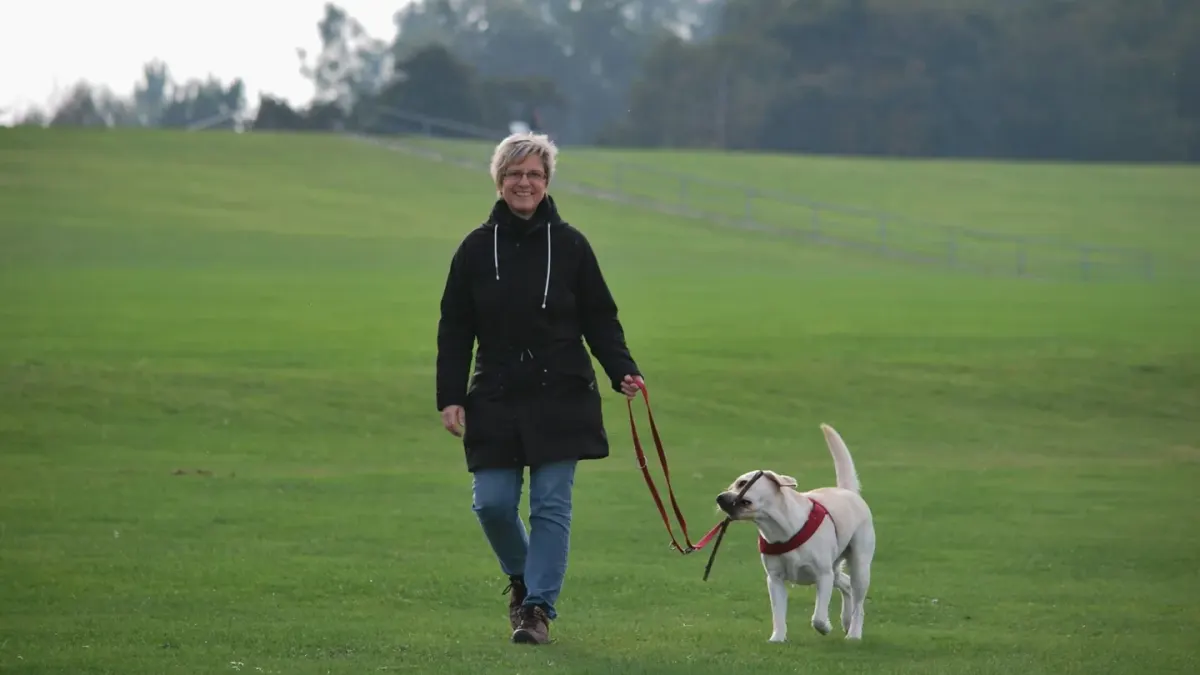
Start with 10 to 15 minutes, two to three times a day, on flat, forgiving ground — grass, packed dirt, a rubberized track. Avoid pavement and stairs where you can. Watch for the dog sitting down mid-walk, lagging behind on the leash, or excessive panting that doesn’t resolve within a few minutes of stopping; any of those means the session was too long, not that the dog is being stubborn. If a dog handles two weeks of short sessions without soreness the next morning, extend time before you extend pace.
The Activities Worth Building a Rotation Around
A few formats consistently give you exercise volume without asking much of an already-stressed joint:
Leash walking on soft, level surfaces. Still the most accessible option for most owners, and the easiest to dose in small increments. For dogs whose owners want a structured alternative to unpredictable dog-park sessions, our guide to Dog Park vs. Structured Exercise breaks down why the predictability of a walk matters more than people assume for a joint that’s already under load.
Swimming. Water removes most of the body-weight load from the joints while still working the cardiovascular system and musculature, which is part of why it’s often the single best option for a dog that’s both overweight and already sore. We go into the specific mechanics of what water does and doesn’t do for a joint in Is Swimming Good Exercise for Dogs?
Slow treadmill or underwater treadmill work, where available through a rehab facility, gives you precise control over speed and incline that’s hard to replicate outdoors.
Scent work and short trick sessions. Mentally tiring a dog burns some energy and helps with the frustration of a reduced physical routine, without adding joint load. It won’t replace aerobic exercise, but it earns its place in a rotation, especially on days when weather or soreness rules out a walk.
If a dog’s living situation makes even a short walk logistically hard, the practical workarounds in How to Exercise a Dog With No Yard are worth reading before assuming exercise isn’t feasible.
Where Joint-Support Ingredients Actually Fit
Owners often ask me whether a joint supplement can substitute for slower, more careful exercise programming. It can’t — weight loss and appropriately loaded movement are still the two biggest levers for an overweight dog’s joint comfort, and no ingredient changes that math. But grounding an integrative claim in the nutritional evidence matters here too, because some of these ingredients do have real, if bounded, support behind them.
Chondroitin has been studied in a randomized controlled trial context and was found to support healthy synovial fluid homeostasis, according to research published in Frontiers in Veterinary Science. Glucosamine HCl, in a review of the available data, was shown to help prevent experimentally induced cartilage degradation in vitro, per the Journal of Veterinary Medical Science — worth noting that “in vitro” means lab conditions, not a living dog’s joint under exercise load, so the leap to real-world outcomes is a reasonable one to make cautiously, not confidently. Green-lipped mussel powder has shown anti-inflammatory activity in animal models, reducing paw swelling and markers like TNF-α and IL-17, as reported in Nutrients; that’s a rat arthritis model, not a canine osteoarthritis trial, and I’d rather say that plainly than let a reader assume more than the study shows.
The honest summary: glucosamine and chondroitin are among the most studied joint-support ingredients for dogs, and green-lipped mussel has a plausible mechanism worth watching, but none of them are a substitute for a exercise and weight plan built around actual joint load. Structure/function language — “may help support joint comfort” — is the right register here, not a promise.
Signs You’re Pushing Too Hard
Stop and shorten the next session if you see limping that doesn’t resolve within an hour, reluctance to get up the following morning, or a dog that suddenly refuses a route it normally takes without complaint.
The Dog I Still Think About
There was a beagle mix, Daisy, sixty-one pounds on a body that should have carried maybe forty-two, whose owner had been told at a previous clinic to “just walk her more” without any guidance on how much was too much. By the time I saw her, she’d developed a hitch in her right hind gait that showed up specifically after rest — first thing in the morning, and after long naps on the tile floor in her sunroom. We cut her walks down to three short sessions a day on grass, added two weekly swim sessions at a local canine rehab pool, and revisited her food portions alongside it. Over about ten weeks her morning hitch became less pronounced, though it never fully vanished, which is a realistic outcome and not the tidy before-and-after story owners sometimes hope for. What actually changed her trajectory wasn’t a single activity; it was matching volume to what her joints could tolerate on any given day, week over week, rather than chasing a fixed daily step count.
Bottom Line
Build the rotation around load, not just intensity: short, frequent, soft-surface walking, swimming where it’s accessible, and mental enrichment on the days a joint needs rest — with weight loss doing the real work and any supplement playing a supporting, evidence-bounded role at best.
Frequently asked questions
How long should a walk be for an overweight dog?
Start with 10 to 15 minutes, two to three times a day, on flat, soft ground, and extend duration only after two weeks without next-day soreness.
Is swimming better than walking for a heavy dog's joints?
Swimming removes most of the body-weight load from the joints while still providing cardiovascular exercise, which often makes it the lower-load option for a dog that's both overweight and already sore.
Can a joint supplement replace exercise for weight loss?
No. Weight loss and appropriately loaded movement remain the two biggest factors in joint comfort; ingredients like glucosamine, chondroitin, and green-lipped mussel may help support joint health but are not a substitute for either.
Sources
- Chondroitin and Synovial Fluid Homeostasis — Frontiers in Veterinary Science
- Glucosamine HCl and Cartilage Degradation — Journal of Veterinary Medical Science
- Green-Lipped Mussel Powder and Inflammatory Markers — Nutrients