Is Swimming Good Exercise for Dogs? What the Water Actually Does to a Joint
A veterinary nutritionist and sports-medicine specialist explains what swimming does to a dog's joints, muscles, and pain signaling — and when it isn't the right call.
Swimming unloads the joint while still asking real work of the muscle around it — which is exactly why it earns a place in most rehab plans.
On this page
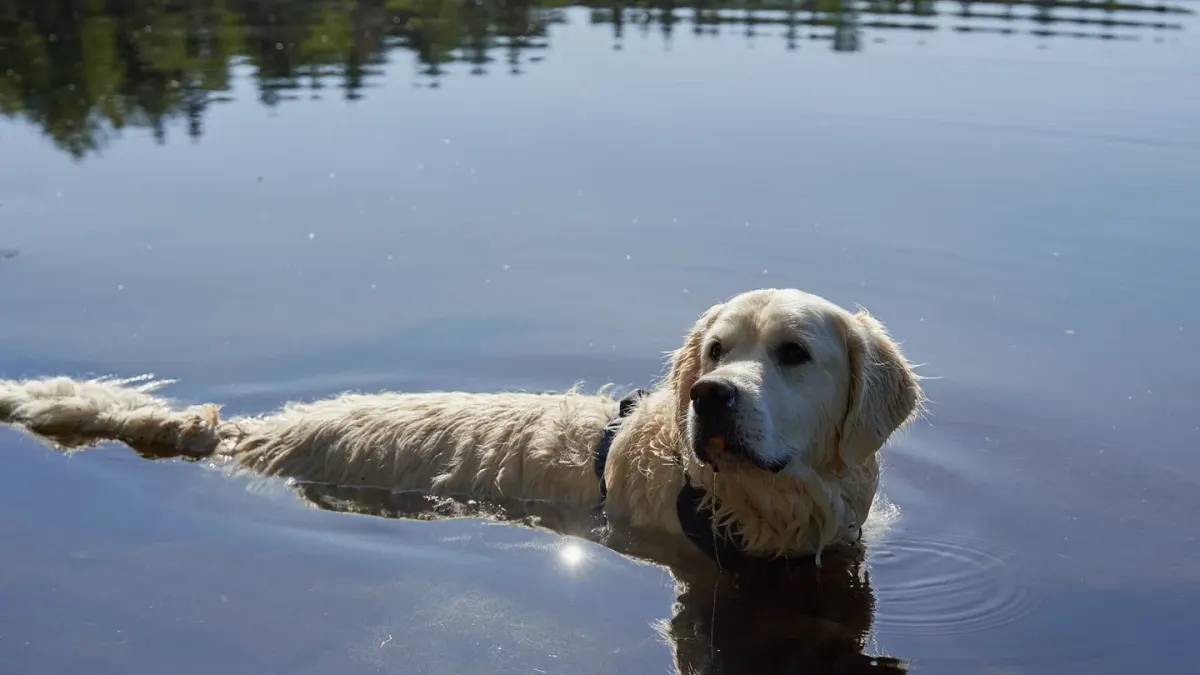
A twelve-year-old Labrador named Otter used to take four tries to get into the lake before her owner gave up and just lifted her front end over the drop-off. That was the detail that stuck with me — not that she was slowing down, which every senior Lab does, but that the hesitation only showed up on the bank, never once she was actually swimming. Once she was in the water she paddled for twenty minutes without the stutter-step she’d developed on pavement. Her owner had noticed it that spring: stiffness after naps, a slower first ten steps down the hall, a reluctance to jump into the car. We talked about what was actually happening in that lake versus what was happening on her daily walk, and it’s a conversation I have often enough that I think it’s worth writing down properly.
What buoyancy actually removes from the joint
The honest starting point is physics, not enthusiasm. A dog standing in water at roughly shoulder height is bearing something like a third of its normal body weight through its limbs — the rest is displaced by buoyancy. That’s the mechanism behind why hydrotherapy is used so often in canine rehabilitation: water levels at or just above the shoulder produce close to 38% weight-bearing, which is low enough to let a dog with degenerative joint disease or a healing surgical site move without loading the joint the way a walk would. That’s not a marginal difference — it’s the difference between a joint absorbing full ground-reaction force with every step and one that’s mostly just moving through resistance.
What buoyancy does not remove is the demand on muscle. Water is roughly 800 times denser than air, and moving a limb through it takes real, sustained effort — arguably more than moving the same limb through air, just distributed differently. That combination — low joint load, high muscular engagement — is the entire case for swimming as exercise, and it’s also why it isn’t interchangeable with a walk. A walk builds bone density and proprioception through impact; swimming does not replicate that. It’s a different tool for a different problem.
What the studies actually show, and where they stop
A study published in PMC looked at clinical functional parameters and serum biomarkers in dogs, both healthy and osteoarthritic, before and after a structured swimming program, and found measurable improvement in hip range of motion by around week eight — notably, in both groups, not just the arthritic dogs. That’s a meaningful finding because it suggests the benefit isn’t purely compensatory; healthy joints also moved better after sustained water work. The same body of research found that range of motion during swimming itself, largely from increased flexion, was significantly greater than during trotting, while stride length and frequency were both reduced compared to a land trot. In plain terms: the stroke a dog uses in water is a genuinely different movement pattern than a walk or a trot, not just a wet version of the same one.
A separate pilot study on underwater treadmill programs, published via MDPI, found significant improvement in joint flexion and extension across all measured joints after a ten-session program — evidence that a controlled water-based protocol can move the needle on mobility, at least over that short course. I want to be careful about what that does and doesn’t establish. It’s a pilot study, not a large randomized trial, and it measured range of motion, not long-term outcomes like reduced NSAID use or slowed radiographic progression. The authors themselves note the broader canine hydrotherapy literature is thin and inconsistent on dosing — how many sessions, how deep, how often — which means most of what vets recommend in practice is extrapolated from smaller studies and clinical experience rather than a single definitive protocol.

Where I land, and the counterargument I take seriously
My position is that swimming earns a real place in a joint-conscious exercise plan for most dogs — not as a replacement for walking, but as a low-load way to maintain muscle mass and range of motion around a joint that can’t tolerate full impact yet. I recommend it often for dogs recovering from cruciate repair, dogs with hip or elbow dysplasia, and heavier-bodied dogs whose joints are carrying more load than their conditioning can currently support.
The counterargument worth taking seriously is that open-water swimming is uncontrolled in a way a rehab pool or underwater treadmill is not. A dog paddling hard against current, cold water, or a steep bank exit can strain a shoulder or a stifle just as easily as it can help one — and unlike a supervised underwater treadmill session, nobody is watching stroke mechanics or limiting duration. For a dog with an unstable joint, acute pain, or a recent surgery, I’d rather see a controlled hydrotherapy session with a trained professional before I’d send that same dog into a lake for twenty unsupervised minutes. The tool is sound; the setting matters as much as the tool.
I think about a nine-year-old mixed-breed I worked with a few years back, a sixty-pound dog with bilateral hip dysplasia whose owner had been told to “just rest him” after a bad flare. We started him on twice-weekly underwater treadmill sessions instead, alongside his existing plan. Over about six weeks his owner reported he was climbing the two steps to the back deck without pausing at the top — something he’d stopped doing months earlier. I want to be precise about what that observation is: it’s one dog’s case, not a study result, and I don’t present it as evidence of what swimming or underwater treadmill work will do for every dog. But it’s the kind of change that made me take the mechanism seriously rather than treat it as marketing language.
Where joint-support ingredients fit into this, and where they don’t
Swimming addresses load and muscle conditioning; it doesn’t address what’s happening at the biochemical level inside the joint itself, which is where nutritional support sometimes enters the conversation. Glucosamine and chondroitin are among the most studied joint-support ingredients for dogs, and there’s real laboratory evidence behind the individual components. A Frontiers in Veterinary Science study found that chondroitin supports healthy synovial fluid homeostasis, and a review in the Journal of Veterinary Medical Science found that glucosamine HCl can help prevent experimentally induced cartilage degradation in vitro. Green-lipped mussel has its own literature: a study in Nutrients found that mussel-derived compounds alleviated paw swelling in rats and reduced serum levels of rheumatoid factor, anti-cyclic citrullinated peptide antibody, and inflammatory cytokines like TNF-α and IL-17.
I’d frame that evidence honestly: it’s real, and it’s mechanistic, but it’s largely in vitro and animal-model work rather than large-scale clinical trials in pet dogs. That doesn’t make it worthless — it makes it structure/function evidence, not proof of a clinical outcome you should expect on a specific timeline. A supplement may help support joint comfort and cartilage health as an adjunct; it isn’t a substitute for the load management that swimming, weight control, and appropriate exercise volume provide. I’ve seen owners reach for a joint chew as the whole plan and skip the exercise conversation entirely, and that’s backwards. The ingredient can support the tissue; it can’t undo what a joint experiences on every walk.
For dogs whose main issue is impact tolerance rather than biochemistry — a toy breed navigating stairs, for instance — the more relevant read might be our guide to exercise ideas for toy and small breeds, and for dogs already diagnosed with arthritis, the sharper comparison is in swimming vs walking for an arthritic dog, which gets into load specifics I don’t repeat here.
Practical next step
If you’re deciding whether to add swimming to a dog’s routine, start with why. A young, healthy dog swimming for fun needs almost no ramp-up beyond basic water safety and supervision. A dog recovering from surgery, managing diagnosed arthritis, or carrying excess weight benefits from a more structured approach — ideally a session or two with a rehab professional to check stroke mechanics and set a starting duration, then a home routine built around it. Compare that against your dog’s actual walking tolerance using something like our piece on how long a dog’s walk should be, since the two forms of exercise aren’t meant to replace each other so much as cover for each other’s weak points. And if the plan includes any land-based cardio in the meantime, check the surface temperature first — our pavement test for when it’s too hot to walk a dog is a two-minute habit worth building.
Swimming isn’t a universal fix, and it isn’t risk-free. But the physics behind it are sound, the early clinical evidence backs up what the physics predicts, and in my own casework it’s one of the few interventions that both the joint and the dog seem to tolerate well. That combination is rare enough that I keep recommending it.
Frequently asked questions
Is swimming better than walking for a dog with arthritis?
It depends on the goal. Swimming loads the joint far less than walking because buoyancy offsets most of the dog's body weight, which makes it useful for maintaining muscle and range of motion without pain. Walking still provides bone-loading and proprioceptive input that swimming doesn't replicate, so most rehab plans use both rather than choosing one.
How often should a dog swim for joint benefit?
There isn't a single validated protocol in the literature — published studies range from twice-weekly underwater treadmill sessions to longer open-water programs over eight weeks. Starting at one to two sessions a week and adjusting based on how the dog recovers afterward is a reasonable, conservative approach.
Can swimming replace a joint supplement?
No — they address different things. Swimming manages load and conditioning; ingredients like glucosamine, chondroitin, and green-lipped mussel are studied for their effects on cartilage and synovial fluid at a biochemical level. They're complementary, not interchangeable.
Sources
- Effect of Swimming on Clinical Functional Parameters and Serum Biomarkers in Healthy and Osteoarthritic Dogs — PMC
- A Pilot Study on the Effects of a 10-Session Underwater Treadmill Programme on Canine Joint Range of Motion — MDPI
- Chondroitin and synovial fluid homeostasis — Frontiers in Veterinary Science
- Glucosamine HCl and cartilage degradation — Journal of Veterinary Medical Science
- Green-lipped mussel compounds and inflammatory markers — Nutrients