Core-Strengthening Exercises for Dogs: What Actually Builds a Stronger Trunk
A veterinary nutritionist and sports-medicine specialist breaks down which core exercises for dogs have real biomechanical support, and how to sequence them without overloading a joint.
Core strength for dogs isn't about abs — it's about the deep trunk muscles that keep a spine and joints from absorbing forces they shouldn't.

On this page
- The checklist I actually use
- Why the trunk matters more than the legs
- Sit-to-stands and the case for boring reps
- Cavaletti, balance work, and what the loading data actually shows
- Where joint-support ingredients fit and where they don’t
- Building a weekly rotation without overdoing it
- The dog I still think about
- Bottom line
A twenty-two-pound corgi mix named Biscuit came into my exam room because her owner had noticed something small: she was starting to “walk sideways” going down the porch steps, favoring one hind leg just slightly, only in the evenings. Biscuit wasn’t limping, wasn’t in obvious pain, and her radiographs were unremarkable for her age. What she had was a trunk that had gotten lazy — years of walks and fetch with almost no work asked of the deep stabilizing muscles that keep a chondrodystrophic spine like hers properly supported. That gap between “moves fine” and “moves well” is where most core-strengthening conversations should start, and it’s usually invisible until an owner is standing at the top of the stairs watching their dog hesitate.
The checklist I actually use
Before I get into the mechanism, here’s the short version — the exercises with the best combination of evidence, safety, and real-world feasibility for most dogs:
- Sit-to-stand reps — 8–12 reps, 2–3 sets, done slowly and evenly on both hind legs
- Cavaletti poles at hock height — 4–6 poles spaced to the dog’s stride, walked both directions
- Controlled sit-to-stand on an unstable surface — a low balance disc or air-filled peanut, only once floor reps are clean
- Weight shifting / three-leg stands — brief, seconds-long holds, not minutes
- Backward walking in a straight line for 10–15 feet, on a non-slip surface
- Slow figure-eights around cones or furniture legs to load obliques asymmetrically
None of these require equipment you can’t fit in a hallway. All of them ask more of the trunk than a walk does, which is the point.
Why the trunk matters more than the legs
Dogs don’t have a six-pack in the human sense, but they do have the same functional layers: transverse abdominis, multifidus, and the paraspinal muscles that stabilize each vertebral segment during movement. When those muscles are weak, the limbs and passive joint structures — ligaments, cartilage, the joint capsule — end up absorbing forces the spine should have been managing. That’s a mechanical argument, not a marketing one, and it’s why I bring core work up earlier than most owners expect, often before I’ll discuss any supplement or brace.
For a dog like Biscuit’s, with disproportionately long spines relative to their limb length, this isn’t optional maintenance. It’s closer to structural insurance.
Sit-to-stands and the case for boring reps
Sit-to-stand transitions are unglamorous, and that’s exactly why I default to them. Rising from a sit recruits the quadriceps and hamstrings through a full, controlled range, and doing it slowly — not letting the dog rock or use momentum — forces the trunk to stabilize the spine through the whole rep. I ask owners to count reps out loud, not because it’s precise science, but because it keeps the pace honest. A dog that pops up in half a second isn’t training anything; a dog that takes two full seconds is.
Where this connects to load management: Exercise Ideas for Toy and Small Breeds covers why smaller dogs load their joints differently during ordinary movement, which is part of why sit-to-stands scale so well across sizes — the resistance is bodyweight, and bodyweight scales with the dog.
Cavaletti, balance work, and what the loading data actually shows
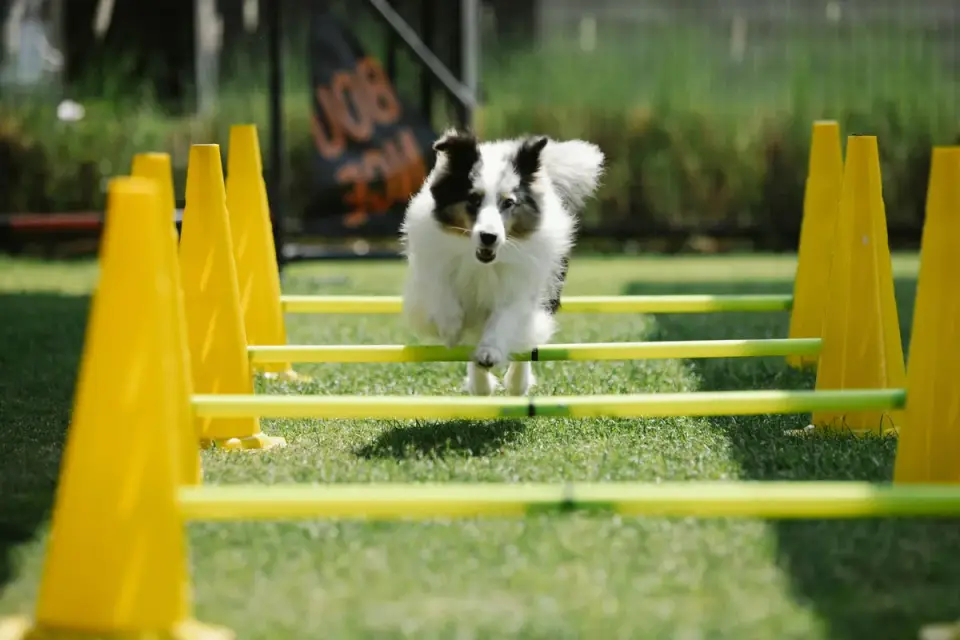
Cavaletti poles — a line of low bars a dog steps over — are one of the few core-adjacent exercises with actual kinematic data behind them. A study titled Kinematics and kinetics of dogs walking over increasing heights of cavaletti exercise measured eight dogs walking over poles at four heights and found that hock-height poles increased shoulder, elbow, and stifle range of motion substantially without raising ground reaction forces — while stifle-height poles increased forelimb peak pressures without adding further range-of-motion benefit. In plain terms: more height isn’t more work in a good way, it’s more stress with no extra payoff. Hock height is the sweet spot for most dogs.
Balance-disc and wobble-board work sits on thinner evidence. A study titled Improving postural stability through proprioceptive training in dogs notes that while proprioceptive exercises are widely used in canine rehabilitation, standardized and validated protocols are still limited, which makes it hard to say precisely how much benefit a given board or disc routine adds versus floor-based reps alone. I still use unstable-surface work in my own case plans, but I frame it to owners as reasonable and physiologically plausible, not as proven the way the cavaletti loading data is.
Where joint-support ingredients fit and where they don’t
Owners doing core work often ask whether a joint supplement should run alongside it. The honest answer is that the two address different things, and the supplement evidence is a mixed bag depending on the ingredient. Chondroitin has research suggesting it “supports healthy synovial fluid homeostasis,” per a study in Frontiers in Veterinary Science — a mechanism that’s relevant to joint comfort, not to trunk strength. Glucosamine HCl has been shown to “prevent experimentally induced cartilage degradation in vitro,” according to a review in the Journal of Veterinary Medical Science, which is laboratory evidence, not a clinical outcome claim. Green-lipped mussel has data from rodent models showing that mussel-derived compounds “alleviated paw swelling in rats and reduced serum levels of rheumatoid factor (RF), anti-cyclic citrullinated peptide (anti-CCP) antibody, and pro-inflammatory cytokines such as TNF-α and IL-17,” per a study published in Nutrients — encouraging for inflammation, but a rat model, not a dog on a wobble board.
I don’t treat any of that as a substitute for the exercises above. A supplement may help support joint comfort and cartilage biology; it does not build the multifidus. Weigh what it can realistically do for a dog’s mobility and recovery, and let the exercise program do the structural work.
Building a weekly rotation without overdoing it
I generally tell owners to think in terms of frequency, not duration. Three sessions a week of five to eight minutes each — sit-to-stands, a short cavaletti pass, maybe a minute of weight shifting — beats one long Sunday session every time, because the trunk muscles adapt to consistent, moderate load rather than occasional maximal effort. For dogs already dealing with joint discomfort, Swimming vs Walking for an Arthritic Dog is worth reading alongside this, since water work can supplement core sessions on days when land-based reps feel like too much. And for owners still calibrating how much total activity is appropriate, How Long Should a Dog’s Walk Be? covers the baseline that core work should be added to, not replace.
Progression matters more than intensity. Add a rep before you add resistance. Add a balance surface only once the floor version is clean for two straight weeks.
The dog I still think about
I think about Biscuit’s case more than most, because the fix was almost anticlimactic. We started with ten minutes of sit-to-stands and backward walking, three days a week, done in the kitchen because it had a non-slip mat and good lighting for her owner to watch form. Within about five weeks, the evening hesitation on the porch steps had stopped. I want to be careful here — that’s one case, watched by one owner, not a study, and I’m not presenting it as a predictable outcome for every dog with a similar build. But it’s the kind of change that convinced me core work deserves to be the first conversation, not an afterthought after a joint diagnosis. Her owner still sends me a photo every few months of Biscuit taking those same steps at a normal pace, which is a small thing, but it’s the small thing that tells you the trunk is doing its job again.
Bottom line
Core strength isn’t a cosmetic goal for dogs — it’s the mechanism that keeps a spine and its joints from absorbing forces they weren’t built to handle alone, and sit-to-stands plus hock-height cavaletti work are the two exercises with the clearest evidence behind them.
Frequently asked questions
How often should I do core exercises with my dog?
Three short sessions a week of five to eight minutes each tends to build strength more reliably than one long weekly session, because the trunk muscles respond better to consistent, moderate load than to occasional maximal effort.
Is cavaletti work safe for a dog with early joint changes?
Research on cavaletti height found that poles set at hock level increased joint range of motion without raising the forces on the limbs, while stifle-height poles increased pressure without added benefit — so hock height is generally the safer starting point, ideally confirmed with your veterinarian first.
Can a joint supplement replace core-strengthening exercise?
No. Ingredients like chondroitin, glucosamine, and green-lipped mussel have evidence relevant to cartilage and joint comfort, but none of it addresses the deep stabilizing muscles that core exercises are meant to build.
Sources
- Kinematics and kinetics of dogs walking over increasing heights of cavaletti exercise — PMC
- Improving postural stability through proprioceptive training in dogs — PMC
- Protective effects of turmerosaccharides rich extract of Curcuma longa L. in osteoarthritic dogs — Frontiers in Veterinary Science
- Glucosamine HCl and cartilage degradation — Journal of Veterinary Medical Science
- Green-lipped mussel oil in adjuvant-induced arthritis models — Nutrients