Can I Give My Dog Bone Broth for an Upset Stomach?
A TCVM-trained veterinarian explains when plain bone broth genuinely helps a dog's upset stomach, where the evidence runs thin, and the signs that mean broth isn't enough.
Plain, unseasoned bone broth can ease a mild stomach upset by rehydrating a dog and coaxing her appetite back — it isn't treatment for anything beyond that.

On this page
A twelve-pound terrier mix skips breakfast, vomits once around noon, then turns her nose up at dinner. By the second day her owner is standing in the kitchen with a pot of simmering bones, wondering whether this is a reasonable thing to do or a way to make a mild problem worse. It’s one of the most common questions I field in practice, and it deserves a straight answer rather than a hedge.
Is bone broth actually safe to offer here?
Usually, yes — with real conditions attached. Plain bone broth, made without onion, garlic, or added salt, is a mild, easily tolerated liquid that can rehydrate a dog and make food seem worth eating again during a rough GI stretch. That’s the same logic behind the Best Foods to Soothe Your Dog’s Upset Stomach list from the American Kennel Club, which groups broth alongside boiled chicken, rice, and plain pumpkin as bland, low-effort options for a dog who’s off her feed. None of those foods treat an underlying disease. They buy comfort and calories while a self-limiting upset runs its course.
The bones themselves are the part people get wrong. Dr. Jerry Klein, the AKC’s chief veterinarian, is blunt about it in Bone Broth for Dogs: A Superfood With Many Benefits: cooked bones themselves are incredibly dangerous for dogs, since cooking makes them brittle and prone to splintering. The broth has to be strained thoroughly, with every fragment removed, before it goes anywhere near a bowl. Salt, onion, and garlic belong on the same avoid list — the AKC flags all three as additives that turn an otherwise gentle food into a liability.
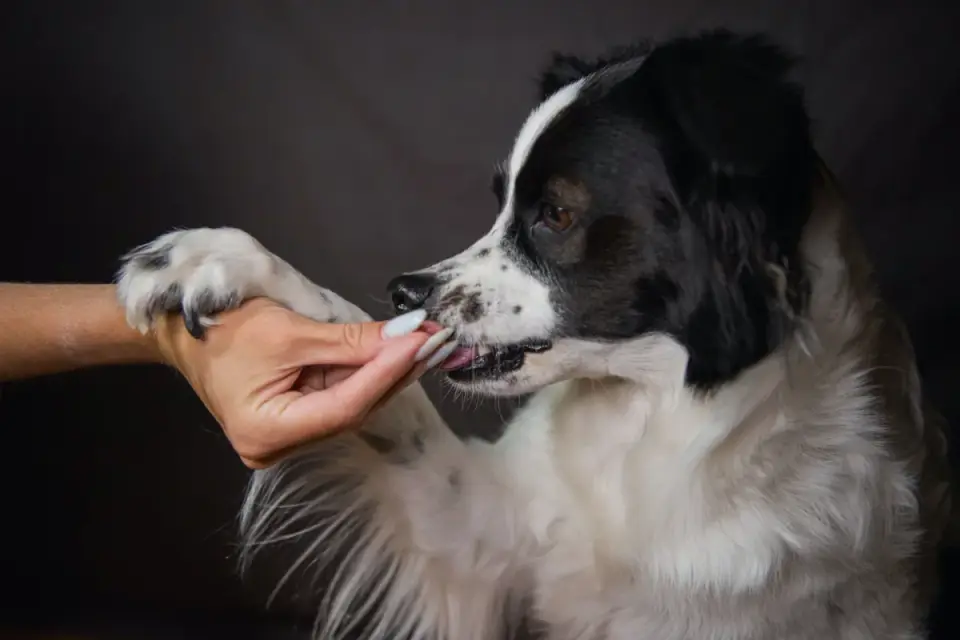
I think about this in four parts, the way I think about most cases: what the gut needs mechanically, what the diet is doing to support or undermine that, whether bodywork or acupuncture has anything to offer a nauseated patient, and where an herbal formula might complement rather than replace what’s already working. Broth sits almost entirely in the food-therapy pillar. In TCVM terms it’s a warming, easily digested fluid that’s traditionally used to support a weakened or “cold” digestive pattern — and in plain Western structure/function language, it’s simply a low-residue, low-fat liquid that’s gentle on an irritated gut lining while a dog rehydrates. Both descriptions point to the same conservative use: short-term support, not a fix.
What’s actually happening in a dog’s gut during a bland-diet stretch?
A five-year-old Labrador comes in after three days of intermittent vomiting and soft stool, no blood, still drinking water and reasonably bright. Her owner switched her to bone broth and boiled chicken on day one, and by day three the stool has firmed up about halfway. That’s a fairly typical trajectory for a self-limiting dietary upset — not proof that the broth did the work, since plenty of these cases resolve with fasting and time alone, but it’s a reasonable sign the approach isn’t hurting and the gut is settling. What it doesn’t tell you is whether something more specific triggered the episode in the first place, which matters more the longer symptoms persist.
That question — self-limiting versus something that needs a real diagnosis — is where the evidence gets genuinely useful. A dog’s gut microbiome is more resilient than owners often assume, but it isn’t infinitely so. Research on probiotic supplementation in dogs found that diversity metrics did not distinguish non-responders from responders, according to a peer-reviewed trial published via Frontiers in Veterinary Science. In plainer terms: even when researchers can measure how varied a dog’s gut bacteria are, that number alone doesn’t reliably predict which dogs will improve on a given intervention. That’s a limitation worth sitting with before anyone — including me — promises a bland diet or a supplement will resolve a case on a predictable timeline. If you want the fuller picture on what actually moves the needle for gut bacteria, our guide to the best probiotic for dogs walks through the evidence strain by strain.
When does bone broth stop being enough?
This is the part I want owners to sit with, because it’s where a reasonable home remedy turns into a delay. A ten-year-old spaniel had been on and off bland diets — broth, rice, boiled chicken — for nearly six weeks, losing close to four pounds despite eating normally most days. The stool wasn’t just loose; it was greasy and unusually large, a texture that should raise a flag on its own. That pattern, chronic weight loss paired with fatty, high-volume stool despite adequate intake, points toward malabsorption rather than a simple upset, and no amount of broth was going to correct it. Diagnostics confirmed exocrine pancreatic insufficiency, and the case only turned around once real treatment started.
That’s a useful contrast to keep in mind. EPI is treated by pancreatic enzyme replacement therapy, nutritional management with low-residue diets of moderate fat content, and supplementation of cobalamin — not by bland food alone, per a review in JAVMA. Bone broth’s low residue, low fat profile can slot into that kind of nutritional plan reasonably well, but it’s a supporting player, not the therapy. The same review notes that researchers still don’t fully understand why dysbiosis persists in some EPI dogs even after enzyme replacement starts, which is an honest admission that the science here isn’t finished. If your dog’s digestive enzymes seem like the more relevant piece of this puzzle than diet alone, our breakdown of digestive enzymes for dogs covers when supplementation is actually warranted.
Vomiting or diarrhea that lasts more than a day or two, blood in the stool, lethargy, a dog who won’t drink, or any of this in a puppy or senior dog — those are reasons to call a vet rather than wait out a broth-and-rest protocol. Weight loss over weeks, even with normal appetite, is its own red flag regardless of stool consistency.
How should you actually make it, if you’re making it at home?
Plain is the whole rule. Simmer beef marrow bones or poultry bones in water for an extended low simmer, then strain thoroughly — twice, if you’re not confident the first pass caught everything — until there isn’t a bone fragment left in the liquid. Skip the onion, garlic, and salt entirely; skip commercial broths, too, unless the label confirms none of those are present, since human-formulated versions are frequently seasoned for a different customer. Offer it in small amounts alongside water rather than as a full meal replacement, and if a dog’s diet has also just changed recently — a new food, a switch to raw, a new treat — factor that in before blaming the broth for anything that follows. We cover that overlap in more detail in dog stomach upset after switching to raw food.
The practical next step
If your dog is otherwise bright, drinking, and the upset is a day or two old, a small amount of plain, well-strained bone broth is a reasonable, low-risk way to keep her hydrated and interested in eating while things settle. Treat it as comfort food, not medicine — and if the vomiting, the loose stool, or the disinterest in food stretches past 48 hours, or if weight starts dropping even when she’s eating, that’s your cue to get a diagnosis instead of a bigger pot of broth.
Frequently asked questions
Can I give my dog bone broth every day?
For an acute upset, short-term use over a few days is reasonable once it's plain and bone-fragment-free; daily long-term use should be discussed with your vet, especially for dogs on a fat-restricted diet.
Is store-bought bone broth safe for dogs?
Only if the label confirms no onion, garlic, or added salt — many human-formulated broths are seasoned in ways that make them unsuitable for dogs.
How long should I wait before calling the vet about an upset stomach?
If vomiting or diarrhea continues past 48 hours, or if your dog is lethargic, refusing water, or losing weight, that's a reason to call rather than continue home care.
Sources
- Bone Broth for Dogs: A Superfood With Many Benefits — American Kennel Club
- Best Foods to Soothe Your Dog's Upset Stomach — American Kennel Club
- Exocrine Pancreatic Insufficiency in Dogs: Treatment and Persistent Dysbiosis — JAVMA
- Probiotic Response and Microbiome Diversity in Dogs — Frontiers in Veterinary Science