How to Rebuild Muscle in a Senior Dog
A veterinary nutritionist's evidence-based checklist for reversing age-related muscle loss in older dogs — protein targets, loaded movement, and where joint-support ingredients realistically fit.
Rebuilding muscle in an old dog is mostly a protein-and-loading problem, and only partly a supplement problem.

On this page
A twelve-year-old Lab mix named Otto came in at 71 pounds, down from a stable 78 the year before, and his owner’s complaint wasn’t weight — it was that he’d stopped jumping into the SUV. She’d noticed it over about six weeks: he’d pace at the tailgate, then wait for the ramp. His topline had gone from a filled-in curve over the spine to a ridge you could count vertebrae along with two fingers. That’s muscle, not fat, and it’s the thing most owners miss until a dog can’t get up off a hardwood floor without a running start.
What actually rebuilds muscle in an older dog — the short list:
- Protein above minimum, not just “senior formula.” Older dogs need meaningfully more dietary protein per pound than young adults to hold the same lean mass.
- Resistance-style movement, not just longer walks. Sit-to-stands, incline work, and controlled stairs load muscle in a way flat leash walking mostly doesn’t.
- A muscle condition score at every vet visit, tracked separately from body weight and body condition score.
- Consistent volume over months, not weeks. Sarcopenia reverses slowly; expect a season, not a sprint.
- Pain control first if there’s an underlying joint issue — a dog guarding a hip will never load that limb enough to rebuild it.
- Joint-support ingredients as an adjunct, evaluated on their own evidence — not a substitute for protein or loading.
Each of those deserves more than a bullet, so here’s the reasoning behind the list, and where the evidence gets thinner as you go down it.
Protein Is the Lever Most Owners Never Pull
Most senior diets get marketed on joint ingredients and lower calories, and both of those miss the actual mechanism of sarcopenia. Aging muscle becomes less responsive to the protein a dog does eat — a phenomenon researchers call anabolic resistance — so the fix isn’t a modest bump, it’s a real one. According to Royal Canin Academy, “senior dogs require approximately 50% more dietary protein than younger adults” to maintain the same lean mass, and while the AAFCO minimum is technically adequate, higher intakes tend to preserve muscle better in practice. I tell owners to stop reading the word “senior” on a bag and start reading the guaranteed analysis; a lot of “gentle” senior formulas are actually lower in protein than the adult food the dog was already eating, which works against the goal.
This is also where a muscle condition score earns its keep. Weight can hold steady while a dog quietly trades muscle for fat — Otto’s case, more or less — so body weight alone will lie to you. Palpating the spine, shoulder blades, skull, and hips at every visit catches that shift months before it shows up on the scale.
Loaded Movement Beats Passive Walking
Walking keeps a dog conditioned, but it mostly isn’t loaded enough to build new muscle in a dog whose muscle-protein synthesis is already blunted by age. Royal Canin Academy’s review states plainly that “resistance training is the most effective for improving sarcopenia,” and calls exercise, overall, “by far the more effective” intervention compared with nutrition alone — which is a stronger claim than most senior-dog content is willing to make. In practice that means sit-to-stands, slow incline walking, cavaletti rails, and controlled stair sets, dosed to a dog’s actual joint tolerance rather than to how far the owner wants to walk that day. Our guide to core-strengthening exercises breaks down which of these movements actually load the trunk versus just tiring a dog out, which matters more than it sounds like it should.
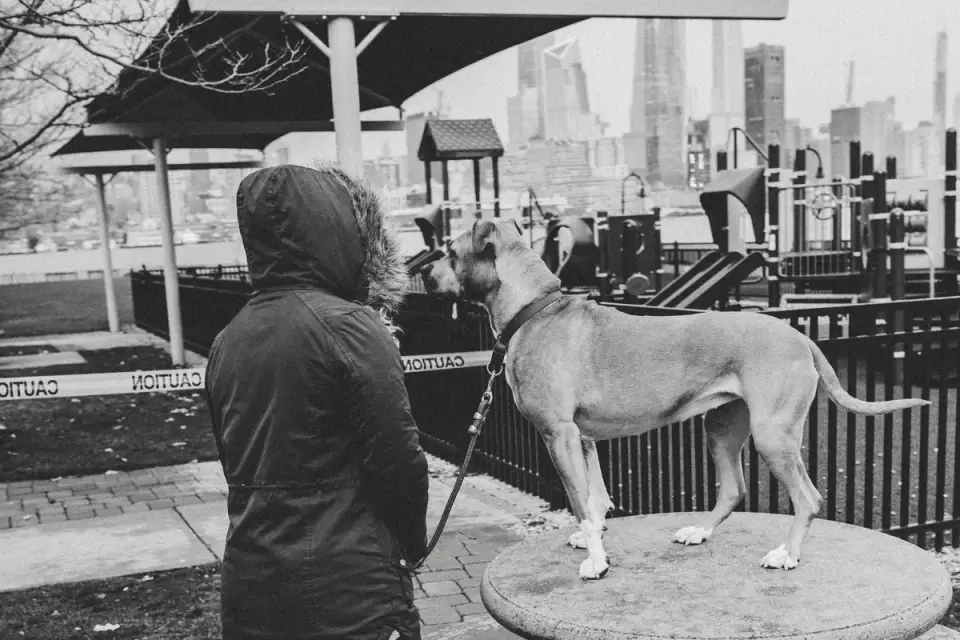
I still think about a fourteen-year-old Cardigan Corgi, a stout 32 pounds, whose owner had been managing her mild hip arthritis with rest, on the reasonable theory that less movement meant less wear. Over about four months her hindquarters had visibly narrowed, and she’d started sitting instead of standing when greeting people at the door — a compensation, not an improvement. We didn’t add mileage; we added ten minutes of sit-to-stands and slow incline work most days, timed to when her NSAID was at peak effect, and paired it with a protein bump. By the third recheck her muscle condition score had moved up a full grade and she was standing to greet people again. One dog isn’t proof of anything, but it’s the pattern I’ve seen often enough to build a program around.
Where a Rehab Vet Changes the Calculus
A home program covers a lot of ground, but there’s a real line past which a certified rehab vet does more good than a well-meaning owner with a YouTube video. That line is usually pain, not age: a dog who won’t bear weight evenly, who yelps on a specific movement, or who’s recovering from surgery needs graded loading under professional eyes, not a generic strength routine. Our breakdown of at-home physical therapy versus rehab-vet care covers that threshold in more detail, and it’s worth reading before you start loading a dog who’s already guarding a limb.
Surface matters here too, more than owners expect. A treadmill belt and a sidewalk put different demands on an aging hip, and choosing the wrong one can undo the gains a strength program is trying to build. We’ve laid out those differences separately in our treadmill-versus-outdoor-walking comparison.
Where Joint-Support Ingredients Actually Fit
Here’s where I have to be honest about the limits of the evidence, because muscle and joint tissue aren’t the same problem even though they’re loaded together. Glucosamine and chondroitin have real basic-science support, but it’s mostly mechanistic rather than proof of outcome in dogs. A review in the Journal of Veterinary Medical Science notes that glucosamine HCl can “prevent experimentally induced cartilage degradation in vitro” — a lab-dish finding, not a guarantee of what happens in a joint under load. Chondroitin’s case is similarly mechanistic: research in Frontiers in Veterinary Science describes it as supporting “healthy synovial fluid homeostasis,” which is a structure/function claim about joint lubrication, not a muscle-building one.
Green-lipped mussel is the ingredient I get asked about most, largely on the strength of its omega-3 and glycosaminoglycan content. A study in Nutrients found that mussel-derived compounds “alleviated paw swelling in rats and reduced serum levels of rheumatoid factor (RF), anti-cyclic citrullinated peptide (anti-CCP) antibody, and pro-inflammatory cytokines such as TNF-α and IL-17” — a rat inflammatory-arthritis model, worth noting as inflammation-pathway evidence rather than a canine muscle-mass result. I weigh that kind of finding honestly with owners: it may help support a joint that’s already tolerating more load because of a strength program, but it isn’t the program itself, and it won’t rebuild muscle on its own. If a dog’s joints are the limiting factor in how much loading they can tolerate, a supplement chosen on real evidence can be a reasonable adjunct to the actual work — protein and resistance movement — not a substitute for it.
Building the Rotation Without Overloading an Aging Joint
Progression is the part owners most often get wrong, usually by doing too much on a good day and then backing off entirely after a sore one. I generally start with three to four short sessions a week, five to ten minutes of loaded work each, and only add volume once a dog handles the current level without stiffness the next morning. A dog recovering from a long layoff — like Otto, six weeks into noticeably avoiding the tailgate — should be reassessed on muscle condition score monthly, not just weighed.
A quick sanity check before you start:
- Has a vet ruled out pain as the reason the dog is avoiding activity?
- Is the current diet’s protein actually above minimum, or just labeled “senior”?
- Are you tracking muscle condition score, or only weight?
- Is the loading progressive, or the same ten-minute walk repeated for months?
The Bottom Line
Otto’s owner didn’t need a supplement aisle; she needed a protein increase and a sit-to-stand routine three times a week, built around when his joints felt best. Eight weeks in, he was clearing the tailgate on his own again — not because any single ingredient did the work, but because the diet and the loading both changed at once. That’s the honest shape of this problem: muscle comes back slowly, mostly through protein and controlled resistance movement, with joint-support ingredients doing whatever narrower job the evidence actually supports around the edges. What would you change first in your own dog’s week — the food, or the workout?
Frequently asked questions
How long does it take to rebuild muscle in an older dog?
Expect months, not weeks. Sarcopenia develops slowly and reverses slowly; most owners see a meaningful muscle condition score change over a season of consistent protein and loaded movement, not a single supplement or a two-week routine.
Can a senior dog with arthritis still build muscle?
Often yes, but pain control usually has to come first — a dog guarding a joint won't load it enough to rebuild the muscle around it. Work with a vet or rehab vet to sequence pain management and loading together.
Do joint supplements build muscle?
No. Ingredients like glucosamine, chondroitin, and green-lipped mussel are studied for joint and mobility support, not for rebuilding lean muscle mass. Protein and resistance-style movement are the two levers with the most direct evidence behind them.
Sources
- Weight loss in senior and geriatric dogs — Royal Canin Academy
- Chondroitin and joint and mobility support — Frontiers in Veterinary Science
- Glucosamine HCl and cartilage degradation — Journal of Veterinary Medical Science
- Green-lipped mussel powder and inflammatory markers — Nutrients