How to Respond When Your Dog Growls
A vet's field guide to reading a growl correctly, responding without punishing the warning, and knowing when calming support or a professional is the next right step.
A growl is information, not disobedience, and how you answer it in the next ten seconds decides whether your dog ever warns you again.
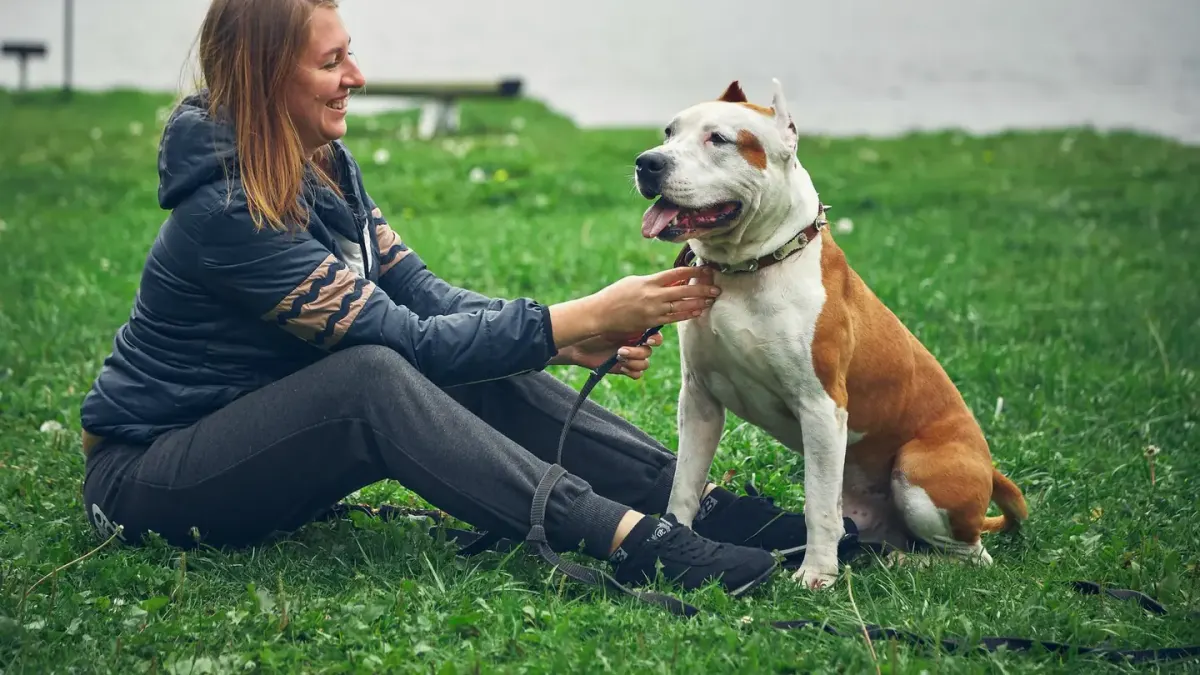
A beagle mix named Otis, six years old and about twenty-four pounds, came into my exam room because his owner had started flinching every time she reached for his collar. Three weeks earlier, Otis had growled when a neighbor’s kid leaned over him on the porch, and the family’s response was to scold him and pull him away by the collar. By the time I saw him, he’d started growling at the leash clip too. Nothing had actually gotten worse about Otis. What had changed was that his one reliable warning system had been punished, so he was starting to skip straight to a stiffer body and a harder stare before anyone could read what was coming.
That case is the whole argument in miniature. A growl is a dog telling you, in the clearest language he has, that he is uncomfortable and would like the situation to change. The single most useful thing an owner can do in that moment is stop, back off the pressure, and figure out why — not punish the messenger.
What the growl is actually telling you
Growling is a distance-increasing signal. It says “more space, please,” or “stop what you’re doing,” and it almost always sits in a sequence with other signals — a freeze, a hard stare, lip lifting, a tucked tail, weight shifted backward — that most owners miss because they’re subtler than the growl itself. If you watch the thirty seconds before the growl instead of the growl itself, you’ll usually find the actual trigger: a hand reaching over the head, a stranger leaning in, another dog crowding a food bowl, a touch near a sore hip or an ear that’s already inflamed.
The instinct many owners have is to correct the growl — a sharp “no,” a leash pop, physically moving the dog. I understand the impulse; a growl is startling, and it can feel like the start of a bite. But suppressing the growl doesn’t remove the discomfort that caused it. It just removes the dog’s warning. Owners I’ve worked with who punished growling consistently reported the same pattern six months later: not a calmer dog, but one who skipped the growl and went straight to snapping, because the growl had stopped working as a way to get space.
What to actually do in the moment
The immediate response is simple, even if it doesn’t feel intuitive: stop moving toward whatever triggered the growl, and give the dog room. Don’t loom, don’t reach for the collar, don’t make prolonged eye contact, and don’t punish. If it’s safe to do so, calmly redirect the dog’s attention or step back yourself. This isn’t about rewarding the growl with a treat in the moment — it’s about not adding a second stressor on top of the first one.
Once everyone is safe, the real work is identifying the trigger and deciding whether it’s a training issue, an environmental setup issue, or a medical one. A dog who growls only when touched in one specific spot — a hip, a low back, an ear — deserves a physical exam before a behavior plan, because pain-driven growling responds to training the way a toothache responds to a pep talk: not at all until the underlying problem is addressed. A dog who growls at strangers reaching over him at a fence, or barks at people on walks, is often dealing with a related but distinct pattern — I’ve written separately about why dogs growl when petted and about the barking that shows up in the same context on walks, since the triggers and the fixes overlap but aren’t identical.
Where I land with owners
I tell owners the same thing every time: never punish a growl, but don’t ignore what it’s telling you either. The goal isn’t a dog who never growls — it’s a dog who feels safe enough that growling is rarely necessary, and who trusts that a growl gets him space instead of a scolding. That means managing the setups that predictably trigger it (kids reaching over the head, strangers looming, being cornered while eating) and building the dog’s tolerance gradually, at a pace he can actually handle, rather than flooding him with the trigger and hoping he adapts.
It’s also worth being honest about what looks like simple irritability versus something closer to frustration or fear. Owners frequently ask me to tell the difference between a dog who growls out of overarousal on leash and one who’s genuinely defensive, and the short answer is that it usually takes watching the whole sequence, not just the growl — a distinction I go into in more depth when I write about barrier frustration versus aggression. The mechanics differ enough that the intervention differs too.
For dogs whose growling is tangled up with a baseline of chronic stress — the ones who are reactive to nearly everything, who startle easily, who never fully settle in the house — a broader look at daily stress load matters as much as the specific trigger. That’s also where the evidence on calming ingredients is worth being precise about, because the research is real but narrower than marketing usually implies. Ashwagandha has the best-supported human evidence of the commonly used calming botanicals: a systematic review of multiple randomized controlled trials, summarized in Cureus, concluded that ashwagandha has a moderate positive impact on stress reduction and cognitive performance. L-theanine’s evidence is more mixed — outside of one study on psychotic anxiety showing a moderate effect at 400 mg/day over eight weeks, results have been inconsistent, according to a review in Molecular Psychiatry. Chamomile sits at the thinnest end: a recent review notes that for most species, “evidence is derived mainly from preclinical studies or traditional use” rather than controlled clinical trials, per Biomedicines. I’ll use a calming supplement as one piece of a larger plan for a chronically stressed dog, but I’m careful never to suggest it replaces reading the growl correctly or addressing the trigger itself — structure/function support, not a fix for a warning signal.
There was a stretch with Otis, about five weeks, where the plan was almost entirely about rebuilding trust: no more collar grabs, no more scolding, hand-feeding near the areas he’d started guarding, and a session with a trainer to work on cooperative handling for nail trims and vet visits. His owner didn’t need him to stop growling forever. She needed him to trust that a growl still worked the way it used to — that it got him space instead of a correction. By the follow-up visit, he was tolerating the collar clip again, and the growling around handling had dropped off almost entirely, not because we suppressed it, but because we stopped giving him reasons to need it.
If growling is escalating despite management, showing up in new contexts, or paired with lunging or snapping, that’s the point to bring in a certified trainer or veterinary behaviorist rather than troubleshoot it alone — the same threshold I’d use for counter-conditioning a leash-reactive dog, where the technique matters less than getting the sequencing right.
Bottom line: treat a growl as a warning you’re grateful to have received, not a behavior to correct — find the trigger, give the dog space, rule out pain, and build a management plan around what actually set him off.
Frequently asked questions
Should I ever punish a dog for growling?
No. Punishing a growl doesn't remove the discomfort behind it; it just teaches the dog that warning you leads to worse consequences, which can push a dog toward skipping the growl and escalating faster next time.
When does growling need a vet visit instead of just training?
If the growling is localized to touch in one area, like a hip, back, or ear, or has come on suddenly in an older dog, rule out pain or a medical cause before assuming it's purely behavioral.
Sources
- Ashwagandha and Stress: A Systematic Review — Cureus
- L-Theanine and Anxiety: A Review — Molecular Psychiatry
- Chamomile in Anxiety and Stress: A Review — Biomedicines