Impulse-Control Games That Build Self-Regulation in Dogs
A vet's brand-neutral guide to the impulse-control games that actually teach dogs to pause, think, and self-regulate — and where calming aids fit around the training, not instead of it.
The dogs who struggle most with self-control aren't being stubborn — they've rarely been asked to practice waiting for anything.
On this page
Is impulse control something a dog is simply born with, or is it a skill — one that can be built the same way you’d build a sit-stay or a loose-leash walk?
In my exam room, that question usually comes up after something has already gone wrong: a dog who bolted through an open door, one who snatched food off a counter mid-conversation, one who couldn’t settle at a restaurant patio for even five minutes. Owners tend to describe these dogs as “hyper” or “stubborn.” What I actually see, most of the time, is a dog who has had very little practice tolerating the gap between wanting something and getting it. That gap — the pause between impulse and action — is trainable. It’s also worth separating from behavior problems rooted in fear or frustration, which is a different conversation (barrier frustration and leash reactivity covers that distinction well.
Start here: the games worth your time
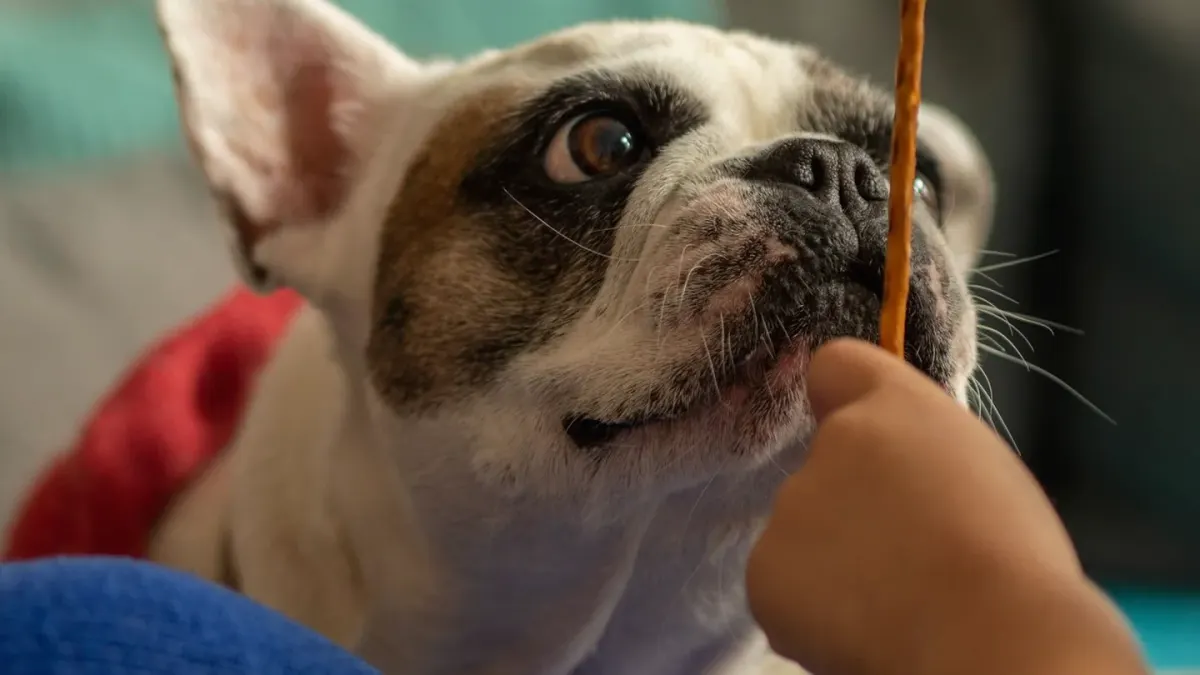
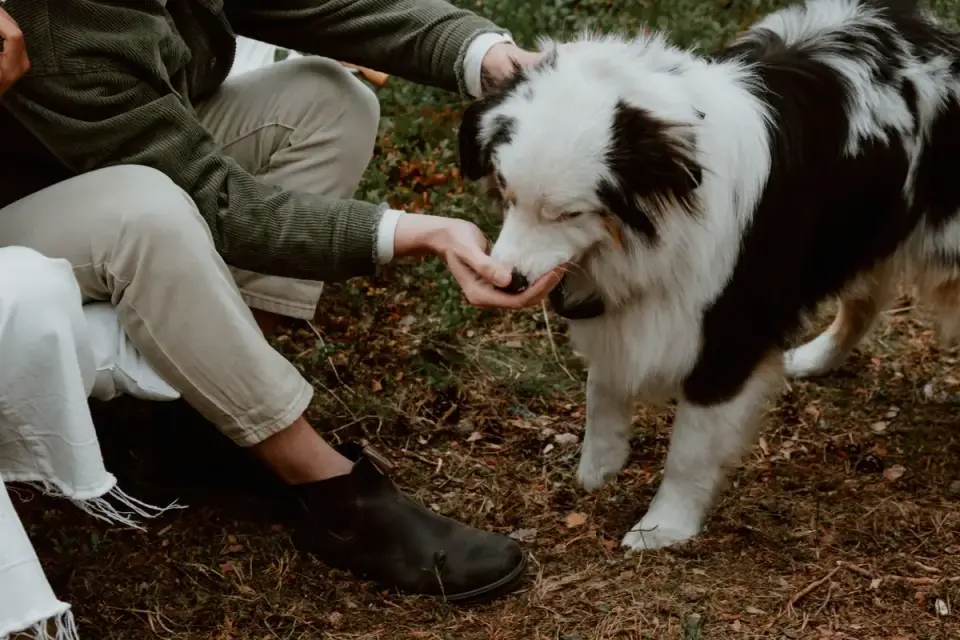
- “It’s Your Choice” — food is presented on an open palm; the dog only gets it when it stops trying to take it.
- Doorway and threshold waits — the dog must hold position while a door, crate, or car hatch opens.
- Leave-it progressions — building from a covered treat to a dropped one to a moving temptation.
- Settle-on-a-mat — rewarding calm, disengaged lying-down in the presence of distraction.
- Release-word games — teaching that “okay” or “free” is what actually unlocks access, not the dog’s own timing.
Each of these teaches the same underlying skill from a different angle: pause first, then act. I’ll walk through why that matters and how to sequence them below.
Why the pause is the whole point
Most obedience cues ask a dog to do something — sit, come, heel. Impulse-control games ask a dog to not do something for a few seconds, then a few more. That’s a fundamentally different mental task, and it’s one a lot of dogs have never been deliberately taught. A young dog who’s never had to wait for a bowl of food, a leash clip, or a door to open has had no reps at tolerating frustration in a low-stakes setting — so the first time it matters (a dropped pill bottle, a gate left open) is also the first time the dog has ever had to try.
This is why I ask owners to practice these games in boring moments, not big ones. Feeding time, leash-on time, door-opening time — these are free repetitions that cost nothing and happen daily.
A short case that changed how I explain this
A three-year-old vizsla named Otto came in because his owners could no longer walk him past the dog park without him lunging toward the gate the second it opened, regardless of who or what was on the other side. He wasn’t reactive to other dogs specifically — he was reactive to open thresholds. We started with something almost absurdly small: waiting two seconds at his own front door before the leash was clipped, rewarded, then released. Over about six weeks, that built to waiting at the car door, then the dog-park gate itself, with the release word doing the work instead of Otto’s own momentum. His owners tracked it on their phone — two seconds became ten, then a full count to twenty by week four. He was never a “calm” dog by temperament, and I want to be honest that this was one dog’s trajectory, not a guarantee — but the mechanism, rehearsing a pause in a low-stakes doorway until it generalized to a high-stakes one, is the same mechanism behind every game on this list.
Sequencing: easy to hard, not hard to harder
The games above aren’t interchangeable difficulty levels — they build. “It’s Your Choice” and mat settling are foundational because the dog controls almost nothing else in the environment; the only variable is its own behavior. Doorway waits and leave-it progressions add environmental temptation — motion, novelty, distance — on top of that foundation. Skipping straight to a high-distraction leave-it (a dropped chicken bone on a walk) without the foundational reps is where most owners get frustrated and conclude the dog “just can’t do it.” The dog usually can. It just hasn’t had the graduated practice.
Where anxiety and frustration muddy the picture
Impulse-control games work well for dogs who are simply under-practiced at waiting. They work less well, on their own, for dogs whose “impulsive” behavior is actually driven by anxiety or true frustration — a dog who bolts because the doorbell terrifies it isn’t lacking self-control, it’s flooded. That distinction matters for training strategy, and it’s worth reading about separately if the behavior looks more like panic than excitement; boredom and separation anxiety is a useful comparison for sorting that out, as is understanding whale eye as a stress signal rather than a defiance one.
Puppies deserve a specific note here too, since a lot of “impulsive” puppy behavior — the counter-surfing, the mouthing, the door-bolting — overlaps heavily with normal developmental exploration rather than a training failure. If mouthing is the main complaint, puppy biting and mouthing is the more direct resource.
Where calming ingredients fit — and where they don’t
Games build the skill; they don’t touch a dog’s baseline arousal level, and for some dogs baseline arousal is a real part of the problem. This is where the evidence on calming ingredients is genuinely useful to know, and where it’s genuinely thin. A review in Biomedicines notes that for chamomile’s effects on anxiety and stress, “for the remaining species, evidence is derived mainly from preclinical studies or traditional use” — which is a fair way of saying the animal data lags behind the tradition. For ashwagandha, the picture is stronger: a systematic review published in Cureus “analyzed multiple RCTs and concluded that ashwagandha has a moderate positive impact on stress reduction and cognitive performance,” though that body of evidence is human-focused. L-theanine has more mixed human trial results — a review in Molecular Psychiatry found meaningful effect “except for one study on psychotic anxiety (SMD = 0.54; 400 mg/day for 8 weeks),” underscoring how dose- and population-dependent these effects are.
None of that is a reason to skip the training. A calming ingredient may help support a dog’s baseline state, but it doesn’t teach a dog to wait at a door — only the repetitions do that.
Where I land with owners
I tell owners the same thing every time: pick one game, practice it in the most boring moment of your day, and expect the timeline to be measured in weeks, not one session. A dog that can hold a two-second doorway wait this week is a dog that can probably hold a five-second one in a month, not because anything magical happened, but because the pause got rehearsed. That’s the whole model. It’s also, frankly, the same model I use for almost every behavior concern that lands in my exam room — small, boring, repeated reps beat one dramatic training day, every time.
FAQ
Q: How long does it take to see improvement with impulse-control training? A: Most owners notice a measurable shift within two to four weeks of daily short sessions, though full generalization to high-distraction settings (like an open gate or a dropped plate) often takes longer.
Q: Can impulse-control games replace medication or behavioral therapy for a genuinely anxious dog? A: No — these games teach a skill for dogs whose main issue is under-practiced self-control. A dog whose “impulsive” behavior is actually driven by fear or anxiety needs that root cause addressed first, often alongside a veterinarian or veterinary behaviorist.
Q: Is it normal for a puppy to fail at these games at first? A: Yes. Puppies have shorter attention spans and less developed self-control by default; short, frequent, low-pressure sessions work better than long ones.