Independence Training for a Velcro Dog: A Vet's Practical Plan
Why some dogs shadow their owners room to room, what's normal attachment versus what needs attention, and a step-by-step way to build calm independence.
Teaching a Velcro dog to settle alone starts with rewarding distance, not eliminating it, one deliberate step at a time.
On this page
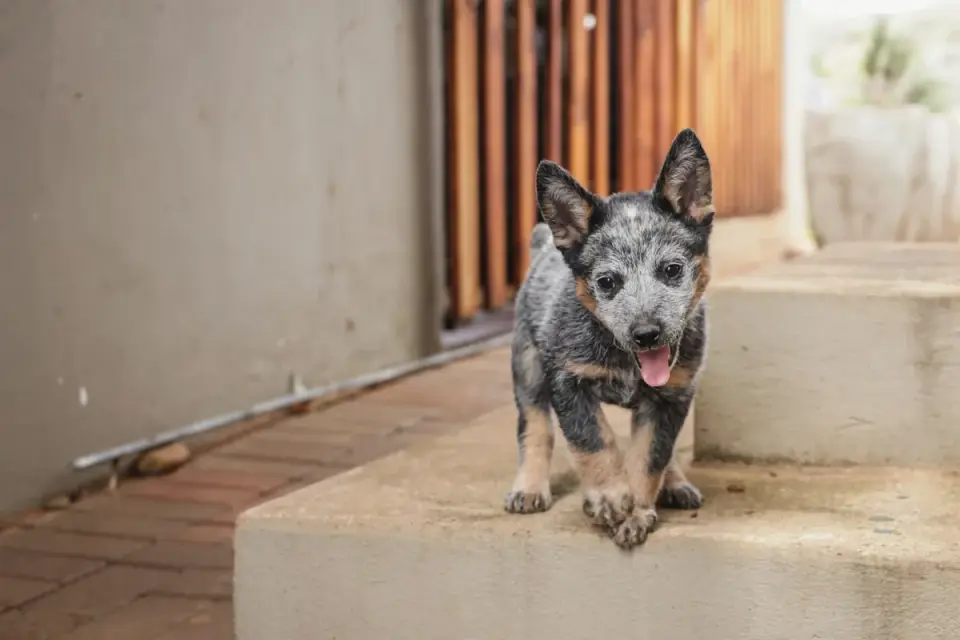
Milo was a nine-month-old cattle dog mix, about 38 pounds, who’d started following his owner Rachel into the bathroom, standing at the shower curtain, and whining if she closed a door with him on the wrong side of it. It had crept up over six or seven weeks, she told me, right around when she’d switched to working from home full time. By the time she brought him in, she was apologizing for what she assumed was a training failure. It wasn’t. Milo’s shadowing was a learned habit built on a completely reasonable foundation: Rachel was interesting, safe, and endlessly available. My job wasn’t to punish the following. It was to teach Milo that space from her was fine, boring even, and never something to panic about.
What normal shadowing looks like at different ages
Puppies track their people the way ducklings track a hen; it’s baseline attachment behavior, not a problem to fix. Most dogs loosen this instinct gradually between four months and two years old as they build confidence navigating rooms, stairs, and time alone. A dog who follows you to the kitchen and then flops down nearby is doing something entirely different from a dog who paces, whines, or scratches at a door the moment you’re out of sight. The first is companionship. The second is the beginning of a pattern I want to interrupt early, before it hardens into something that looks a lot like separation-related distress. If you’re trying to sort out which one you’re watching, Boredom vs Separation Anxiety: How to Tell the Difference is worth reading alongside this piece, because the two get confused constantly and the training response differs.
Why the following escalates in adolescence and midlife
Adolescent dogs, roughly six months to two years, often get more velcro-like before they get less so. Hormonal shifts, a widening awareness of the world, and in many households, a change in routine — a new job, a move, a baby — all coincide with this stage. I see it constantly: a dog who was fine being left alone at four months starts crying at the door at eight months, and owners assume regression. It’s usually just a nervous system catching up to a bigger, scarier world, and the fix is the same either way — rebuild trust in short, low-stress doses rather than trying to muscle through longer absences.
The order I actually recommend
Start with distance inside the house before you ever touch the front door. Reward your dog for lying on a mat or bed six feet away from you, not right at your feet — a treat tossed to the mat, repeated until the dog starts choosing it on their own. Once that’s solid, close a door between you for ten seconds, then thirty, then a couple of minutes, always returning before any whining starts so the dog never rehearses distress. Only after several days of that does actual departure training belong in the plan: keys picked up and set back down, a coat put on and taken off, a car door opened and closed, none of it followed by leaving. Dogs read these cues faster than owners expect, and skipping straight to real absences is the single most common mistake I see.
In my practice, the dogs who backslide are almost always the ones whose owners jumped stages — thirty seconds of alone time on day one to twenty minutes by day three because it “seemed fine.” One Australian shepherd I worked with, about four years old, had done beautifully with mat training for two weeks, then her owner left for a full hour to run errands and came home to a chewed door frame. We didn’t start over, but we did drop back to two-minute departures for another ten days before building distance again. Setbacks like that aren’t failures; they’re information about pace. The dogs that make steady progress are the ones whose owners resist the urge to test the plan against a real-world absence before the dog has actually earned it.
Where calming support fits, and where the evidence is thin
Some owners ask about calming chews or supplements alongside training, and it’s a fair question, especially for dogs whose following has a genuinely anxious edge to it rather than simple companionship-seeking. The evidence here is real but modest, and it matters to be precise about what it actually shows. A review in Biomedicines on chamomile’s role in anxiety and stress notes that “for the remaining species, evidence is derived mainly from preclinical studies or traditional use” — meaning the animal data, dogs included, is thinner than the human data and shouldn’t be oversold. Ashwagandha has somewhat firmer human backing: a systematic review in Cureus “analyzed multiple RCTs and concluded that ashwagandha has a moderate positive impact on stress reduction and cognitive performance,” though that’s a human-trial conclusion, not a canine one. L-theanine’s human evidence is narrower still — a review in Molecular Psychiatry found benefit largely limited to “one study on psychotic anxiety (SMD = 0.54; 400 mg/day for 8 weeks),” which is a specific and fairly niche result to extrapolate from. None of this replaces the behavioral work. I think of these ingredients, when I recommend them at all, as something that may help support a dog who’s already mid-training, not a substitute for teaching the skill of being alone.
When it’s more than a training problem
Not every velcro dog needs a supplement or a mat protocol; some need a broader look. If the following comes with destructive chewing specifically when left alone, that’s worth separating from boredom chewing — see Is My Dog Chewing Out of Boredom or Anxiety? for how those present differently. And if a dog who follows you everywhere also stiffens, growls, or shows whale eye when you reach for them at rest, that’s a different conversation entirely, closer to resource guarding of proximity than simple attachment; Why Does My Dog Growl When I Pet Him? covers that pattern. True separation anxiety — panic, drooling, self-injury attempts at doors or windows — is a clinical presentation, not just an intense version of shadowing, and it usually needs a trainer or veterary behaviorist alongside any at-home plan.
What I tell owners to start with tonight
I had a client last spring, a seven-year-old beagle named Peanut, whose owner described him as “basically my shadow” for his entire life — not new, not escalating, just constant. That’s a different situation from Milo’s, and it’s one I see often in older, securely attached dogs who’ve simply never practiced distance because they’ve never needed to. We didn’t chase a diagnosis. We built a five-minute mat routine before dinner each night, added a closed door for a few minutes during her shower, and within three weeks Peanut was choosing to nap in the next room on his own some evenings. No supplement, no dramatic intervention — just consistent, low-pressure repetition. That’s usually where I land with owners: start smaller than feels necessary, keep sessions short enough that the dog never has a chance to panic, and build the skill of tolerating distance the same patient way you’d build any other one.
If your dog’s following feels more like anxiety than habit, begin with the mat-and-door sequence above for one week before adding anything else, and track whether the whining shows up at ten seconds or ten minutes — that number tells you where to start tomorrow.
Frequently asked questions
Is it normal for a dog to follow me to every room in the house?
Some shadowing is normal, especially in puppies and newly adopted dogs still learning the household is safe. It becomes worth addressing when the dog can't settle unless you're in sight, or panics briefly when a door closes between you.
How long does independence training usually take?
Most dogs show noticeable change within two to three weeks of short, daily distance practice, though dogs with a longer-standing pattern, like an older dog who's simply never practiced being apart, may take longer to build the same comfort.
Should I ignore my dog when they follow me to stop the behavior?
Ignoring the following itself isn't the lever; rewarding distance and calm settling is. Punishing or scolding a dog for shadowing tends to increase anxiety rather than reduce the behavior.
Sources
- Chamomile in Anxiety and Stress Across Species — Biomedicines
- KSM-66 Ashwagandha and Stress: A Systematic Review — Cureus
- L-Theanine and Anxiety Outcomes — Molecular Psychiatry