Is Swimming Safe for Senior Dogs? What the Evidence Actually Supports
A veterinary nutritionist and rehab specialist walks through when swimming helps an aging dog's joints, which health conditions change the calculus, and how to introduce water exercise safely.
For most senior dogs without cardiac or respiratory disease, swimming is not just safe — it may be the single lowest-impact way to keep an arthritic joint moving.

On this page
I still remember an eleven-year-old Labrador named Duke, sixty-eight pounds, who came into my office because his owner noticed he’d stopped jumping into the truck bed sometime that spring — she couldn’t pin down exactly when, just that one week he was doing it and the next he wasn’t. His hips were mildly dysplastic on radiographs, nothing surgical, but the kind of low-grade osteoarthritis that makes a dog quietly opt out of things rather than yelp about them. His owner asked if the lake behind their house, where Duke had swum every summer of his life, was still a good idea now that he was slower getting up in the mornings. That question — is swimming still safe, now that he’s old — is one I get from owners of arthritic and cardiac-compromised seniors more than almost any other exercise question, and the honest answer depends less on the dog’s age than on which specific conditions are layered underneath it.
The buoyancy argument, and where it actually comes from
Water removes load from a joint in a way no land-based exercise can. A dog standing chest-deep is bearing a fraction of its body weight through its limbs, which is the physiological reason swimming shows up so often in rehabilitation programs for dogs with elbow dysplasia and hip dysplasia — even a single hydrotherapy session has been associated with increased range of motion and stride length in Labradors with elbow dysplasia, according to Great Pet Care’s review of the rehabilitation literature. That’s a mechanical effect, not a supplement or a drug: less compressive force on cartilage and subchondral bone while the dog still has to actively engage stabilizing muscle to paddle. For a joint that hurts under normal weight-bearing, that combination — motion without load — is close to the theoretical ideal, which is why rehabilitation vets reach for a pool or an underwater treadmill before they reach for almost anything else mechanical.
That said, “low-impact” is not the same as “risk-free,” and the senior-specific caveats are where I spend most of my time with owners. According to the American Kennel Club, swimming can be therapeutic for older dogs but should be cleared with a veterinarian first, particularly for dogs with cardiac, respiratory, or joint conditions — a physical exam and senior bloodwork before starting is the standard recommendation, not an optional extra. A dog with underlying heart disease can decompensate under the cardiovascular demand of swimming faster than it would on a walk, because swimming is a full-body aerobic effort even when it doesn’t look strenuous from the shore. This is the conversation I have before I have any conversation about technique.
What actually goes wrong, and how often
The two failure modes I see aren’t dramatic. The first is fatigue outpacing judgment — a dog that used to swim for twenty minutes without thinking about it now tires at eight, but keeps paddling because dogs generally don’t self-regulate exertion the way we’d like them to. An overtired senior dog with weaker hindquarter muscling can struggle to climb out of a pool or up a bank, and that’s the moment things go wrong, not the swimming itself. The second is ear disease. Dogs have an L-shaped ear canal that doesn’t drain the way ours does, and moisture trapped down in that canal creates exactly the environment yeast and bacteria need to overgrow — a mechanism the Merck Veterinary Manual describes as a core driver of otitis externa in dogs generally, and one that hits floppy-eared, hairy-canaled breeds hardest. A senior dog that swims regularly and has never had an ear problem can still develop one; drying the canal after every swim is a cheap habit that prevents a genuinely common complication.
Skip water exercise altogether if your dog has an open wound, an active skin infection, a diagnosed heart condition that hasn’t been cleared by a cardiologist, or a level of weakness that makes sustained paddling doubtful. None of those are senior-specific facts, exactly — they’re just more common in an older dog’s chart than a younger one’s, which is why the “is this safe for my senior dog” question so often collapses into “does my dog have one of these things,” rather than being about age as a number.
Where joint-support ingredients fit into that picture
Swimming addresses the mechanical side of osteoarthritis — load and motion. It doesn’t touch the biochemical side, which is where nutritional and supplement strategy comes in, and it’s worth weighing what each ingredient can realistically be expected to do rather than treating them interchangeably. Glucosamine and chondroitin are among the most studied joint-support ingredients for dogs, and the mechanistic case for chondroitin centers on supporting healthy synovial fluid homeostasis — the fluid environment a joint needs to glide with less friction, according to a 2026 review published under DOI 10.3389/fvets.2026.1536366 in Frontiers in Veterinary Science. Glucosamine HCl’s evidence base is narrower and more preclinical: in vitro work has shown it can help prevent experimentally induced cartilage degradation, per a review published in the Journal of Veterinary Medical Science — a finding worth taking seriously, but one generated in a dish, not a clinical trial in dogs. Green-lipped mussel’s anti-inflammatory signal is similarly early-stage; a 2026 study in Nutrients found that mussel-derived compounds reduced paw swelling and pro-inflammatory markers including TNF-α and IL-17 in a rat model, which is suggestive mechanism, not a demonstrated outcome in arthritic dogs. I’d rather be precise about that gap than round it up into a promise, because owners deserve to know which claims are “well-studied mechanism” versus “shown to work in your dog’s joint” — those are different sentences, even when both point the same direction.
None of that changes the swimming recommendation. It just means a supplement strategy and a buoyancy-based exercise strategy are solving different halves of the same problem, and a dog doing well in the water can still benefit from support on the cartilage-biochemistry side that swimming alone can’t provide.
Building a safe routine for an older dog
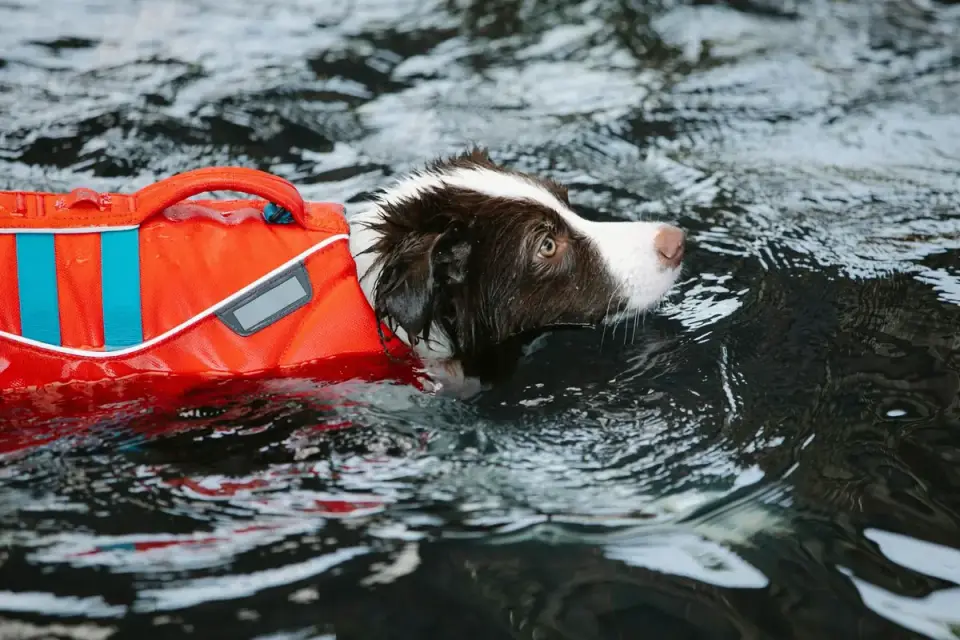
Start shorter than you think you need to — five to ten minutes is a reasonable opening session for a dog that hasn’t swum regularly in a while, with duration built up gradually as strength and confidence return. Watch for the early signs of fatigue rather than waiting for a dog to struggle: a change in stroke rhythm, a lower head position in the water, or reluctance to keep swimming toward you are all cues to end the session, not push through it. A well-fitted life vest is worth the cost for a dog with weaker hindquarters or reduced confidence in water, because it lets the dog spend its energy on moving the joint instead of staying afloat. Dry the ears thoroughly after every session, and if your dog has cardiac or respiratory disease, treat every swim like it needs the same medical clearance a new exercise program would.
For dogs whose joint disease is more advanced or whose mobility loss is progressing despite exercise modifications, our companion piece on swimming versus walking for an arthritic dog breaks down which format protects the joint better at different disease stages, and at-home physical therapy for dogs covers when a home routine stops being enough and a certified rehab vet becomes the right next call. If your dog is still building general fitness rather than managing diagnosed arthritis, core-strengthening exercises for dogs is a reasonable complement to water work, since a stronger trunk changes how well a dog tolerates paddling in the first place.
I think back to Duke fairly often. His owner cleared him with her vet, added a life vest for his first few sessions back in the lake, and kept swims to about fifteen minutes through that first summer. He didn’t start jumping into the truck bed again — that ship had sailed, and no amount of water exercise reverses established joint disease — but he was climbing the porch steps more easily by September, which was the outcome that actually mattered to her. That’s one dog, not a study, and I’d be doing owners a disservice if I implied otherwise. But it’s a fairly representative shape for what a cleared, well-managed senior dog can get out of the water.
Practical next step: if your senior dog has no diagnosed heart, lung, or skin condition, ask your vet for a quick pre-swim check at the next routine visit, start sessions at five to ten minutes with a life vest, and dry the ears every time.
Frequently asked questions
What age counts as "senior" for swimming safety purposes?
There's no single cutoff — it depends more on the individual dog's cardiac, respiratory, and joint status than a birthday. A vet exam is the better gauge than age alone.
Can a dog with arthritis swim every day?
Many can, once cleared by a vet, but watch for post-swim soreness or reduced appetite for activity the next day and adjust frequency accordingly.
Do ear infections from swimming mean a dog should stop?
Not usually — most are preventable with thorough ear drying after each swim, and a vet can recommend a drying solution for dogs that swim often.
Sources
- Is Swimming Therapeutic for Senior Dogs? — American Kennel Club
- Hydrotherapy for Dogs: Benefits and Uses — Great Pet Care
- Ear Infections and Otitis Externa in Dogs — Merck Veterinary Manual