Why Does My Dog Lick His Paws Raw? A Vet's Guide to Causes and What Actually Helps
A veterinarian explains the real causes behind raw, red paw licking in dogs — allergies, pain, and anxiety — and what evidence supports for each.
Most dogs who lick a paw raw aren't doing it out of habit — something is itching, hurting, or unsettling them, and the paw is just where it shows up first.
On this page
Checklist first, because owners in this situation usually want direction before explanation:
- Check for a physical cause first — foreign bodies (grass awns, splinters), cracked nails, interdigital cysts, or a hot spot between the toes.
- Look at timing and location — seasonal, all-paw licking points toward allergies; one paw, one spot, points toward local irritation or pain.
- Rule out joint or soft-tissue pain, especially in older dogs or dogs who favor a limb before or after the licking starts.
- Consider the behavioral layer — stress and boredom licking is real, but it’s rarely the first explanation, and it’s almost never the only one.
- Don’t treat the paw and ignore the trigger — a bitter spray or a sock stops the licking, not the reason for it.
I’ll go through each of these in order, because the order matters more than most owners expect.
In my practice, one of the dogs I remember most clearly was a four-year-old English bulldog named Otis, sixty pounds, who came in because his owner noticed a wet, reddish-brown stain on the fur between his front toes that hadn’t been there a month earlier. She’d first spotted it on a Sunday morning, on the tile by the back door, right after he came in from the yard. He was licking at rest, not just after walks, and by the time she called us the skin between two toes was raw and slightly thickened. She’d already tried a bitter-apple spray from the pet store — it worked for about a day. What she was weighing was real: he’d had a food change six months prior that seemed to help his ears, and she didn’t want to reintroduce something that might undo that progress just to test a new theory. We worked through it as an allergy case with a secondary yeast infection, and it took closer to six weeks, not six days, before the paw looked normal again.
What raw paw licking usually means, by pattern
The pattern of the licking is more diagnostic than the licking itself.
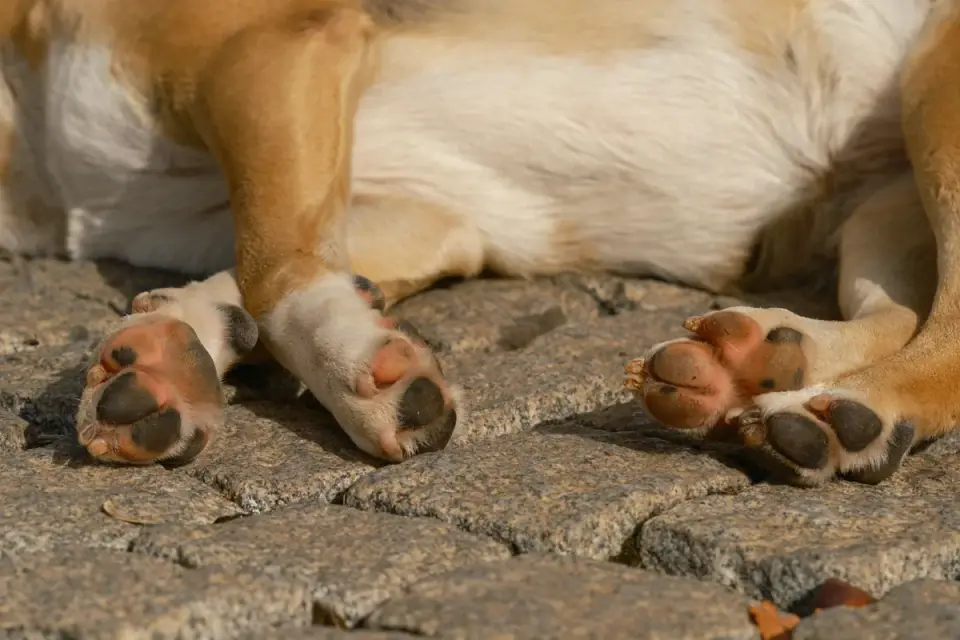
All four paws, seasonal or year-round, often with itchy ears or face-rubbing: this is the classic presentation of environmental allergies (atopic dermatitis) or a food sensitivity. The paws are thin-skinned and low to the ground, so they pick up allergens from grass, dust, and stored pollen, and they’re an easy place for a dog to reach and lick.
One paw, one spot, sudden onset: think local cause first — a splinter, a grass awn worked in between the toes, a cracked nail, an interdigital cyst, or a sting. These often come with limping or a visible swelling before the licking becomes constant.
Licking that gets worse with activity or is paired with limping, stiffness after rest, or reluctance to jump: this needs an orthopedic look. Dogs sometimes lick or chew at a paw or lower leg because of referred discomfort from an arthritic joint, a soft-tissue strain, or early degenerative changes — the paw becomes the accessible target for discomfort that actually originates higher up. This is easy to miss because owners (understandably) look at the wet, red paw and assume the paw is the problem.
Licking mainly when left alone, during storms, or during specific stressful routines: this points toward a stress or anxiety component. It’s a legitimate contributor, but it should be a diagnosis of exclusion — reached after medical causes are ruled out, not instead of ruling them out.
Why the distinction changes what you do next
Treating the symptom without identifying the driver is the single most common mistake I see with raw paw licking. An Elizabethan collar or a bitter spray can stop the mechanical damage, which matters for wound healing, but it does nothing for allergic inflammation, a lodged grass awn, or joint pain — the licking will resume, move to a new spot, or the dog will find a new outlet for the same underlying discomfort.
This is where I ask owners a fairly blunt question: is your dog also stiff after resting, slower on stairs, or hesitant to jump onto the couch or into the car? If the answer is yes, the paw licking may not be the primary problem at all — it may be a symptom sitting downstream of a joint that’s starting to bother him. That’s a different workup and a different plan than an allergy case, even though both can look identical from across the room.
Where calming or stress-support ingredients fit — and where they don’t
Anxiety-driven licking is real, and for dogs whose licking clearly tracks with stressful triggers — being left alone, thunderstorms, a change in routine — a calming layer can be a reasonable part of the plan alongside behavioral work, not instead of it.
The evidence for individual calming ingredients is mixed and worth being specific about. For chamomile, a recent review notes that “for the remaining species, evidence is derived mainly from preclinical studies or traditional use,” in Biomedicines — meaning the traditional-use case is old, but the controlled-trial case in most species, including dogs, is thin. Ashwagandha has somewhat more human clinical backing: a systematic review “analyzed multiple RCTs and concluded that ashwagandha has a moderate positive impact on stress reduction and cognitive performance,” reported in Cureus. L-theanine’s human evidence is narrower still — a review found benefit “except for one study on psychotic anxiety (SMD = 0.54; 400 mg/day for 8 weeks),” published in Molecular Psychiatry, a dose studied in people, not dogs.
None of that is a reason to avoid these ingredients in a stress-support product. It is a reason to hold them to structure/function language — “may help support relaxation” — rather than expecting them to resolve licking that has a medical root cause. If the paw is raw, inflamed, or infected, a calming supplement is not the first move; it’s a possible adjunct once the actual driver is identified and addressed.
What I actually recommend, in order
- Get the paw examined, especially if one paw is worse than the others, if there’s swelling, odor, or discharge, or if the licking is sudden rather than gradual.
- Ask about the whole dog, not just the paw — mobility, appetite, ear or skin issues elsewhere, and any recent changes in diet, environment, or routine.
- Treat the identified cause — allergy management, a foreign-body removal, an infection treated with the appropriate medication, or a mobility workup if pain is suspected.
- Address secondary anxiety if it’s present, using calming support and behavioral strategies as an adjunct, with realistic expectations about what the evidence supports.
- Protect the paw while the underlying issue resolves — a boot, sock, or short-term collar prevents the licking from becoming a self-sustaining skin infection while you wait for the real fix to work.
Near the end of Otis’s case, after the allergy workup and the yeast infection had cleared, his owner asked me something I hear often: could the anxiety part have been the whole story, and could she have skipped the allergy testing? I told her no, and I’d tell any owner the same — the licking started with allergic inflammation, and no amount of calming support would have resolved skin that was actively infected. That’s the trap with raw paw licking: it’s tempting to reach for the most convenient explanation, and stress is often the most convenient one, because it doesn’t require a vet visit. In my experience, it’s rarely the first domino, even when it’s a real part of the picture.
If your dog’s licking is mild, intermittent, and clearly tied to a stressful event, watching it for a few days while addressing the trigger is reasonable. If the paw is red, wet, swollen, or the licking is constant enough to interrupt sleep, that’s worth a same-week exam rather than a wait-and-see approach — the difference between a two-week allergy case and a six-week infected one is usually how early it’s caught.
For related behavior questions I get asked alongside this one, see how to tell the difference between boredom and separation anxiety, what’s going on with barrier frustration versus aggression on leash, and what whale eye can tell you about a dog’s stress level in the moment.
Frequently asked questions
Is it normal for a dog to lick one paw more than the others?
Occasional licking is normal grooming, but licking that's concentrated on one paw, is constant, or leaves the skin red or wet usually points to a local cause — a foreign body, cracked nail, infection, or pain in that limb — and is worth an exam.
Can anxiety alone make a dog lick a paw raw?
It can, but medical causes should be ruled out first. Allergies, infections, and joint pain are more common drivers of raw paw licking, and anxiety is best treated as a contributing factor rather than the default explanation.
Will a bitter spray or e-collar solve the problem?
They can stop the physical damage while you address the underlying cause, but they don't treat allergies, infection, or pain — the licking typically returns or shifts elsewhere if the actual trigger isn't identified.
Sources
- Chamomile evidence review — Biomedicines
- KSM-66 Ashwagandha systematic review — Cureus
- L-theanine anxiety review — Molecular Psychiatry