Low-Impact Exercise for a Dog That Cannot Use Stairs
A rehab-minded plan for flat-ground walks, traction, ramps, and water exercise when stairs are off limits.
Skip the stairs and keep the dog moving — this flat-ground plan protects sore joints without losing fitness.
On this page
Skip the staircase entirely for now and rebuild fitness on flat ground, because stairs concentrate load on hips, stifles, and elbows in a way level walking does not.
I saw this tradeoff clearly with a 9-year-old, 78-pound Labrador who lived in a split-level home and had started freezing at the bottom step. His owner carried him at first, then tried luring him with treats, and his hind-end sway got worse over two weeks. We moved his bed, food, and water to the main floor, blocked stair access with a baby gate, and started two 8-minute leash walks on grass with a rear-support harness. By day 10 his morning stiffness eased enough that he would stand to greet without shifting his weight forward, and that flat-ground baseline let us progress without another stair refusal.
What stairs ask a sore joint to do
Climbing drives deep flexion of the hip and stifle under body weight, then demands eccentric control on the way down. Descending is often harder than climbing. Dogs compensate by shifting weight forward, bunny-hopping, crabbing sideways, or refusing altogether.
Do this instead. Keep all exercise on one level. Use ramps with traction for car and porch access. Add rugs or yoga mats over hardwood. Walk on grass, packed dirt, or rubber track rather than concrete when you can.
The flat-ground starter plan that actually holds
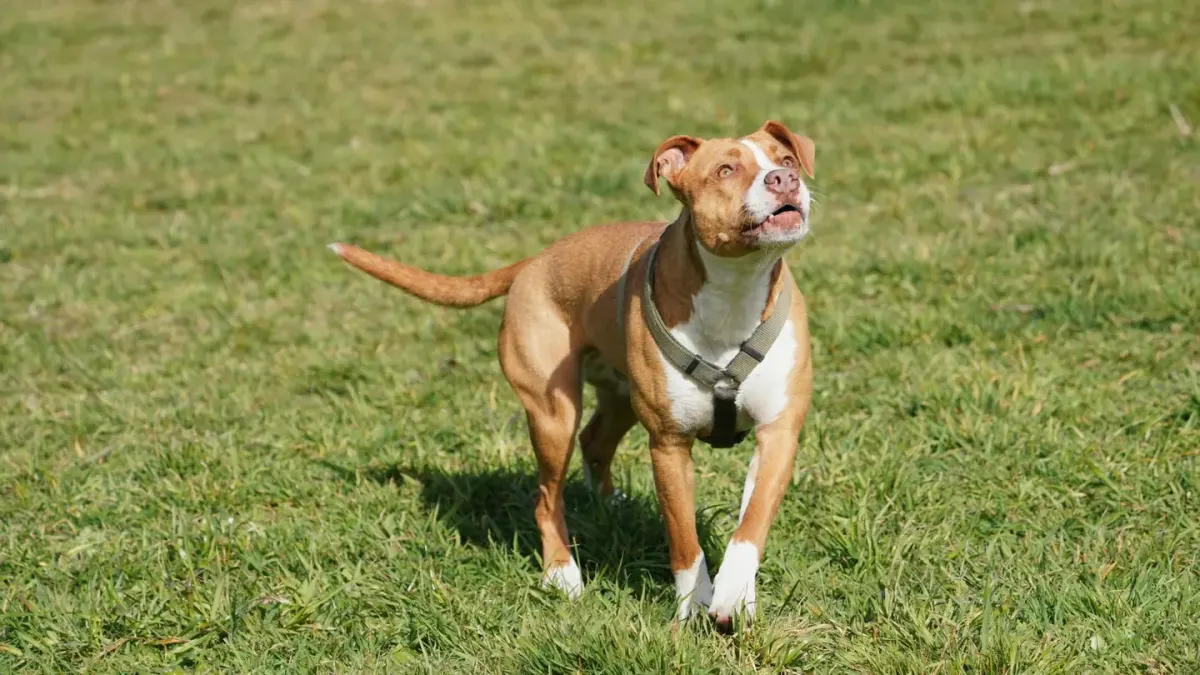
Start smaller than you think. Walk on leash for 5–10 minutes, twice daily, on level ground. Keep the pace conversational — your dog should be able to sniff and walk without panting hard. Add 2–3 minutes per walk every three to four days if next-morning stiffness does not worsen.
Follow each walk with three step-ordered basics:
- Warm up for two minutes with slow marching on grass.
- Do 5–8 sit-to-stands on a non-slip surface, with rests between reps.
- Finish with 3–5 minutes of gentle sniff walking to cool down.
Stop the session if you see lagging behind, sitting down mid-walk, heavy panting that does not resolve, or increased limping the next morning. Those signs mean you overshot, not that the plan failed.
The second week is where owners usually push too far. A 6-year-old, 44-pound mixed-breed dog in a ground-floor apartment did beautifully on 10-minute loops for nine days, so the owner added a 30-minute riverside walk on a Saturday. Three weeks in sounds patient on paper, but that single jump tripled duration and added uneven bank terrain. The dog came home toe-touching on the right hind and needed three days of strict rest and shorter outings to reset. We returned to 12-minute walks, added cavaletti poles made from broom handles on grass twice weekly, and only then rebuilt duration by about 10% per week.
Water, traction, and strength without steps
Once flat walks are steady, rotate in one low-load modality at a time. Underwater treadmill with a rehab professional is ideal because water unloads weight while preserving gait pattern. If that is unavailable, try chest-deep wading in calm water for 5 minutes, with a well-fitted harness and secure entry that needs no steps.
At home, prioritize traction and core control. Lay a 10-foot runner from bed to door. Use a ramp at 18 degrees or less for the car. Practice weight-shifting by gently rocking the pelvis side to side while the dog stands square for 10 seconds, rest, and repeat three times.
For ideas on building duration safely in deconditioned dogs, compare notes with how to build up exercise for a rescue dog with no fitness history and how to exercise a dog with no yard. If fetch is the temptation, read why repetitive sprinting loads joints differently in fetch vs. structured walks.
Where food and joint ingredients fit
Exercise does the mechanical work; nutrition sets the ceiling for diet, mobility, and recovery. I weigh what a supplement can realistically do here: it does not replace weight management, traction, or graded activity, but it may help support the joint environment those efforts depend on.
The evidence is ingredient-specific and bounded. Chondroitin research is often summarized as supporting joint structures, with one recent review noting it “supports healthy synovial fluid homeostasis,” as reported in Frontiers in Veterinary Science. Glucosamine work is largely preclinical, including findings that it can “prevent experimentally induced cartilage degradation in vitro,” as described in the Journal of Veterinary Medical Science. Green-lipped mussel contains omega-3 fatty acids and glycosaminoglycans studied for joint support, and one mechanistic paper reported that “BMO, GMO, and KO all alleviated paw swelling in rats and reduced serum levels of rheumatoid factor (RF), anti-cyclic citrullinated peptide (anti-CCP) antibody, and pro-inflammatory cytokines such as TNF-α and IL-17,” per Nutrients.
That is thin to mixed for clinical outcomes in dogs, which is why I ground an integrative claim in the nutritional evidence rather than promise improved mobility. Keep the diet complete and lean, keep omega-3 intake consistent if your veterinarian recommends it, and judge any joint product by label transparency and consistent dosing over 4–6 weeks alongside the exercise log.
The edge case owners miss is the dog that looks better because it moved less, not because it healed. A 12-year-old, 18-pound terrier mix stopped attempting stairs after we gated them, and for two weeks the owner reported success because there was no crying or slipping. On exam the thigh circumference had dropped and the dog struggled to rise from a low bed — disuse, not comfort. We raised the bed to stifle height, resumed 6-minute level walks twice daily plus supported stands, and tracked stands rather than stairs as the marker. By week four rise time shortened and the dog initiated play again, a reminder to measure strength on flat ground once stairs no longer test it.
Ask your veterinarian promptly if there is sudden inability to rise, new knuckling, loss of bladder control, vocalizing in pain, or swelling and heat in a joint. Those findings change the plan from conditioning to diagnosis.
Frequently asked questions
What is the best low-impact exercise if my dog cannot do stairs at all?
Short, leashed walks on level grass plus sit-to-stands and traction improvements. Add wading or rehab treadmill only after flat walks are tolerated without next-day soreness.
Should I carry my dog up the stairs?
Avoid repeated carrying on steep stairs if you can gate access and live on one level. Use a low-angle ramp with traction and a support harness for unavoidable steps, and ask your vet about the safest handling for your dog's size.
How do I know I am pushing too hard?
Watch for lagging, sitting down mid-walk, prolonged panting, or worse stiffness the next morning. Hold or step back duration for several days when those appear.
Sources
- Synovial homeostasis review — Frontiers in Veterinary Science
- Cartilage degradation in vitro study — Journal of Veterinary Medical Science
- Mussel oil anti-inflammatory mechanisms — Nutrients