Off-Leash Play vs On-Leash Walks: Which Actually Exercises Your Dog's Joints Better?
A veterinary nutritionist compares off-leash play and leash walking for joint health, energy expenditure, and injury risk, with a practical weekly split.
Off-leash play builds range of motion and cardio fitness fast; leash walks build the low-impact, controllable mileage most joints need every day.

On this page
A ten-month-old Vizsla I treated for a mild toe sprain had never once worn a leash off her own property. Her owner ran her three miles a day around the neighborhood, on pavement, at a steady clip — and separately let her rip around a fenced field on weekends. The sprain didn’t happen on the field. It happened on a leash walk, when she planted a foot wrong lunging at a squirrel and her owner’s hand held the other end of that momentum. That’s the piece people miss when they ask me which is “better” for exercise. The leash itself changes the physics of how a joint absorbs force.
Neither format wins outright. Off-leash play and on-leash walking exercise a dog differently enough that most healthy adult dogs benefit from both in a normal week, and the right ratio depends on age, joint history, and what the dog actually does when you unclip the leash.
What each format actually asks of a joint
A leash walk is close to a metronome. Speed is roughly constant, direction changes are gradual, and the dog’s owner is effectively a governor on top speed and sudden stops. That predictability is exactly what makes it useful for a dog recovering from injury, a senior dog with early arthritis, or a young, growing large-breed puppy whose growth plates aren’t ready for repeated hard impact.
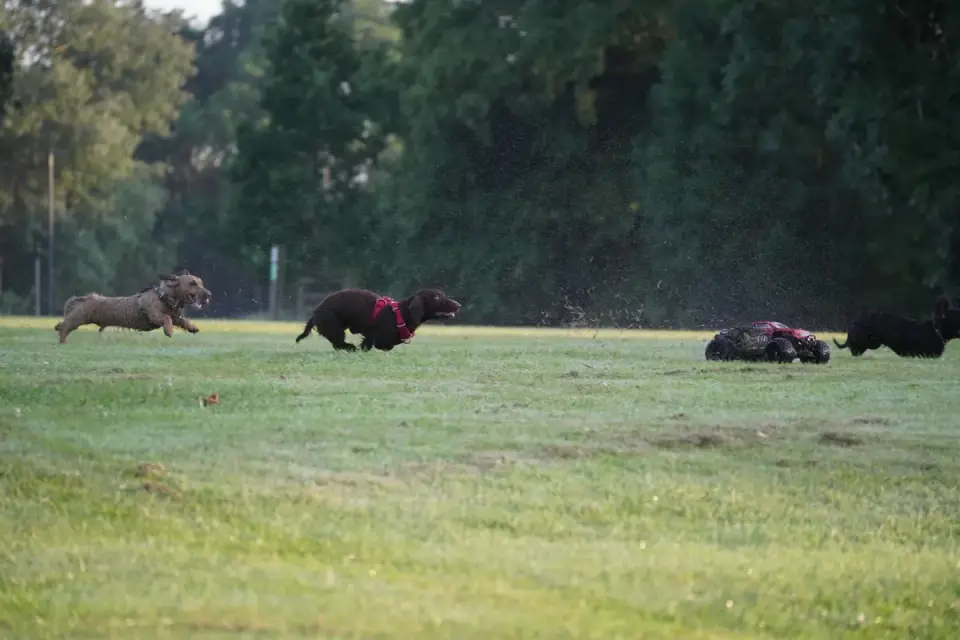
Off-leash play is the opposite. A dog chasing a ball, another dog, or a scent trail accelerates, decelerates, pivots, and jumps with no external pacing. According to the American Veterinary Medical Association, exercise can involve walking on- or off-leash and access to an area where spontaneous activity occurs, and the agency notes that a dog benefits from the opportunity to achieve a full running stride — something a six-foot leash rarely allows. That range of motion and cardiovascular load is genuinely hard to replicate on-leash. It’s also where most soft-tissue injuries happen, because the forces are unpredictable and the dog is making split-second decisions about footing.
The comparison that actually matters for a joint owner
Stop asking “which is better” and start asking these three questions instead:
- Is the dog’s cardiovascular fitness the bottleneck, or is joint tolerance the bottleneck? A fit, structurally sound adult dog usually needs the intensity off-leash play provides. A dog with hip dysplasia, prior cruciate surgery, or visible stiffness after rest usually needs the control a leash provides.
- Is the terrain and social situation actually safe for unstructured movement? Play and Exercise guidance from VCA Animal Hospitals frames exercise needs around a dog’s individual temperament and physical condition rather than a fixed leash/no-leash rule, which is the same lens I use in the exam room.
- Does the dog have the recall and impulse control to move safely without a handler setting the pace? A dog that bolts after every squirrel is a dog for whom “off-leash” mostly means unpredictable braking forces on a joint, not free-flowing exercise.
In my practice, I ask owners to describe a specific recent walk before I recommend anything. One recent visit, a nine-year-old Golden Retriever named Otis, sixty-eight pounds, had started refusing the second half of his usual forty-minute loop. His owner had assumed he was just slowing down with age, but when we talked through it, she realized the real trigger was a hard sprint after a rabbit three weeks earlier — he’d been fine that day, sore the next, and had been shortening his own walks ever since. We swapped his off-leash field time from daily to twice a week, kept the leash walks at a controlled pace, and within about a month he was finishing the full loop again without the mid-walk stall.
A joint-smart weekly rotation
For a healthy adult, mid-size dog with no diagnosed joint disease, I generally suggest something close to this split:
- Daily leash walks, 20–40 minutes, for predictable low-impact mileage and mental stimulation.
- 2–3 off-leash sessions per week in a safe, enclosed space, kept to 15–30 minutes so fatigue doesn’t erode footing quality late in the session.
- A warm-up walk before any off-leash sprinting, especially in cold weather or with a dog over seven years old, since a cold joint absorbs sudden force worse than a warmed-up one.
- A hard stop on off-leash sprinting for the first 12–18 months in large- and giant-breed puppies, per the growth-plate caution most orthopedic vets apply, in favor of leashed or self-paced walking instead.
Small and toy breeds load their joints differently again — see our Exercise Ideas for Toy and Small Breeds guide if that’s your dog. And if you’re unsure how long a session should even run before you’re pushing past useful exercise into fatigue territory, we cover that separately in How Long Should a Dog’s Walk Be?
Where supplement ingredients fit — and where they don’t
Neither format substitutes for joint tissue support, and no ingredient substitutes for choosing the right format for the dog in front of you. But the two do interact: a dog doing more unstructured, high-impact off-leash work is putting more mechanical stress through cartilage and synovial fluid, and that’s exactly the context where the evidence on joint ingredients is worth knowing rather than skipping.
Chondroitin has research behind it here. A 2026 study in Frontiers in Veterinary Science found that chondroitin supports healthy synovial fluid homeostasis — synovial fluid being the lubricant a joint depends on more heavily during the pivoting, jumping motion of off-leash play than during a straight-line walk. Glucosamine HCl has a longer research history and a narrower one: a review in the Journal of Veterinary Medical Science found it can help prevent experimentally induced cartilage degradation in vitro — a laboratory finding, not a guarantee of the same effect in a living, exercising dog, which is the kind of distinction I try to hold onto rather than round up. Green-lipped mussel has shown anti-inflammatory activity in animal models as well; a 2026 study in Nutrients reported that mussel-derived compounds reduced paw swelling and lowered inflammatory markers including TNF-α and IL-17 in a rodent arthritis model.
I don’t hand every dog with a joint the same supplement plan, and I don’t tell owners a chew replaces good exercise judgment. What I do say is that a dog logging real off-leash mileage — the sprinting, cutting, jumping kind — is a dog whose joints are working harder than a leash-walked dog’s, and that’s a reasonable moment to ask your vet whether a structure/function joint ingredient with real evidence behind it belongs in the routine.
The scene I keep coming back to
I still think about a scruffy fourteen-pound terrier mix named Pepper, whose owner brought her in convinced she was “just an anxious dog” because she wouldn’t settle after off-leash park visits. Pepper wasn’t anxious — she was sore. She’d spend forty minutes sprinting full-tilt after every dog in the park, then spend the evening restless and unable to get comfortable on the couch. Once her owner capped off-leash time at fifteen minutes and added a slower, structured leash walk in its place most days, the evening restlessness disappeared within two weeks. Nothing about Pepper’s underlying joints changed in that time. What changed was the volume of high-impact, unpredictable movement she was doing in a single sitting. That’s usually the lever that matters more than which format is “better” in the abstract — it’s how much, how hard, and how controlled.
Where this leaves owners
Pick based on the dog, not a rule. A structurally sound, well-recalled adult dog benefits from both leash walks and off-leash sessions most weeks. A dog recovering from injury, a growing large-breed puppy, or a senior with stiffness does better leaning toward leash-controlled movement, with off-leash time reserved for shorter, lower-intensity sessions. And if your walks themselves have started shrinking or your dog seems to be pacing you rather than the other way around, that’s worth a conversation with your vet before you assume it’s just age.
Frequently asked questions
Is off-leash play more tiring than a leash walk?
Usually yes, minute for minute, because off-leash play lets a dog reach full running stride and change direction freely, which raises cardiovascular demand faster than a paced leash walk.
Should senior dogs still get off-leash time?
Many can, in short, lower-intensity sessions on safe footing, but a dog with diagnosed arthritis or recent stiffness usually does better with most of their exercise controlled on a leash.
Can leash walks alone meet a dog's exercise needs?
For many dogs, yes, especially with varied pace and route, though most active adult dogs also benefit from some unstructured off-leash movement for range of motion and mental stimulation.
Sources
- Protective effects of turmerosaccharides rich extract of Curcuma longa L. in osteoarthritic dogs — Frontiers in Veterinary Science
- Glucosamine HCl and cartilage degradation — Journal of Veterinary Medical Science
- Blue mussel, green mussel, and king oyster mushroom extracts in rheumatoid arthritis models — Nutrients
- AVMA Background and Context: Model Bill — Care for Dogs Intended as Pets — American Veterinary Medical Association
- Dog Behavior and Training - Play and Exercise — VCA Animal Hospitals