Surviving Puppy Crate Crying at Night
Learn why puppies cry in their crates at night, what actually helps (and what doesn't), and a practical plan to support your puppy through this challenging phase.
Crate crying is your puppy's stress response, not defiance—here's what actually stops it.

On this page
It was past 10 p.m. when one of my clients texted. Their 12-week-old Golden Retriever, Remy, had been crying nonstop for nearly three hours. The owners had done everything “right”—crate training during the day, positive associations, a worn blanket from the litter. Yet here was Remy, howling like something was terribly wrong, while the owners sat in the living room second-guessing every decision. They were exhausted, heartbroken, and ready to give up on crating altogether. What they didn’t understand was that Remy wasn’t being difficult. She was genuinely distressed, experiencing her first real separation from littermates and her mother, in an unfamiliar room, at a time when her nervous system was flooded with uncertainty.
Puppy crate crying at night is almost always rooted in stress and fear, not stubbornness. Your puppy is experiencing genuine separation anxiety, sensory overwhelm, or both. He’s also biologically programmed to signal distress when isolated—in the wild, a pup separated from the pack is in real danger. That cry isn’t manipulation. It’s his nervous system telling him something feels unsafe.
Why Puppies Cry in Their Crates at Night
The first hours alone in a crate feel like a genuine emergency to a young puppy. His littermates are gone. His mother’s warmth is gone. The room is strange, dark, and quiet in a way he’s never experienced. He has no reference point for this isolation. Most critically, his bladder capacity is limited by his age and size, so there’s often a real physiological need tangled up in the emotional distress.
Puppies also have an immature nervous system. They cannot yet regulate stress the way older dogs do. When stress hormones spike at night, your puppy has almost no self-soothing capacity. The cry escalates because the puppy is genuinely frightened and doesn’t yet know how to manage that fear. This is developmental, not behavioral.
The Environment Matters First
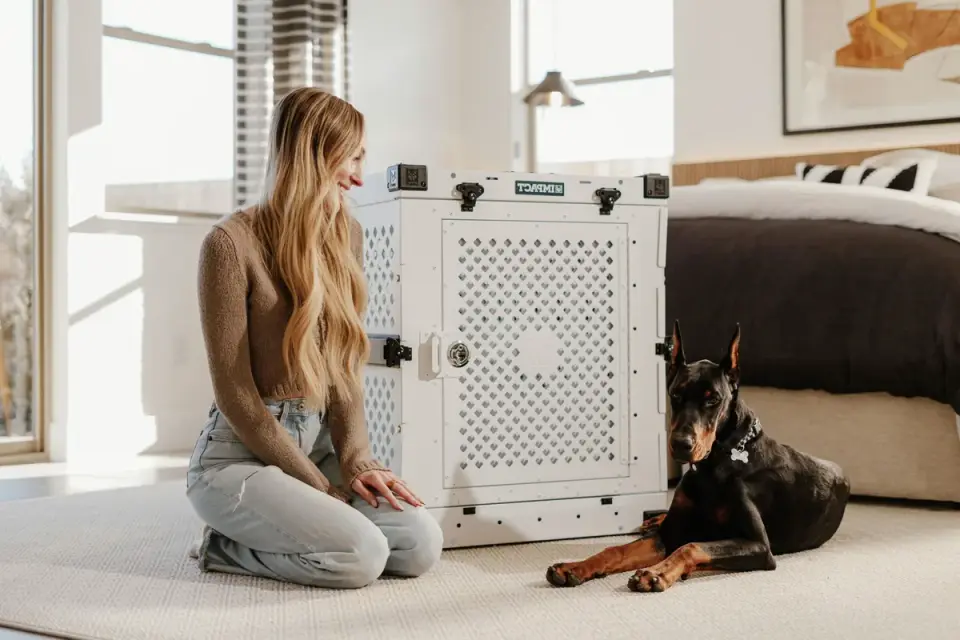
Before you add anything to help your puppy settle, build the physical foundation. The crate itself should feel like a den, not a prison. Cover three sides with a blanket to create walls. Place the crate in your bedroom, not downstairs—your puppy needs to know you’re nearby. A ticking clock or white-noise machine can replicate littermate heartbeats and mask household sounds that startle young dogs.
The timing of bedtime is also critical. Puppies cry hardest when they’re overstimulated and overtired. A hard play session before bed actually keeps a puppy’s nervous system elevated. Instead, aim for a calm wind-down: a short walk, a meal, and quiet time together an hour before sleep. This allows his nervous system to downshift rather than spike when you leave him.
The Behavioral Piece: Teaching Confidence, Not Compliance
The mistake most owners make is thinking crate crying is a training problem that requires unwavering consistency and ignoring. Consistency matters, but so does the actual reason your puppy is crying. If he’s crying from stress, ignoring him teaches him nothing except that you disappear when he’s frightened—which often deepens the anxiety.
Instead, respond to night crying strategically. If your puppy has had a potty break within the last two hours, a brief cry period (5–10 minutes) may self-settle as he learns the routine. But a prolonged cry—especially a panicked, escalating cry—signals real distress. One trip outside, calm and matter-of-fact, often breaks the cycle. Return to bed quietly. You’re not rewarding the cry; you’re addressing the legitimate stress underneath it.
Desensitization also helps. Spend daytime crate sessions building positive associations: toss treats in, leave the door open, sit nearby while your puppy naps. Let him get used to the space when he’s not exhausted and afraid. By bedtime, the crate feels less like a trap. This is particularly important if your puppy has started associating the crate with panic—undoing that association takes time but is possible.
When Calming Support Can Help
For some puppies, even a well-structured environment and gentle nighttime responses aren’t enough. If your puppy’s stress response is particularly intense—screaming rather than whining, or a pattern that hasn’t improved after two weeks—calming support can help bridge the gap while his nervous system matures and he learns to self-regulate.
Several ingredients have research backing for stress support in dogs. Biomedicines notes that chamomile has been used traditionally for relaxation support, though evidence in animals is mainly from preclinical studies rather than controlled trials. A Cureus systematic review found that ashwagandha, specifically the KSM-66 standardized form, may have moderate positive impact on stress reduction—though most research is in humans. Nature Mental Health reports that L-theanine, an amino acid from tea, has been studied for calming properties, with human studies using doses around 400 mg per day showing measurable effects.
The key word across all three is “support.” None of these are sedatives or cures for anxiety. They may help take the edge off your puppy’s stress response, making him more receptive to the behavioral and environmental changes that actually train his nervous system. For a deeper dive into comparing chamomile and l-tryptophan options, see our full ingredient guide. If you’re considering a calming supplement, discuss it with your veterinarian first—some ingredients interact with medications or carry risks for very young puppies.
I see this play out regularly in my practice. One client brought in an eight-week-old Lab mix, Milo, who had been crying in his crate for two weeks straight. The owners had tried everything—white noise, the family cat for “company” (a bad idea), sleeping with the crate door open (which just meant Milo wandered and peed on the kitchen tiles). Milo’s system was genuinely flooded. We repositioned the crate to the parents’ bedroom, simplified the bedtime routine to exclude playtime after 6 p.m., and added a gentle herbal calming blend to his evening routine. Within a week, Milo’s panic cry had downshifted to a brief whimper—still there, but no longer desperate. Within three weeks, he was settling within minutes. The calming support didn’t train him; it gave his nervous system just enough stability so the training could actually stick.

How Long Until This Improves?
Realistic timeline: two to four weeks before substantial improvement, assuming the environment and routine are solid. A puppy whose stress is well-supported may self-settle within days. One whose routine is chaotic or who has real separation anxiety may take two months or longer to feel safe.
The goal is not a puppy who never cries. The goal is a puppy whose cry downshifts from panic to mild protest, whose nervous system recovers faster between episodes, and who begins to recognize that you always come back.
When to Call a Behaviorist
If your puppy’s crate crying doesn’t improve after four weeks despite a solid routine and calming support, or if the behavior escalates into destructive panic (fence jumping, self-injury), consult a certified dog behaviorist. Some puppies do have genuine separation anxiety that requires specialized intervention. A behaviorist can also rule out medical causes—chronic pain, ear infections, or digestive issues can all trigger night crying that looks like anxiety at first glance. Additionally, if your puppy displays other signs of anxiety like growling when touched, resistance to handling, or extreme startle responses, these may indicate a broader anxiety pattern worth addressing early.
I worked with a nine-week-old English Springer Spaniel recently, Emma, whose owners were also convinced they’d made a terrible mistake with crating. Emma would cry for 20 minutes after bedtime—not with the panic I described earlier, but with a younger, more testing quality. The owners had already done the hard work: they’d moved the crate to their bedroom, they’d eliminated the evening play sessions, they’d been consistent with potty breaks. What they lacked was patience with the timeline. After three weeks, Emma’s cry had shifted to a 2–3 minute whimper. By week six, she was self-settling within 90 seconds. The owners had nearly quit at week two. The owners I see most often in my practice who succeed with crating are not the ones with the easiest puppies—they’re the ones who understand that behavioral change takes time, especially when you’re working with a nervous system that’s still developing.
Looking Ahead
As your puppy grows into adolescence and adulthood, a well-managed crate becomes one of the most valuable tools you have. A dog who trusts his crate is safer in a car, calmer at the vet, and more able to settle when life gets chaotic. The work you’re doing now—the hard nights, the strategic responses, the patience—is building that trust from the foundation. Surviving crate crying now means raising a dog who feels secure later.
Sources
- Chamomile for Anxiety & Stress — Biomedicines
- Ashwagandha Systematic Review — Cureus
- L-Theanine & Anxiety — Nature Mental Health