Walking vs. Running: Which Is Better for Your Dog's Joints?
A veterinary sports-medicine look at how walking and running load a dog's joints differently, and which one actually serves long-term mobility.
Running is not a faster version of a walk — it's a different mechanical event, and most dogs' joints are better served by more of the first and less of the second.
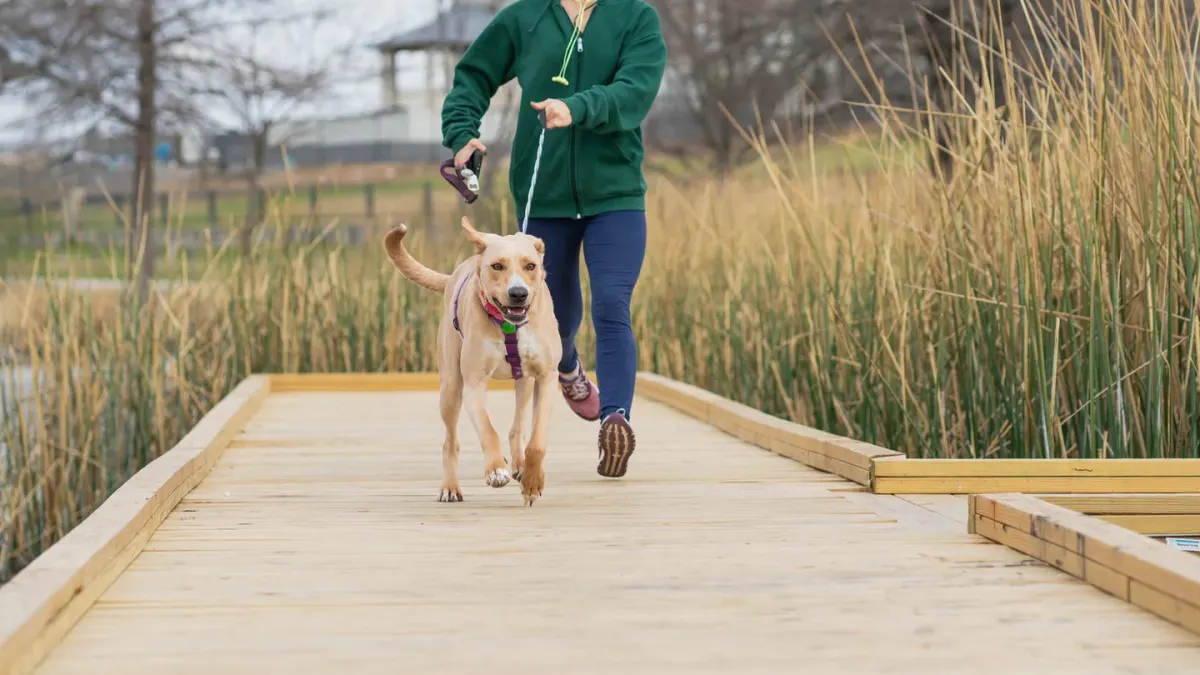
Ground reaction force during a trot runs roughly 1.5 to 2 times a dog’s body weight through each limb; during a walk, it’s closer to body weight itself. That single number explains most of what follows.
I think about that difference every time an owner tells me their dog “gets plenty of exercise” because they run three miles together most mornings. Distance isn’t the variable that matters most to a joint. Load per stride is, and running simply asks more of cartilage, tendon, and subchondral bone than walking does, stride for stride.
Two gaits, two different jobs. A walk is a four-beat gait with at least one foot on the ground at all times — there’s no true suspension phase, and peak forces stay comparatively modest. A trot or gallop introduces an airborne phase, and landing after that phase concentrates force into a shorter window of contact. The dog’s soft tissue and joint surfaces absorb that force whether or not the dog is conditioned to handle it. Puppies with open growth plates, dogs recovering from orthopedic surgery, and older dogs with early osteoarthritis are the three groups where I see this go wrong most often, because the mismatch between what the owner intends (fitness, enrichment, a tired dog at the end of the day) and what the joint actually experiences (repetitive high-force impact) isn’t visible until it already hurts.
One dog I still think about was a five-year-old Vizsla named Ranger, fifty-two pounds, whose owner ran with him five mornings a week on asphalt because that was the only time that fit her schedule. Nothing looked wrong for two years. Then, over about six weeks one winter, she noticed he was slower to get up from the kitchen floor and started declining the stairs to the bedroom he used to take two at a time. He wasn’t limping on the leash — the change only showed up in the transitions, sit to stand, floor to stairs, which is exactly where early joint pain tends to hide first. We didn’t stop running entirely, but we cut his mileage, moved most of his running to dirt trail instead of asphalt, and added structured walking days in between. The stiffness eased over the following months. That’s one dog’s course, not a study result, but the pattern — pain showing up in transitions before it shows up in gait — is one I’ve watched repeat often enough to take seriously.

Surface matters almost as much as gait. Asphalt and concrete don’t deform under a paw the way packed dirt, grass, or a rubberized track does, so every stride on hard pavement returns more of that impact energy straight back into the limb. A dog running on a sidewalk is taking a harder hit per stride than the same dog running the same speed on a trail. We’ve covered how this same logic plays out for Dog Treadmill vs. Outdoor Walking, where belt cushioning changes the equation again. For most healthy adult dogs, alternating surfaces and keeping higher-impact running sessions on forgiving ground is a simple way to keep the benefits of running without stacking all the risk onto the same joints every day.
Where does supplementation fit into this picture? It’s a fair question, and I’d rather be precise than promotional about it. Glucosamine and chondroitin are among the most studied joint-support ingredients for dogs, and the research on each addresses a specific piece of joint physiology rather than the whole problem. A 2026 paper in Frontiers in Veterinary Science found that chondroitin supports healthy synovial fluid homeostasis — relevant because synovial fluid is what lubricates and nourishes the joint surfaces that absorb repetitive load. A review in the Journal of Veterinary Medical Science reported that glucosamine HCl can help prevent experimentally induced cartilage degradation in vitro, which speaks to cartilage protection at the cellular level rather than to pain relief you’d notice day to day. And in Nutrients, researchers studying green-lipped mussel extracts found that the mussel oil, glycolipid, and ketone fractions all alleviated paw swelling in an arthritis model and reduced markers of inflammation, including TNF-α and IL-17 — evidence of an anti-inflammatory mechanism worth noting, even though that specific study wasn’t done in dogs. None of that is a substitute for managing gait, surface, and mileage; it’s a complement to those decisions, and I’d weigh what a supplement can realistically do for a dog’s diet, mobility, and recovery before I’d lean on it as the main lever. The honest summary is that the mechanical choices — how far, how fast, on what surface, at what age — still do more for a joint than any ingredient on a label.
Owners often ask me to just pick a winner, and I understand the appeal of a simple answer. I’ll give one, with a caveat. For the average companion dog, walking should be the daily baseline and running, if the dog enjoys it and is built for it, is something layered on top in moderation rather than the default mode of exercise. The counterargument worth taking seriously is that plenty of dogs — working breeds, young athletic dogs, dogs bred for endurance — are genuinely under-exercised by walking alone, and restricting them to slow leash walks trades one problem (joint load) for another (frustration, weight gain, behavioral issues from pent-up energy). That’s a real tradeoff, not a strawman. My answer to it is that the fix for an under-exercised athletic dog isn’t unlimited running, it’s more walking volume, off-leash time on soft ground, and structured play, with running used deliberately rather than as the only outlet.
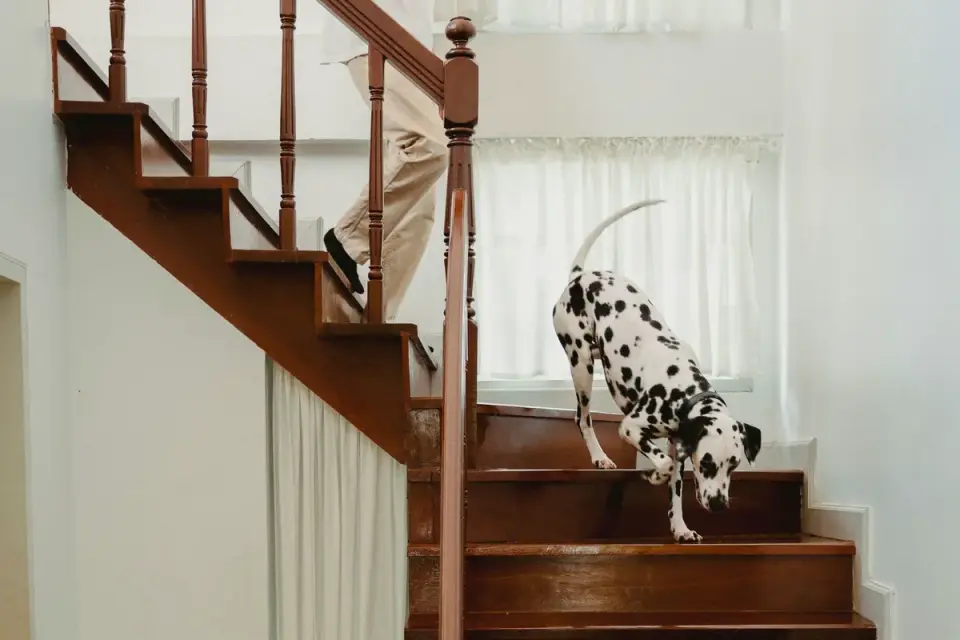
I keep coming back to a version of Ranger’s case whenever a new client tells me their running routine is the whole exercise plan. The dog is almost always fine on paper — good weight, good energy, no obvious limp. It’s the small things, the hesitation on the stairs, the slower rise from the bed, that tend to arrive first. If you run with your dog, I’d rather you keep doing it thoughtfully than stop out of caution: choose softer surfaces when you can, watch how your dog moves in the twenty minutes after a run rather than during it, and treat how long a walk should be as the more reliable daily baseline, with running as the deliberate addition on top of it, not the substitute for it. For dogs already showing joint changes, exercise ideas for toy and small breeds covers how to scale activity down without losing the enrichment a run provides. The mechanics don’t change with age, but the margin for error does.
Frequently asked questions
Is running bad for a dog's joints?
Not inherently, but running places substantially more force through each limb than walking does, so it needs to be introduced gradually, on forgiving surfaces, and matched to a dog's age and orthopedic history.
How old should a dog be before running long distances?
Most dogs shouldn't run significant distances until their growth plates have closed, which varies by breed size, generally somewhere between 9 and 18 months for medium to large breeds.
Can joint supplements replace exercise management for an active dog?
No. Ingredients like glucosamine, chondroitin, and green-lipped mussel target specific aspects of joint physiology, but managing mileage, surface, and pacing does more to protect a joint over time than any supplement alone.
Sources
- Protective effects of turmerosaccharides rich extract of Curcuma longa L. in osteoarthritic dogs — Frontiers in Veterinary Science
- Glucosamine HCl and Cartilage Degradation: A Review — Journal of Veterinary Medical Science
- Blue Mussel Oil, Green Mussel Oil, and Ketone Fractions in Adjuvant-Induced Arthritis — Nutrients