When Can a Dog Exercise Again After Being Spayed or Neutered?
A veterinary nutritionist explains the physiology behind post-spay and post-neuter activity restrictions, why the standard timeline exists, and how to judge when a dog is actually ready to run.
Most dogs need roughly two weeks of restricted movement before running again after being spayed or neutered, but the incision, not the calendar, decides.
On this page
A twenty-nine-pound spayed Australian Shepherd named Junie came in for her ten-day recheck with a torn suture line and an owner who was, understandably, mortified. Nothing dramatic had happened. Junie had simply seen a squirrel through the sliding door on day eight, and the leash wasn’t attached yet. The incision had looked closed on day six, which is exactly the problem: it looked closed before it was closed.
That gap between how an incision looks and what’s happening underneath it is the entire reason “when can my dog run again” doesn’t have a one-line answer, even though owners deserve one. Here’s the honest version.
Most healthy adult dogs can return to running and off-leash play around ten to fourteen days after a routine spay or neuter, once the incision has fully sealed and any swelling has resolved — but the timeline bends for puppies, large-breed dogs, and anything beyond a straightforward procedure.
What’s Actually Healing Under the Skin
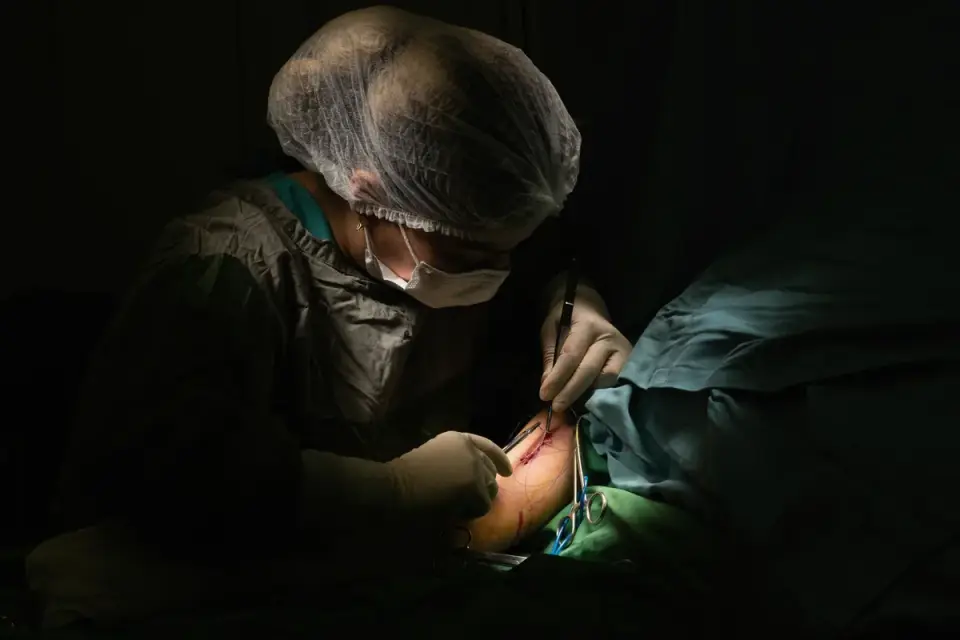
A spay (ovariohysterectomy) or neuter (orchiectomy) is abdominal or inguinal surgery, not a skin nick. In a spay, the surgeon enters the abdominal wall itself, and that linea alba incision needs to regain tensile strength before it can tolerate the intra-abdominal pressure spikes that come from sprinting, jumping, or a hard twist chasing a ball. Skin typically seals within about three to five days. The muscle and fascia underneath take longer — most of the early tensile strength returns over the first two weeks, which is why the visible incision looking “done” on day six is misleading. A neuter is generally less invasive, since it doesn’t cross the abdominal wall, and many male dogs recover faster, but scrotal or inguinal swelling still needs to fully settle before hard exercise resumes.
This is also why vets restrict jumping specifically, not just running. A dog going airborne off a couch generates far more abdominal load in that split second than a dog trotting across a yard. It’s the acceleration, not the distance, that stresses a healing incision.
The Restart Curve I Use With Clients
In my practice, I don’t give owners a single date and send them off. I give them a curve. Days one through three: leash walks to the yard and back, nothing more, because this is when swelling peaks and dogs feel deceptively normal on pain medication. Days four through ten: short, flat leash walks, gradually longer, with zero off-leash time and zero stairs beyond what’s unavoidable. Around day ten to fourteen, if the incision is fully closed, dry, and non-swollen at recheck, I clear dogs for a gradual return to normal activity over another week — not a switch flipped from “restricted” to “sprinting,” but a ramp.
The dogs who blow this timeline are almost always the ones who feel great early. Pain control is good enough now that a three-year-old Labrador can be pain-free and still have an unhealed abdominal wall. That mismatch between how the dog feels and what the tissue can tolerate is the actual clinical problem, and it’s why the fourteen-day window exists as a floor, not a suggestion.
Puppies and Large Breeds Change the Math
A four-month-old spayed or neutered puppy heals skin fast but is a different risk profile than a mature adult, mostly because puppies do not yet have the judgment to self-limit and because early spay/neuter is increasingly timed around growth-plate closure in large and giant breeds. That’s a separate conversation from incision healing, but it matters here: a large-breed puppy recovering from a spay may also be under longer-term activity guidance related to skeletal development, not just the surgical site. If your dog is a growing large breed, ask your vet whether the post-op restriction and the growth-plate guidance are the same timeline or two different ones — they’re often not.
The Evidence on Supporting a Joint That’s Already Under Load
None of this is about joint supplements fixing a slow recovery — it isn’t a substitute for surgical healing time, and no ingredient shortens incision closure. But owners of dogs with existing joint sensitivity, or dogs returning to running after a longer restriction period than usual, often ask what the research actually supports once activity resumes. The evidence base here is real but bounded. A 2026 study in Frontiers in Veterinary Science found that chondroitin “supports healthy synovial fluid homeostasis,” which is a structural claim about joint lubrication, not a claim about surgical recovery speed. A review in the Journal of Veterinary and Medical Science found glucosamine HCl helped “prevent experimentally induced cartilage degradation in vitro” — laboratory evidence about cartilage protection, not a clinical outcome trial in recovering dogs. And research published in Nutrients on green-lipped mussel extracts found the compounds “alleviated paw swelling in rats and reduced serum levels of rheumatoid factor (RF), anti-cyclic citrullinated peptide (anti-CCP) antibody, and pro-inflammatory cytokines such as TNF-α and IL-17” — again, an animal inflammation model, not a study of post-surgical dogs specifically.
I weigh these the way I weigh any supplement claim against a diet and recovery plan: the mechanism is credible, the dose-response data in dogs recovering from soft-tissue surgery is thin, and none of it changes the fourteen-day rule. If a dog already has joint sensitivity going into the surgery, that’s a conversation to have with your vet before, not instead of, following the incision-healing timeline.
The Dog I Still Think About
Junie healed fine, in the end — a second, tighter closure and another two weeks of leash-only walks did it. But I think about her owner more than I think about the suture. She’d done everything right for eight days and then had one unguarded moment, because nobody had told her that “looks healed” and “is healed” are different facts about the same incision. That’s the piece I try to hand every owner now: not just a date, but the reason the date exists, so a good ten days doesn’t get undone by one open door.
If you want a broader framework for how much activity is appropriate as a dog reconditions, How Long Should a Dog’s Walk Be? is a reasonable next stop, and for dogs recovering from anything more involved than a routine spay or neuter, At-Home Physical Therapy for Dogs covers when a structured rehab program is worth the referral. Owners of small or toy breeds navigating the same restrictions often find Exercise Ideas for Toy and Small Breeds useful once off-leash activity resumes.
Bottom Line
Ten to fourteen days of genuinely restricted activity, cleared by a recheck exam rather than a calendar guess, is the standard that protects the abdominal wall or inguinal site while it regains real strength. Puppies and large-breed dogs may need a longer or separately timed plan. Joint-support ingredients like chondroitin, glucosamine, and green-lipped mussel have credible mechanistic evidence for joint tissue generally, but none of it substitutes for that healing window — and no supplement earns a dog an earlier return to running than the incision allows.
Frequently asked questions
How soon after a spay can my dog go for a walk?
Short, leashed potty walks are typically fine within the first few days, but longer or off-leash walking should wait until your vet clears the incision, usually around the ten- to fourteen-day recheck.
Is a neuter recovery faster than a spay recovery?
Often yes, since a neuter doesn't involve entering the abdominal wall, but swelling still needs to fully resolve before hard exercise resumes, and your vet's clearance still matters more than the calendar.
What happens if my dog runs too soon after being spayed?
The incision or the underlying tissue can reopen or herniate, which is more likely when swelling and pain medication mask how unhealed the area still is.
Sources
- Chondroitin sulfate and synovial fluid homeostasis — Frontiers in Veterinary Science
- Glucosamine HCl and experimentally induced cartilage degradation — Journal of Veterinary and Medical Science
- Blue Mussel, Green Mussel, and Extract Effects in an Arthritis Model — Nutrients