Helping a Dog Who Is Scared of Other Dogs on Walks
A vet's guide to why some dogs freeze, bolt, or lunge at other dogs on leash, how to tell fear from frustration, and what actually helps.
A dog scared of other dogs on walks needs a plan, not just distance and hope.
On this page
Scout came into my exam room on a Tuesday afternoon, a twenty-eight-pound terrier mix, about three years old, adopted from a county shelter four months earlier. His owner described the same scene on repeat: partway down the block, Scout would suddenly plant his feet, drop his weight low, and refuse to move until the other dog passed. If the other dog got too close too fast, he’d lunge and bark. It had started small, maybe six weeks after adoption, and by the time I saw him the owner had stopped walking him on their usual route entirely.
That pattern, a dog who was fine on day one and increasingly reactive by week eight, is one of the more common stories I hear in practice, and it’s rarely about a single bad encounter. It’s usually a leash, a narrow field of view, and a dog who has learned that other dogs mean something unpredictable is about to happen.
Reading Fear Correctly: Fear vs. Frustration on Leash
The first thing I sort out with an owner is whether we’re looking at fear or frustration, because the two look similar at a glance and need different plans. A frustrated dog usually wants to get to the other dog and is blocked by the leash; the body language leans forward, the tail is often high and stiff, and the dog may whine as much as bark. A fearful dog wants distance, not contact. Watch for the tail tucked low, weight shifted backward even while the head faces forward, ears pinned, and a closed mouth or lip-licking before any noise happens. Some dogs freeze first and escalate to barking only when the other dog keeps closing the gap.
This distinction matters for the plan. A frustrated, leash-reactive dog often does better with structured greetings and impulse-control work. A fearful dog needs the opposite: more distance, not less exposure, and a slower path back toward comfort. Confusing the two is one of the most common reasons a well-intentioned training plan stalls out. If you’re not sure which you’re seeing, Barrier Frustration vs Aggression: What’s the Difference in Dogs on Leash? walks through the specific tells side by side.
Why the Leash Itself Makes Fear Worse
Off leash, a nervous dog can create space on its own terms: veer wide, circle, or simply walk away. On leash, that option disappears. The dog is tethered to a human moving at a fixed pace toward whatever is making it uncomfortable, and the only tools left are freezing, backing up against the leash’s resistance, or making a loud display to get the other dog to back off first. Owners often read the barking and lunging as aggression, but in a genuinely fearful dog it’s more accurately a last-resort request for space that the leash won’t allow.
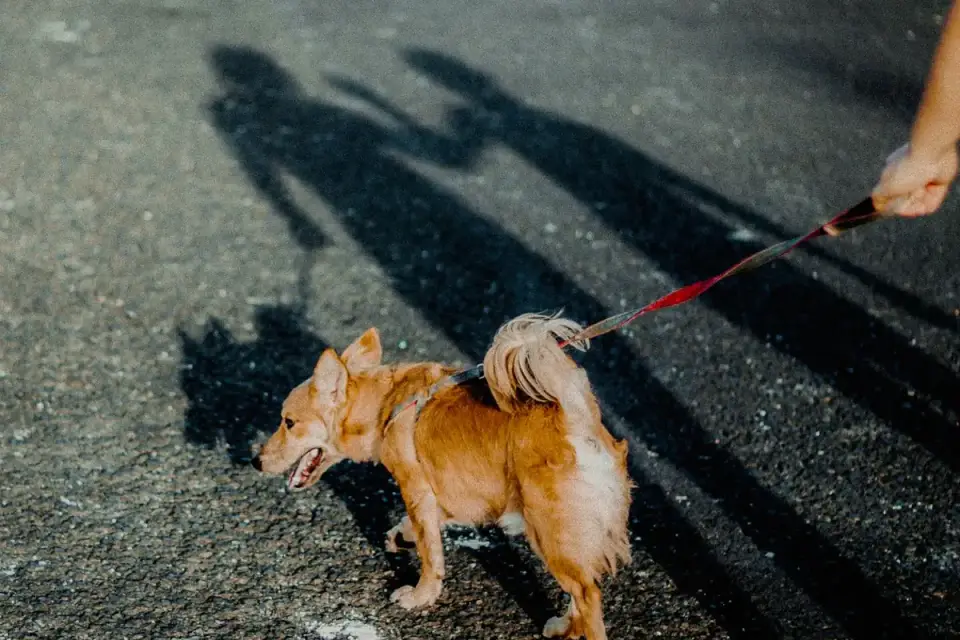
Owners sometimes tighten the leash reflexively when another dog appears, which transmits their own tension straight down the line and adds to the dog’s read that something is wrong. A loose leash, a wide arc around the other dog, and a calm, unhurried voice do more in that moment than any correction.
Ruling Out Pain and Medical Causes First
Before I settle on a purely behavioral plan, I want to know whether a dog’s reactivity is new, and if so, what changed physically around the same time. I saw this play out with a seven-year-old Shih Tzu named Mochi, fourteen pounds, whose owner brought her in because she’d started snapping at approaching dogs on their evening walks, something she’d never done in six years. On exam, Mochi had reduced range of motion in both hips and mild discomfort on extension, consistent with early osteoarthritis. Once we addressed the joint pain, her tolerance for other dogs on the sidewalk improved within a few weeks, though her owner still kept greetings brief and on her terms. A dog in pain has a shorter fuse and a stronger incentive to keep other dogs from getting close, because a bump or a rough greeting hurts more than it used to.
Any sudden onset of reactivity in a dog with no prior history deserves a physical exam before it gets labeled purely behavioral, especially in older dogs, larger breeds, or dogs who’ve had a recent limp, stiffness after rest, or reluctance to jump.
Calming Ingredients: Where the Evidence Is Solid and Where It’s Thin
Owners often ask whether a calming chew or supplement can take the edge off before a walk. The honest answer is that some ingredients have real support behind them, and some don’t, and it’s worth knowing which is which rather than treating the category as one thing.
L-theanine, an amino acid found in tea, has been studied for its calming properties, and in the human anxiety literature reviewed in Molecular Psychiatry, one study on psychotic anxiety found a moderate effect size at 400 mg per day over eight weeks. That’s a human dose in a specific population, not a canine one, so it tells us the mechanism is plausible rather than proving anything about dogs on a sidewalk. Ashwagandha has a somewhat firmer evidence base: a systematic review in Cureus covering multiple randomized controlled trials concluded that ashwagandha has a moderate positive impact on stress reduction and cognitive performance. Chamomile is the most traditional of the three, and the honest limitation is that a recent review in Biomedicines notes that for most species, the evidence is derived mainly from preclinical studies or traditional use rather than controlled trials.
Here’s the tradeoff I lay out for owners: a well-chosen calming supplement may help take the edge off a dog’s baseline stress, but it will not teach a dog that other dogs are safe, and it won’t fix a leash-handling habit that’s making things worse. Structure/function support and behavior modification aren’t competing options; they’re different layers of the same plan, and the layer that changes the dog’s actual experience of walks is the behavioral one.
The Plan I Give Owners, Step by Step
I keep this simple on purpose, because a plan with twelve steps rarely survives a rainy Tuesday.
Start below the dog’s reaction threshold. That means walking at whatever distance from other dogs lets your dog notice them without freezing, lunging, or shutting down, even if that distance feels absurdly large at first. Pair that distance with something the dog genuinely wants, delivered the moment they notice another dog and stay under threshold, not after they’ve already reacted. Over days and weeks, as the dog handles a given distance calmly and consistently, close the gap in small increments rather than big jumps. Watch the dog’s body language throughout, not just their behavior, since a dog can be technically quiet while still showing tucked tails, pinned ears, or whale eye, the whites of the eyes showing in a sideways glance, which usually means they’re still uncomfortable and just not vocalizing it. What Does Whale Eye Mean in Dogs? is worth a look if you’re unsure whether your dog is actually relaxed or just holding still.
Realistic timelines matter here. Most owners see meaningful change over six to twelve weeks of consistent, below-threshold work, not days, and dogs with a longer history of reactivity or a rougher early-life experience with other dogs often need longer. Setbacks after a bad encounter are normal and don’t mean the plan failed.
If a dog’s fear response includes real aggression, a bite history, or doesn’t budge with consistent below-threshold work, that’s the point to bring in a certified trainer or veterinary behaviorist rather than pushing through alone.
Where This Settles
Six weeks after that first visit, Scout’s owner sent an update: he could now hold a sit at about thirty feet from another dog on the same sidewalk without freezing, something that would have triggered a full reaction at week one. They weren’t approaching other dogs yet, and that was fine; the goal wasn’t proximity, it was a dog who could notice another dog and keep functioning.
That’s the outcome I aim for with fearful dogs on leash: not a dog who suddenly loves other dogs, but one who can walk past them without their whole nervous system going off. Distance, patience, and ruling out pain get a dog there more reliably than any single product ever will. A dog who suddenly growls in other contexts, like being touched or petted, is worth a separate look too; Why Does My Dog Growl When I Pet Him? covers a related but distinct pattern.
Frequently asked questions
Is a dog scared of other dogs on walks the same as being aggressive?
Not usually. Fearful dogs want distance and show tucked tails, low posture, and pinned ears, while aggression driven by frustration often looks more forward and stiff-bodied. The distinction changes which training approach helps.
How long does it take to help a dog who's scared of other dogs?
Most owners see meaningful change over six to twelve weeks of consistent, below-threshold walks, though dogs with a longer history of reactivity may need more time.
Should I see a vet if my dog suddenly becomes scared of other dogs?
Yes, especially if the fear appeared suddenly with no clear trigger, since new pain, particularly joint pain in older or larger dogs, can lower a dog's tolerance for other dogs getting close.
Sources
- Ashwagandha and stress: a systematic review of randomized controlled trials — Cureus
- L-theanine and anxiety: a review of clinical evidence — Molecular Psychiatry
- Chamomile and its role in anxiety and stress: a review — Biomedicines