How to Build a Consistent Daily Walking Routine
A practical, evidence-grounded guide to designing a daily dog walking routine that fits real schedules, protects joints, and adapts as a dog ages.
Consistency beats duration — a dog that walks 20 honest minutes every day is better off than one saved for a marathon Saturday.

On this page
A twelve-week-old goldendoodle and a nine-year-old Lab mix have almost nothing in common physically, but I get some version of the same question from both owners in a single week: how much should we be walking, and how do we make it stick? Usually the answer isn’t about finding more time. It’s about building a routine simple enough to survive a rainy Tuesday, a work trip, or a dog having an off day.
I’ll give you the verdict first, then walk through why. The routine that actually holds up long-term is short, frequent, and built around your dog’s real signals — not a fixed mileage goal, not a weekend catch-up walk, and not a plan copied from a dog twice the size or half the age of yours. Frequency protects joints and behavior more than length does; a dog that gets out twice a day for fifteen minutes is doing more for its body and mind than one that gets a single exhausting hour every Sunday.
What a Daily Routine Actually Needs to Cover
Before you pick times and distances, it helps to know what you’re actually optimizing for. A working routine needs to satisfy four things at once, and most routines that fall apart are missing one of them:
- Frequency you can repeat without willpower. A schedule that depends on motivation collapses within a month. One that’s tied to an existing habit — coffee, the first email check, dinner prep — tends to survive.
- A pace and surface matched to the dog’s joints. Concrete sprints and a senior dog’s hips don’t mix the same way grass and a measured pace do.
- Room to shorten without guilt. A routine with only one setting (the full 40-minute loop) gets skipped entirely on bad days. One with a five-minute backup version gets kept.
- A way to notice change. Stiffness after rest, hesitation on stairs, a slower sit — these show up on a walk before they show up anywhere else.
That last point is worth sitting with. According to the American Kennel Club, most dogs in good body condition can tolerate a daily 20 to 30-minute walk, and one or two walks a day is generally the right cadence — but the AKC is also clear that breed, age, and health status change that baseline. A routine built for a healthy three-year-old terrier is not the routine for the same dog at ten.
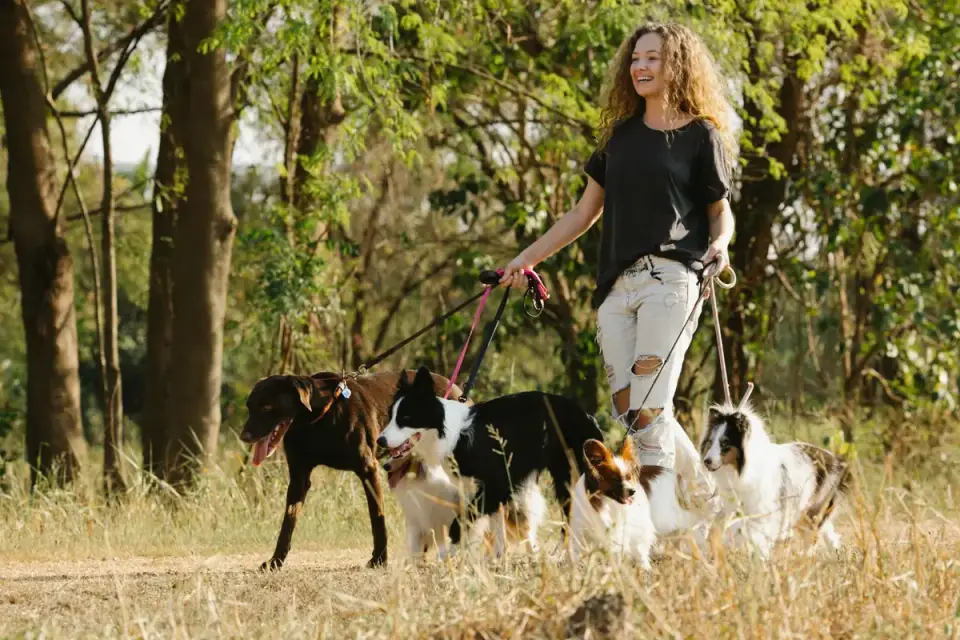
Setting the Frequency, Duration, and Pace
Start with frequency, not distance. Two shorter walks spaced through the day do more for a dog’s joints and behavior than one long walk, because they break up long stretches of inactivity that stiffen joints and because they give a dog more chances to relieve themselves, sniff, and settle. VCA Animal Hospitals notes that exercise strengthens muscles and joints while also helping manage weight — and weight is arguably the single biggest modifiable risk factor for joint stress a walking routine can address.
Duration should scale up gradually, especially for puppies and dogs returning from an injury or a long sedentary stretch. A dog that hasn’t walked regularly in months shouldn’t jump straight to 45 minutes because the calendar says “start today.” Build in ten-minute increments over two or three weeks and watch how the dog recovers the next morning — not just how they perform during the walk itself.
Pace matters more than most owners expect. A brisk, steady pace on a flat surface is lower-impact than a stop-and-start walk full of sudden lunges toward squirrels, and it’s dramatically lower-impact than letting a dog free-run on hard pavement. If your dog’s routine includes off-leash time, structured walks generally load the joints more predictably than fetch or park chaos, which is worth knowing if you’re managing a dog with any early joint concerns.
Reading Your Dog’s Signals Instead of the Calendar
This is the part that separates a routine that protects a dog from one that just exercises them on autopilot. A slower pace on stairs, a longer pause before jumping onto the couch, sitting instead of lying down after a walk — these are worth logging, even informally. Canine Arthritis Resources and Education recommends adjusting activity based on how a dog moves after rest, not just during activity, because post-exercise stiffness is often the earliest sign that a routine needs modifying.
If you’re weighing whether a dog park, a treadmill, or plain sidewalk walking fits your routine better, the honest answer is that surface and control matter as much as the activity itself — a controlled walk gives you far more information about your dog’s gait than a dog park sprint does, because you can actually watch how they move.
A dog with diagnosed joint disease needs a different conversation entirely, and swimming can sometimes serve as a lower-impact substitute or supplement to walking for dogs whose joints can’t tolerate repetitive ground-contact exercise. That’s a decision to make with your veterinarian, not from a blog post — but it’s worth knowing the option exists before you assume walking is the only tool available.
A Routine That Held Up Through a Bad Year
I worked with a nine-year-old Lab-shepherd mix named Duke whose owner worked rotating shifts at a hospital. The walking routine they’d had for years — a long loop most evenings — fell apart within weeks of the new schedule. What we rebuilt instead was smaller: two ten-minute walks, one right after whichever shift she’d just finished, timed to the same fifteen-minute window regardless of whether that was 7 a.m. or 9 p.m. No mileage goal, no weekend catch-up walk. Within about six weeks, she told me Duke’s morning stiffness — the reason we’d started tightening things up in the first place — was showing up less often, and he was taking the porch steps without the pause he’d developed that spring. I don’t present that as a study result; it’s one dog, one owner, one imperfect schedule that worked because it matched her actual life instead of an ideal one. But it’s the pattern I see most often: routines that survive are the ones built around the schedule a person already has, not the one they wish they had.
Where Supplements Fit — and Where They Don’t
Owners often ask whether a joint supplement should be part of the routine itself, especially once a dog starts slowing down on walks. I think it’s worth being precise about what the evidence actually supports here, because it’s easy to oversell this category. Glucosamine and chondroitin remain among the most studied joint-support ingredients for dogs, and the research base, while not uniformly strong, is more substantive than for most supplement categories. A recent review found glucosamine HCl may help prevent experimentally induced cartilage degradation in vitro, according to the Journal of Veterinary Medical Science — evidence that’s mechanistic rather than a guarantee of outcome in a walking dog. Chondroitin has similarly been studied for its role in supporting healthy synovial fluid homeostasis, per Frontiers in Veterinary Science. Green-lipped mussel extract has shown anti-inflammatory activity in animal models, with Nutrients reporting that mussel-derived compounds “alleviated paw swelling in rats and reduced serum levels of rheumatoid factor (RF), anti-cyclic citrullinated peptide (anti-CCP) antibody, and pro-inflammatory cytokines such as TNF-α and IL-17.”
What I’d weigh against that: none of these findings translate to a promise that a supplement will make a specific dog’s walk more comfortable, and no supplement substitutes for the two things that actually move the needle — appropriate weight and a consistent, joint-matched exercise routine. A supplement is a reasonable addition to a routine that’s already sound; it isn’t a fix for one that isn’t. If your dog is already showing gait changes, that’s a conversation for your veterinarian first, a supplement second.
Building It Into a Week You’ll Actually Keep
If you’re starting from nothing, don’t design the perfect routine — design the one you’ll still be doing in March. Pick two fixed time windows tied to something you already do daily. Start at ten to fifteen minutes per walk if your dog isn’t currently active, and add time only after the dog recovers well from the current load for a full week. Keep a five-minute backup version for bad-weather days so the streak doesn’t break, because a broken streak is usually where routines actually die. And once a week, actually watch how your dog moves in the twenty minutes after the walk ends — that’s where the early signs show up, long before anything else tells you a routine needs adjusting.
If your dog already has a joint diagnosis or you’re unsure what pace is appropriate, core-strengthening work alongside walking can help build the trunk stability that supports a dog’s gait — but that’s a layer to add once the daily walk itself is dependable, not before.
Frequently asked questions
How long should a daily dog walk be?
Most healthy adult dogs do well with 20 to 30 minutes per walk, once or twice a day, though this varies with breed, age, and health status — the AKC notes this should be adjusted for individual dogs rather than treated as a fixed target.
Is it better to walk a dog once a day for longer, or twice a day for shorter periods?
Two shorter walks generally serve joints and behavior better than one long walk, since they avoid long stretches of stiffness-inducing inactivity and give a dog more frequent chances to move at a comfortable pace.
How do I know if my dog's walking routine needs to change?
Watch how your dog moves in the twenty minutes after a walk ends. Slower stair use, hesitation before jumping up, or stiffness after rest are earlier indicators than anything you'll notice mid-walk.
Sources
- Protective effects of turmerosaccharides rich extract of Curcuma longa L. in osteoarthritic dogs — Frontiers in Veterinary Science
- Glucosamine HCl and Cartilage Degradation — Journal of Veterinary Medical Science
- Green-Lipped Mussel Powder and Joint Inflammation — Nutrients
- How Often Should You Walk Your Dog? — American Kennel Club
- Healthy Exercise for Dogs — VCA Animal Hospitals
- Activity Modifications for Dogs with Arthritis — Canine Arthritis Resources and Education