How to Tell If Your Dog Is Anxious
A vet-reviewed guide to the body-language signals, behavioral patterns, and medical rule-outs that separate true anxiety from excitement, boredom, or pain in dogs.
The clearest way to know if your dog is anxious is to watch for specific, repeatable body-language signals, not vague hunches.
On this page
I had a Cavalier King Charles Spaniel in my exam room a while back — Daisy, six years old, fourteen pounds — whose owner swore nothing was wrong. Daisy wasn’t hiding, wasn’t shaking, wasn’t barking at the door. She just wouldn’t eat her breakfast on days her owner left for work before 7 a.m., and she’d pace a tight oval by the kitchen island for ten or fifteen minutes after the door closed, caught on the home camera. That was the whole complaint. No vomiting, no destroyed furniture, nothing dramatic. It took watching three days of footage together before the owner saw what I saw: lip licking with no food nearby, a tail carried low and stiff instead of loose, and ears pinned back every time keys hit the counter. That’s usually how real anxiety shows up first — not as a crisis, but as a pattern of small, repeatable tells that are easy to miss until someone points them out.
You can usually tell your dog is anxious by watching for specific, repeatable body-language signals, not vague hunches. Anxiety in dogs is a cluster finding, not a single symptom — one flattened ear or one lip lick means very little on its own, but three or four signals showing up together, in the same context, on a regular basis, is a real pattern worth acting on.
The Signals That Matter Most, In Order
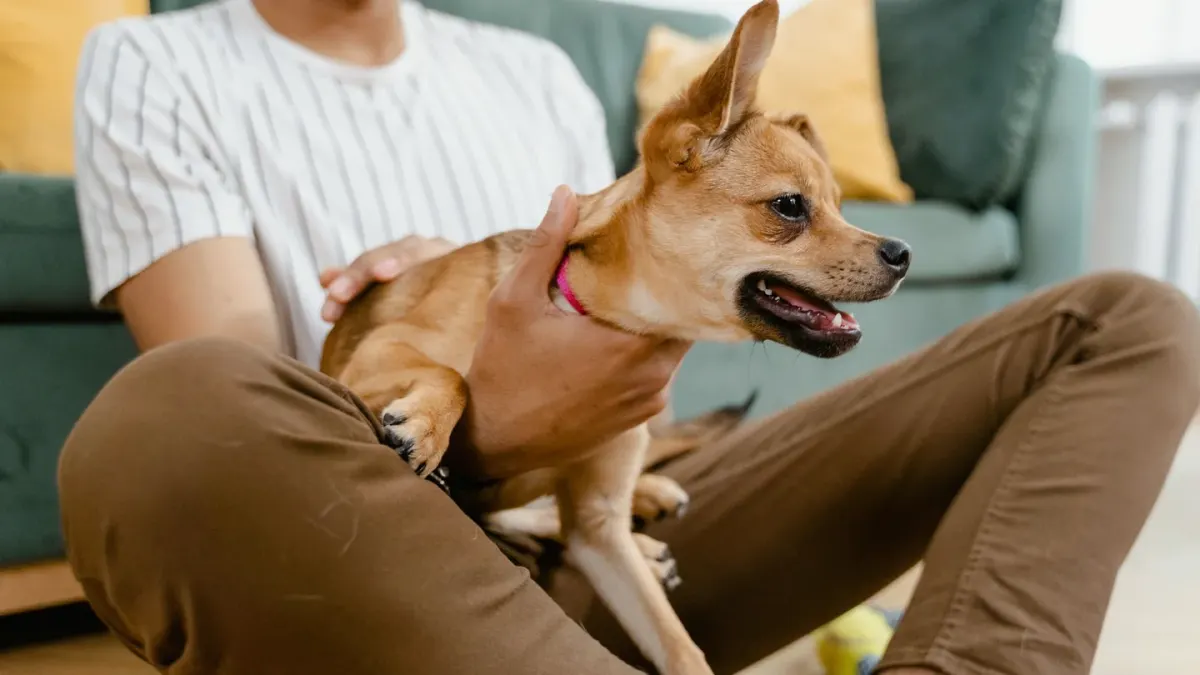
Start with the body, not the behavior. A genuinely anxious dog tends to show some combination of: a tucked or stiffly low tail, ears pinned flat or held unnaturally forward, lip licking or yawning with no food or fatigue involved, panting when it isn’t hot or after exercise, whale eye (the whites of the eyes showing in a half-moon), and a lowered head or crouched posture. You can read more about what whale eye actually signals if that’s the piece you’re seeing most.
Behavior comes second, and it’s where owners get tripped up, because a bored dog and an anxious dog can look almost identical from across the room. Pacing, drooling, destructive chewing near doors or windows, house-soiling in a previously reliable dog, and excessive barking when left alone can all point to anxiety — but they can also point to plain understimulation. The distinction usually comes down to timing and trigger: anxiety symptoms cluster around a specific antecedent (the owner leaving, a thunderstorm, a stranger at the door), while boredom symptoms are more evenly spread across the day. If separation is the suspected trigger, it’s worth comparing the pattern against a dedicated breakdown of boredom versus separation anxiety before assuming either one.
Anxious Isn’t the Same as Excited, Reactive, or Aggressive
This is where I see the most misdiagnosis from well-meaning owners. A dog spinning and barking at the front door before a walk is usually aroused, not anxious — the tail is often up and loose, the mouth is open and relaxed, and the dog is moving toward the stimulus, not away from it. A dog that growls when you reach for its collar might be anxious, but it might also be guarding a resource or reacting to a specific touch history; the distinction changes the plan, and I’d rather owners read a real explanation of why a dog growls when petted than guess. Leash reactivity is its own category too — some of it is frustration at being barred from something the dog wants, which reads very differently from fear-based anxiety, and the difference between barrier frustration and aggression is worth understanding before you label a dog “anxious” on a walk.
Ruling Out Pain and Medical Causes First
Anxiety and pain can look nearly identical in dogs — reluctance to move, restlessness at night, panting, changes in appetite, and irritability show up in both. In my practice, before I commit to a behavioral diagnosis I want a basic exam and, in older dogs especially, bloodwork to rule out thyroid dysfunction, cognitive decline, or an orthopedic source of discomfort that’s making the dog guard itself. A dog that suddenly won’t jump on the bed isn’t necessarily anxious about the bed; it may hurt to jump. That single mix-up is one of the most common reasons owners chase a behavioral fix for months without progress.

Where the Calming-Ingredient Evidence Actually Stands
Once anxiety is the working diagnosis, owners often ask about calming supplements, and the honest answer is: the evidence is real but uneven, and it’s mostly borrowed from human research rather than built from the ground up in dogs. Chamomile is the most-used botanical in this space, and a recent review noted plainly that “for the remaining species, evidence is derived mainly from preclinical studies or traditional use,” published in Biomedicines — which is a fair summary of where we actually stand with dogs specifically, not an endorsement of chamomile as a treatment. Ashwagandha has firmer footing in humans: a systematic review in Cureus concluded that “a systematic review analyzed multiple RCTs and concluded that ashwagandha has a moderate positive impact on stress reduction and cognitive performance.” L-theanine sits somewhere in between — a large meta-analysis in Molecular Psychiatry found benefit was inconsistent across most trials, “except for one study on psychotic anxiety (SMD = 0.54; 400 mg/day for 8 weeks),” which is a narrow, human-specific finding, not a green light for dosing dogs. None of these ingredients treat or cure anxiety. At best, the research supports using them as structure/function support alongside — never instead of — an actual behavior plan.
I’ve watched owners spend real money on a calming chew expecting it to replace training, and it never does. One dog I worked with, a rescued Shepherd mix named Otis, about sixty pounds and roughly three years old, had severe thunderstorm anxiety that started the summer his family adopted him. His owners tried a supplement first, on its own, for six weeks, and saw almost nothing change. It was only after we added a structured desensitization plan and, on the vet’s recommendation, a short-acting anti-anxiety medication for the worst storm days that Otis’s panting and pacing during storms actually eased over the following season. The supplement stayed in his routine afterward, but it was never the thing that moved the needle by itself — and I tell owners that upfront now, before they spend money assuming otherwise.
What I Actually Tell Owners to Do
My honest recommendation, and the one I’ll defend against the “just try a calming chew and see” approach some owners get from a friend or a pet store employee: start with a medical rule-out, then log the specific triggers and body-language signals for at least a week before labeling anything. That log is what a trainer, a veterinary behaviorist, or your own vet will actually use to build a plan — a vague “he seems anxious sometimes” gets you nowhere, but “he paces and pants for twelve minutes starting the moment I pick up my keys” gets you a real intervention. Supplements can be a reasonable add-on once you have a plan, not a substitute for one, and the realistic timeline for behavioral change is usually measured in weeks to a few months of consistent work, not days. If the signals are frequent, intense, or the dog is at risk of injuring itself or someone else, that’s the point to bring in a certified trainer or veterinary behaviorist rather than keep managing it alone.
FAQ
Q: Can a dog be anxious without any obvious signs like shaking or hiding? A: Yes — subtle signals like lip licking, low tail carriage, and pacing after a specific trigger are common in mild-to-moderate anxiety, and they’re often missed because owners are watching for more dramatic behavior.
Q: Is it possible for a dog to be both anxious and in pain at the same time? A: Yes, and it’s common enough that a medical exam is a reasonable first step before assuming a behavioral cause, since untreated pain can itself produce anxiety-like restlessness and irritability.
Frequently asked questions
Can a dog be anxious without any obvious signs like shaking or hiding?
Yes — subtle signals like lip licking, low tail carriage, and pacing after a specific trigger are common in mild-to-moderate anxiety, and they're often missed because owners are watching for more dramatic behavior.
Is it possible for a dog to be both anxious and in pain at the same time?
Yes, and it's common enough that a medical exam is a reasonable first step before assuming a behavioral cause, since untreated pain can itself produce anxiety-like restlessness and irritability.
Sources
- Chamomile and complementary approaches to anxiety and stress across species — Biomedicines
- Ashwagandha as an Adaptogenic Herb: A Comprehensive Review of Immunological and Neurological Effects — Cureus
- Cognitive and affective effects of L-Theanine: a systematic review and meta-analysis of 31 randomized trials — Molecular Psychiatry