How to Travel With a Puppy for the First Time
A vet's practical guide to a puppy's first road trip — crate versus harness, the socialization window, motion sickness, and a day-by-day plan that keeps a new dog calm and safe.
Traveling with a puppy for the first time works best when you secure the ride, protect the socialization window, and plan for a queasy stomach.
On this page
The first time I met a nine-week-old cavapoo named Biscuit, he’d already thrown up twice on I-95 and his owners were ready to cancel the rest of the drive. He weighed four pounds, he’d had one set of vaccines, and he was headed to a lake house six hours away for the long weekend. Nothing about that trip was wrong to attempt — but almost nothing about it had been planned.
That’s the pattern I see most: owners treat a puppy’s first trip like a logistics problem, when it’s really a physiology-and-behavior problem wearing a logistics costume.
Two Puppies, Two First Trips
I remember a Boston terrier named Pearl, ten weeks old, twelve pounds, who came in the week before a family drove her from Raleigh to Charlotte for the first time. Her owners had read that puppies shouldn’t leave the house until fully vaccinated, so she’d spent her first ten weeks almost entirely indoors. The car ride terrified her — not from motion sickness, but from the sheer novelty of engine noise, highway rumble strips, and a rest-stop parking lot full of strangers. She trembled the whole way and refused to eat for a day afterward.
Compare that with a Australian shepherd puppy, Otto, same age bracket, whose owners had done five-minute driveway sessions daily for a week before a real trip: engine on, five minutes parked, then a short loop around the block. Otto slept through most of his first real drive. The difference wasn’t luck. It was exposure, sequenced early and kept short.
The Verdict, Stated Plainly
Secure the puppy physically before you worry about anything else, then use the trip itself as a socialization opportunity rather than something to postpone until vaccines are finished. Those two priorities compete for attention in most owners’ minds, and in my experience the physical safety piece loses far too often — it feels less urgent than the vaccine question, so it gets skipped. It shouldn’t.
Crate or Harness: What the Crash Data Actually Shows
This is the comparison owners ask about most, and the honest answer is that most products on the market haven’t been tested to a standard that means anything in a real crash. Independent testing from the Center for Pet Safety has repeatedly found that a large share of pet carriers, crates, and harnesses fail under crash-test conditions — some crates lose structural integrity, and some restraint systems allow enough forward travel that a dog could still strike the interior of the vehicle. Only a small number of tested products held up as designed.
Practically, that means:
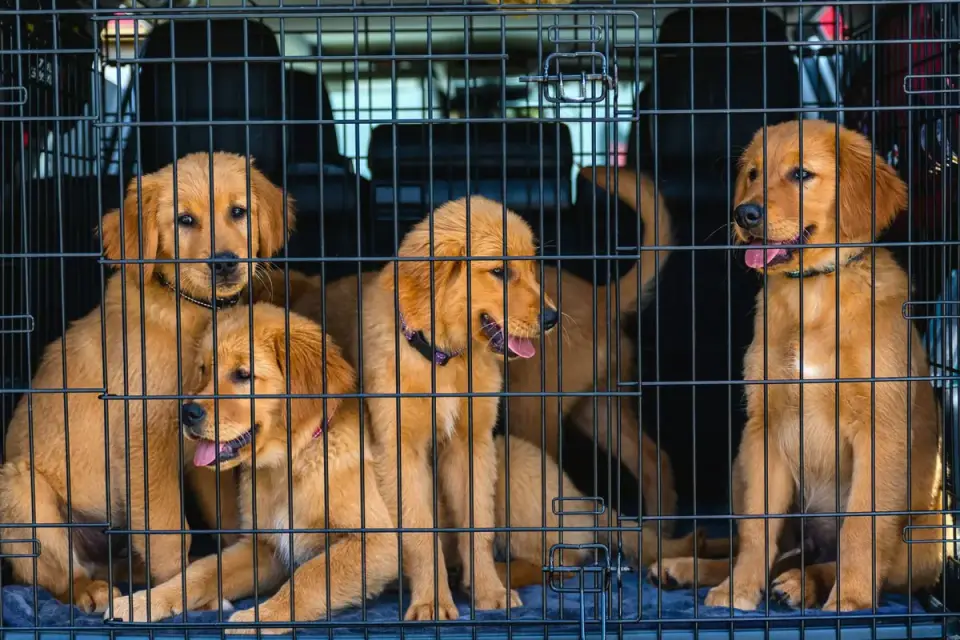
- A hard-sided crate, anchored at multiple points with the manufacturer’s own tie-down hardware, has generally outperformed soft carriers and many harnesses in the testing that exists.
- A harness alone, clipped to a single seatbelt loop, is the weakest of the common setups — it restrains the puppy from wandering the cabin, but it isn’t the same as crash protection.
- Size the crate to the puppy’s current weight, not the adult weight you’re planning for. An oversized crate lets a small puppy become a projectile inside its own enclosure.
None of this is about brand loyalty. It’s about matching the restraint you already own to what’s actually been tested, and upgrading the one piece — usually the tie-down straps — that’s most likely to be missing.
The Vaccination Trap: Waiting Isn’t Risk-Free Either
Owners often assume the safest choice is to keep a puppy home until the vaccine series is complete, sometime around sixteen weeks. That instinct protects against infectious disease, but it ignores a competing risk. The American Veterinary Society of Animal Behavior takes the position that the first three months of a puppy’s life are the primary window for socialization, and that puppies can begin controlled exposure — including short trips — as early as seven to eight weeks, roughly a week after their first vaccine dose, provided the exposure is managed and doesn’t happen in high-risk settings like dog parks or pet store floors.
Behavioral problems, not infectious disease, are the more common cause of death in dogs under three years old, according to that same position statement. A puppy who never rides in a car, never sees a rest stop, never hears a truck downshift until sixteen weeks old is not the “safer” puppy. He’s the one more likely to panic the first time it happens for real.
So the useful middle ground looks like this: skip communal, high-traffic locations until vaccines are further along, but don’t skip the car itself. A puppy carrier in your own vehicle, on a route with minimal stops, is a low-exposure environment you can control.
When Queasy Is Normal — and When It Isn’t
Motion sickness is genuinely more common in puppies than in adult dogs, largely because the inner ear structures that manage balance are still maturing, according to Motion Sickness in Dogs from VCA Animal Hospitals. Most puppies improve on their own by around a year old. That’s useful context if a first trip goes sideways: it’s rarely a sign something is wrong with the puppy specifically.
For a puppy who’s clearly miserable rather than just unsettled, Maropitant Citrate, also summarized by VCA Animal Hospitals, is the medication most vets reach for. It blocks a neurotransmitter involved in the vomiting reflex, it’s approved for puppies over eight weeks old, and unlike older motion-sickness drugs, it doesn’t sedate. Hypersalivation is the most commonly reported side effect. It’s given a couple of hours before departure with a small amount of food, and it should come from your vet, not a leftover bottle from another dog.
If loose stool shows up alongside the nausea — which happens often with travel stress — our guide on firming up a puppy’s loose stool naturally covers the food-first steps before reaching for medication. And if the vomiting keeps happening on every single ride even after the puppy settles into travel generally, it’s worth reading through why a dog vomits every time it goes for a car ride, since that pattern sometimes points past ordinary motion sickness.
Building the First Trip, Day by Day
- Three to five days out: Run five-minute sessions in the parked car, engine running, puppy in the secured crate. Feed a small treat only once the puppy is calm, not while whining.
- One to two days out: Do a short real drive — ten to fifteen minutes — ending somewhere pleasant, like a quiet patch of grass, not the vet.
- Morning of departure: Withhold a large meal for a couple of hours beforehand if motion sickness is a concern; a small amount of food is fine and often preferable to an empty stomach.
- On the road: Stop every two to three hours for a potty break and water, in low-traffic grass areas rather than gas station pavement.
- Arrival: Let the puppy decompress in the crate for a few minutes before introducing a new environment full-on. A new place after hours of stimulation is a lot to process at once.
Skip communal rest-stop dog areas for now. Keep water available but not sloshing in an open bowl the puppy could tip. And resist the urge to let the puppy ride loose “just this once” — the crash-test data doesn’t have a carve-out for short trips.
What I Tell Owners in the Exam Room
The conversation I have most often isn’t about the drive itself — it’s about the week before. An owner will describe a puppy who’s never left the yard, and I’ll ask what the plan is for the actual departure day, and there usually isn’t one beyond “put him in the car.” I tell them the same thing every time: practice the car before you need the car to work. Five minutes in the driveway, three days running, costs almost nothing and prevents most of what turns into a bad first trip.
The owners who skip that step aren’t careless. They’re usually just focused on the bigger logistics — the route, the hotel, the paperwork if a flight is involved — and the car itself feels like the easy part. It’s the part that actually determines how the rest of the trip goes. Puppies who arrive calm settle into new places faster; puppies who arrive rattled carry that rattle for a day or two, sometimes longer.
If your first trip together happens to be a flight rather than a drive, the calculus changes enough that it deserves its own plan — our guide on how to fly with a dog walks through carrier fit, paperwork timing, and airline-specific rules that don’t apply to a car trip at all.
Where the Evidence Is Thin
Crash-test data on pet restraints is limited to a small number of independently tested products, most sized for adult dogs rather than puppies specifically — so treat the size and anchoring guidance above as the closest available proxy, not a puppy-specific certification. Similarly, socialization timing research describes population-level behavioral outcomes, not a guarantee for any individual dog. A puppy raised with ideal early exposure can still develop noise sensitivity or car anxiety later, and one raised more cautiously can turn out perfectly at ease in a car. The recommendations above shift the odds; they don’t remove the variability.
So which risk would you rather manage on the first trip — the small, controllable exposure of a short supervised drive, or the larger, less controllable one of a puppy who’s never done it at all by the time a real trip is unavoidable?
Frequently asked questions
How old should a puppy be for its first car trip?
Most puppies can handle short, controlled car trips starting around seven to eight weeks old, roughly a week after the first vaccine dose, as long as the trip avoids high-traffic communal areas like dog parks.
Is a crate or a harness safer for a puppy in the car?
Independent crash testing has generally found hard-sided crates anchored with proper tie-down hardware perform better than soft carriers or single-point harness attachments, though only a limited number of products have been tested to that standard.
Will my puppy outgrow car sickness?
Most puppies improve on their own by around a year old as the inner ear structures involved in balance mature, though a vet-prescribed anti-nausea medication can help in the meantime.
Sources
- Puppy Socialization Position Statement — American Veterinary Society of Animal Behavior
- Pet Carrier & Crate Crash Test Research — Center for Pet Safety
- Motion Sickness in Dogs — VCA Animal Hospitals
- Maropitant Citrate — VCA Animal Hospitals