Why Does My Senior Dog Pace at Night?
A vet explains the real reasons an old dog paces at night — pain, cognitive decline, or anxiety — and how to tell them apart before you try anything else.
Nighttime pacing in an old dog usually signals pain, cognitive decline, or anxiety — not simple aging.
On this page
It’s usually around 2 a.m. when the phone call comes. The owner is exhausted, whispering so they don’t wake the kids, and the sentence is almost always the same: “He won’t lie down. He just keeps walking in circles.” I’ve had this exact conversation more times than I can count, and the dog on the other end of the leash is almost never young.
If your senior dog is pacing at night, don’t file it under “getting old” and wait it out. That’s the verdict I want to state plainly before we get into the mechanism: nighttime pacing in an aging dog is a symptom with a short list of likely causes — pain, canine cognitive dysfunction, or anxiety tied to a changing sleep-wake cycle — and each one calls for a different plan. Treating all three the same way is how owners end up frustrated and dogs end up undertreated.
What Counts as Normal Restlessness vs. a Symptom Worth a Vet Visit
Before you diagnose your own dog off a blog post (including this one), use three criteria to sort a bad night from a pattern.
- Frequency. One restless night after a stressful day is not the same as pacing that has repeated for two or more weeks.
- Trajectory. Is it stable, or is it creeping — five minutes of circling last month, twenty minutes tonight?
- Company. Is the pacing arriving with other changes — disorientation in familiar rooms, daytime sleepiness, new accidents in the house, or a reluctance to jump on the couch?
If two or more of those are true, this isn’t a phase. It’s a reason to call your vet, and I’ll say why in a minute.
Chester was a twelve-year-old Cardigan Corgi mix, forty-one pounds, who’d always slept through the night without complaint. His owners noticed the shift in early January: a few minutes of circling the family room rug around 2 a.m., gone by the second week to twenty-plus minutes of pacing between the kitchen and the hallway, several nights a week. They’d tried moving his bed, tried a later dinner, tried leaving a hallway light on. None of it touched the pattern, because none of it addressed the actual cause — Chester had moderate hip and lumbar arthritis that hadn’t shown up as limping yet, only as an inability to get comfortable once the house went quiet and the distractions of the day disappeared.
The Three Causes I Look for First
In practice, I sort nighttime pacing into three buckets, roughly in the order I rule them out.
Pain, usually orthopedic. Dogs mask discomfort well during the day, when walks, meals, and activity distract from it. At night, with the house quiet and nothing competing for attention, that same discomfort becomes harder to settle into. A dog that gets up and down repeatedly, circles before lying down, or seems to be hunting for a position it can’t find is often telling you its joints hurt, even without an obvious limp.
Canine cognitive dysfunction (CCD). This is the “doggy dementia” conversation, and it’s more common than most owners expect. According to AAHA, CCD involves disorientation, changed sleep-wake cycles, and increased anxiety, and nighttime restlessness — sometimes called sundowning — is one of its more recognizable patterns. A veterinary survey published in PMC notes that CCD is likely to affect a substantial share of dogs over eight, and that it’s frequently underdiagnosed because owners chalk the signs up to normal aging.
Anxiety, separate from cognitive decline. Some dogs pace at night because they’re genuinely anxious — about noise, about being alone in a room, about a change in the household — and the anxiety compounds once cognition starts to slip. If you’re trying to work out whether restlessness is boredom, separation-related, or something else, Boredom vs Separation Anxiety: How to Tell the Difference walks through how to tell those apart in a younger dog, and a lot of the same logic transfers once you’ve ruled out pain and CCD in a senior.
Why I Rule Out Pain Before I Call Anything Else
Here’s where I’ll be direct, because it’s the mistake I see most often: owners reach for a calming aid before anyone has taken an X-ray. I understand the instinct — pacing looks anxious, so it feels like an anxiety problem. But if the underlying cause is arthritis, a calming supplement won’t touch the pain driving the behavior, and you’ll have spent weeks treating the wrong thing while your dog keeps hurting.
The counterargument I hear is reasonable: “He’s not limping, so it’s probably not his joints.” I don’t buy that as a rule-out. Plenty of arthritic dogs never limp visibly; they compensate, shift weight, and slow down gradually enough that owners don’t clock it as pain. That’s exactly why a physical exam — sometimes with radiographs — belongs before, not after, you try a calming ingredient. Some senior dogs also react to being handled or repositioned once joints are sore, which is worth knowing if you’ve noticed a dog that’s started to growl or stiffen when touched at night; Why Does My Dog Growl When I Pet Him? covers how pain and touch sensitivity can overlap in older dogs.

Chester’s X-rays confirmed what his owners hadn’t been able to see: arthritic changes in both hips and along his lumbar spine, moderate but real. Once he was on a vet-directed pain management plan, the nighttime pacing dropped off within about ten days — not because pacing itself was ever the target, but because the discomfort driving it had a name and a treatment. I’m not presenting that as a guarantee or a general outcome; every dog’s workup and response differ. It’s one case that illustrates why the exam comes first, not a substitute for it.
Where Calming Ingredients Fit — and Where the Evidence Is Thin
Once pain and CCD have been evaluated by a vet, calming ingredients can be a reasonable piece of a broader plan for dogs whose pacing has an anxiety component — but the evidence behind them ranges from solid to preliminary, and it’s worth knowing which is which.
Chamomile has a long history in traditional herbal use for relaxation, but the actual clinical picture in dogs is limited. A review in Biomedicines notes that for most species outside of a few well-studied ones, “evidence is derived mainly from preclinical studies or traditional use” rather than controlled trials — that’s an honest way of saying it’s plausible, not proven.
KSM-66 ashwagandha has more human data behind it. A systematic review in Cureus concluded that ashwagandha has a moderate positive impact on stress reduction and cognitive performance across multiple randomized controlled trials — again, that evidence base is human, and it should be read as a reason for cautious interest rather than a canine guarantee.
L-theanine is the one where I’d push back hardest on inflated claims. A review in Molecular Psychiatry found meaningful effects mostly limited to a single study on psychotic anxiety, using a human dose of 400 mg/day over eight weeks — not a dataset you can extrapolate into “gives your dog a calm night,” even though it’s a genuinely interesting amino acid worth more canine-specific research.
None of that means these ingredients are worthless. It means they’re a supporting layer, not a substitute for a diagnosis, and any brand’s marketing claims should be read against exactly this level of evidence — not beyond it.
What I Actually Tell Owners to Do, In Order
- Track it for a week before you change anything. Note the time pacing starts, how long it lasts, and whether it comes with disorientation, house-soiling, or daytime sleepiness.
- Book a vet visit specifically for this, not as a mention at an annual exam. Ask directly about a pain screen and a cognitive assessment.
- Address pain first if it’s found. This is almost always the highest-leverage fix, and it’s the one owners skip most often.
- Layer in environmental support — a supportive orthopedic bed, a consistent bedtime routine, a short gentle walk in the early evening — regardless of the underlying cause.
- Consider calming ingredients as an adjunct, not a first move, and set expectations around what the evidence actually supports.
When to Call Your Vet Tonight, Not Next Week
Some patterns move up the priority list. Call sooner if pacing arrives with sudden disorientation, a stumbling gait, vocalizing that sounds distressed rather than restless, increased thirst or urination, or any sudden behavior change in a dog who was sleeping fine a week ago. Those can point to something more acute than gradual joint or cognitive change, including conditions like Cushing’s disease or a neurologic event, and they deserve same-week attention rather than a wait-and-see approach. If you’ve also noticed your dog reacting more sharply to everyday sounds, that’s worth mentioning at the same visit — Why an Old Dog Startles at Sounds He Used to Ignore covers a related pattern that sometimes travels alongside nighttime restlessness in aging dogs.
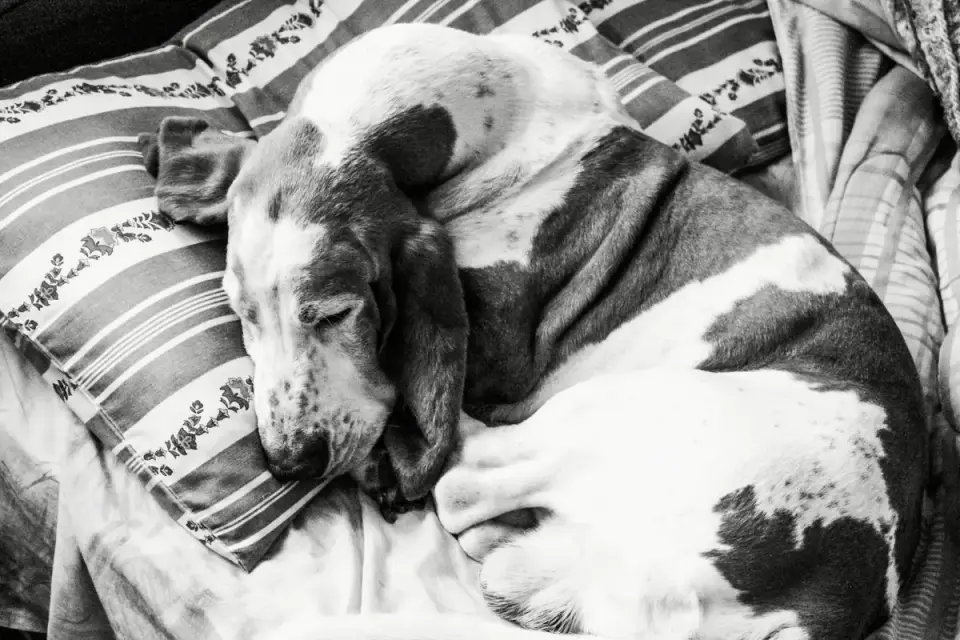
I think about a Lab mix named Percy I worked with a few years back — thirteen years old, sixty-two pounds, whose owner described almost the identical pattern Chester’s family reported: pacing that started small and grew over about a month, worse on nights after a long, busy day rather than a quiet one. Percy’s workup pointed toward early cognitive change rather than pain — his joints were clean on exam, but he’d started getting stuck behind the ottoman and staring at walls during the day. His plan looked different from Chester’s: environmental consistency, a stable bedtime routine, and a conversation with his vet about the same evidence-bounded calming options I’ve described above. The point isn’t that one case proves a protocol works. It’s that the two dogs paced for entirely different reasons, and would have been mismanaged by the same generic fix.
The recap: nighttime pacing in a senior dog is a symptom, not a diagnosis. Rule out pain first, ask specifically about cognitive dysfunction, and treat anxiety-support ingredients as a layer on top of a real workup — not a replacement for one.
Frequently asked questions
Is nighttime pacing always a sign of dementia in old dogs?
No. Pain, especially arthritis, is at least as common a cause, and anxiety unrelated to cognitive decline can also produce it. A vet exam is the only reliable way to tell them apart.
How long should I wait before calling the vet about nighttime pacing?
If it has repeated for two or more weeks, is getting worse rather than staying steady, or is showing up alongside other changes like disorientation or house-soiling, book a visit rather than waiting it out.
Can calming supplements fix nighttime pacing on their own?
They can be a reasonable supporting layer for anxiety-related restlessness, but the evidence behind common calming ingredients is mixed, and they won't resolve pacing caused by unmanaged pain or cognitive dysfunction.
Sources
- Managing Cognitive Dysfunction and Behavioral Anxiety in Senior Dogs — AAHA
- Attitudes of Australian Veterinary Professionals to Diagnosing and Managing Canine Cognitive Dysfunction — PMC
- Chamomile's Anxiolytic Potential Across Species: A Review — Biomedicines
- Ashwagandha (KSM-66) and Stress: A Systematic Review of Randomized Controlled Trials — Cureus
- L-Theanine and Anxiety: A Review of the Clinical Evidence — Molecular Psychiatry