Changing Your Dog's Protein Source Safely
A neurologist's plain-spoken guide to switching a dog to a new protein source — the physiology behind gradual transitions, when a novel protein trial actually matters, and what to watch for along the way.
Switching your dog to a new protein isn't just a bag swap — it's a gut and immune-system event, and the pace you set decides whether it goes smoothly.

On this page
I still remember a nine-year-old Weimaraner named Otto who came into my practice for a neurology consult unrelated to his diet, and whose owner mentioned, almost as an aside, that he’d had loose stool for two weeks straight. She’d switched him from a chicken-based kibble to a lamb formula over a single weekend because he seemed bored with his old food. No blending, no taper — just a clean swap on a Saturday morning. By Monday he was straining in the yard, and by the following week she was mopping up accidents on the kitchen tile. Nothing was wrong with the lamb. The problem was the transition itself: a gut microbiome tuned to one protein’s fiber and fat profile, asked to recalibrate overnight.
That’s the case I reach for when owners ask me how to switch a dog’s protein source, because it captures the real risk. Protein switching isn’t inherently dangerous, and most dogs handle it fine. But the gut microbiome and pancreatic enzyme output are calibrated to what a dog has been eating, and asking them to pivot abruptly is where I see the trouble start. My verdict, and I’ll defend it directly: go slow on the timeline, but don’t be vague about the reason you’re switching. If you’re rotating proteins for variety, a careful multi-day blend is enough. If you’re chasing a true food allergy, a slow blend without a defined novel-protein plan can actually undermine the diagnosis you’re trying to get.
Why the gut treats a new protein like an event, not a swap
Digestion isn’t just mechanical breakdown — it’s an ecosystem response. The bacterial populations in a dog’s gut adapt to the substrate they’re regularly fed, and pancreatic enzyme secretion follows a similar rhythm tied to habitual diet composition. When a dog has a pancreas that’s already under strain, this becomes more than an inconvenience. In dogs with exocrine pancreatic insufficiency, veterinary guidance is explicit that management leans on nutritional strategy alongside enzyme replacement: “EPI is treated by pancreatic enzyme replacement therapy, nutritional management (low-residue diets with moderate fat content), and supplementation of cobalamin,” according to a review published in the Journal of the American Veterinary Medical Association. That’s a specific clinical population, not every dog switching brands — but it illustrates how tightly diet composition and gut function are linked.
Even in that same EPI literature, the picture on the microbiome side is not fully settled. The review notes that “future studies are needed to further understand the causes of persistent dysbiosis in animals with EPI following initiation of pancreatic enzyme replacement therapy and assess the efficacy of treatments to ameliorate these abnormalities,” per the Journal of the American Veterinary Medical Association. I want to be honest about that gap rather than paper over it: we know dysbiosis lingers in some cases, we don’t yet have a clean answer for why or how to fix it faster. That uncertainty is exactly why I favor a cautious, staged approach even in dogs with no diagnosed GI disease — the biology underneath a protein switch is more dynamic than a bag label suggests.
A gradual blend, staged over days not hours
For a healthy adult dog moving between two complete-and-balanced commercial diets — say, swapping a chicken formula for a duck or venison one — I tell owners to think in a week, not a weekend. Cornell University’s Riney Canine Health Center recommends changing a dog’s diet gradually, blending the old and new foods in shifting proportions over several days rather than cutting over in one meal. I follow a version of that: mostly old food with a quarter of the new for a couple of days, half-and-half for a couple more, then mostly new until the swap is complete. If a dog’s stool loosens at any stage, I hold that ratio for an extra day or two before advancing rather than pushing forward on schedule.
Fiber matters more here than most owners expect. A gentler fiber source in the transitional meals can buffer the GI tract while the microbial population catches up. Pumpkin is one of the more commonly used options for this, since “pumpkin fiber is a gentle, natural source of both soluble and insoluble fiber,” per Boops Pets’ veterinary-reviewed digestive health claims (reviewed by Dr. Sarah Mitchell, DVM). I’m not suggesting fiber replaces a proper taper — it doesn’t — but a small addition during the blend window is a reasonable, low-risk adjunct for a dog with a history of a sensitive stomach.
Probiotic support during this window is worth a mention too, though I’d frame it modestly. The clinical picture on probiotics and canine gut health is genuinely mixed depending on the dog: in a recent randomized trial, “diversity metrics did not distinguish non-responders from responders,” according to research published in Frontiers in Veterinary Science. In plain terms, we can’t yet predict from a stool sample which dogs will benefit from a given probiotic strategy. I still think a balanced gut microbiome plausibly supports broader physiology — Boops Pets’ reviewed claim language states that “a balanced gut microbiome supports overall immune function” — but I hold that as a structure/function statement, not a promise that any single supplement will smooth every transition.
When you’re not just rotating — you’re testing for allergy
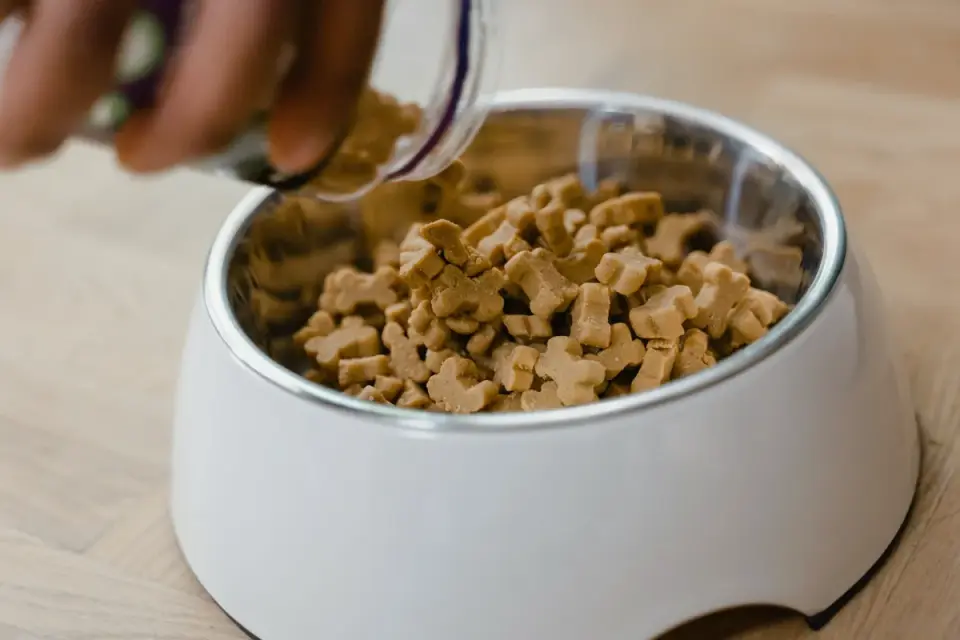
Here’s where I diverge from a purely “go slow and blend” answer, and it’s a distinction I press owners on. If a dog is scratching, chewing paws, or dealing with recurrent ear infections and you suspect a food allergy, a leisurely week-long blend actually works against you. A proper elimination trial needs a genuinely novel protein — one the dog’s immune system hasn’t been primed against — fed as close to exclusively as possible, with no cross-contamination from treats, flavored medication, or table scraps. VCA Animal Hospitals’ guidance on implementing an elimination-challenge diet trial is direct about this: the trial only works if it’s strict, and it typically needs to run for a meaningful stretch of weeks before you can draw a conclusion. Blending in the old suspect protein for days, even at declining ratios, muddies that signal.
So my rule for owners chasing a diagnosis is: talk to your vet about skipping the gradual blend for the initial days on the strict novel protein, accepting a slightly higher risk of transient loose stool, in exchange for a clean read on whether symptoms actually improve. That’s a real tradeoff, and I won’t pretend it isn’t. A dog with a sensitive gut may have a rough few days on the cutover. But a muddled elimination trial that has to be repeated costs more time, and more discomfort, than a short rough patch up front.
I think about this most vividly with a Cavalier King Charles Spaniel named Willow, a dog I worked with who was eight years old and chronically itchy around her paws and ears — the kind of low-grade misery her owner had chalked up to “just her skin” for over a year. We put her on a strict kangaroo-and-potato diet, nothing else, for ten weeks. Her owner was weighing real tradeoffs the whole time: the diet cost more than her usual food, she hated giving up the training treats Willow loved, and the first week brought looser stool than either of them expected. By week six, though, the paw-licking had dropped off noticeably, and by week nine her ears had gone a full month without needing a cleaning. That single case doesn’t prove kangaroo caused the improvement — a controlled reintroduction would be the real test — but it’s the kind of trajectory that makes the strict-trial argument concrete instead of abstract.
What I actually tell owners to watch for
Whichever path applies — routine rotation or diagnostic elimination trial — the markers I ask owners to track are the same ones I’d want logged for any GI workup: stool consistency and frequency, appetite, vomiting, and energy level, checked daily for the first one to two weeks after any change. A single soft stool on day two of a blend isn’t alarming. Vomiting, blood in the stool, or a dog that goes off food entirely is a reason to call your veterinarian, not push through the schedule. If you’re mid-elimination-trial and see a flare after what should have been a clean protein, that’s useful diagnostic information too, not a failure — it may mean the “novel” protein wasn’t as novel as you thought, or that a different ingredient in the new formula is the actual trigger.
If your dog is a puppy or a senior, some of the same gut-transition principles carry over even though the risk profile shifts — our guide on changing food for a senior dog covers the age-specific adjustments I’d make to the pacing described here. And if you’re troubleshooting individual ingredients rather than a whole-diet switch, our pieces on avocado, mushrooms, and onions walk through what actually determines risk for foods owners commonly ask about alongside a protein change.
Looking ahead, I expect the research on predicting which dogs respond to probiotic support during dietary transitions to keep sharpening — the diversity-metric findings I cited above are recent, and this is an active area of veterinary GI research. Until the evidence gets more granular, my practical stance holds: blend gradually for routine protein rotation, go strict and clean for a genuine allergy workup, and let your dog’s stool, appetite, and energy tell you which pace they can actually tolerate.
Frequently asked questions
How many days should I take to switch my dog to a new protein?
For a routine rotation between two complete commercial diets, a five-to-seven day gradual blend — increasing the new food's share every couple of days — gives the gut microbiome time to adjust, per guidance from Cornell's Riney Canine Health Center.
Should I blend gradually if I'm doing a food allergy elimination trial?
Not the same way. A true elimination trial needs a strict, consistently novel protein with no cross-contamination from the old diet or treats, so talk to your vet about a more direct cutover rather than a slow blend in that specific case.
What symptoms mean I should stop the switch and call my vet?
Vomiting, blood in the stool, refusal to eat, or lethargy are reasons to pause and call your veterinarian. A single loose stool during a gradual blend is common and usually not a red flag on its own.
Sources
- EPI treatment and nutritional management review — Journal of the American Veterinary Medical Association
- Probiotic responder diversity metrics study — Frontiers in Veterinary Science
- Re-evaluating your dog's diet — Riney Canine Health Center
- Implementing an Elimination-Challenge Diet Trial — VCA Animal Hospitals