How to Travel With an Anxious Dog
A vet's practical, evidence-based checklist for reducing car and travel anxiety in dogs, from crate conditioning to when medication actually helps.
Most travel anxiety in dogs is a training and exposure problem first, a medication problem second, and a genetics problem you can't fully undo.
On this page
Start here — the checklist I actually give clients before a trip:
- Condition the crate or harness at home for at least a week before travel, not the morning of.
- Do 2–3 short “practice drives” (five to ten minutes, no destination) before the real trip.
- Restrain your dog properly in the vehicle — loose in the cabin is not a safe or calming option.
- Ask your vet about situational medication (like trazodone or gabapentin) at least one trial dose ahead of travel day, never for the first time on the trip itself.
- Pack familiar bedding, a stuffed water/food routine, and skip a full meal within a couple hours of departure.
- Watch for panting, lip licking, whale eye, or refusal to settle — these are your early warning signs, not “just being dramatic.”
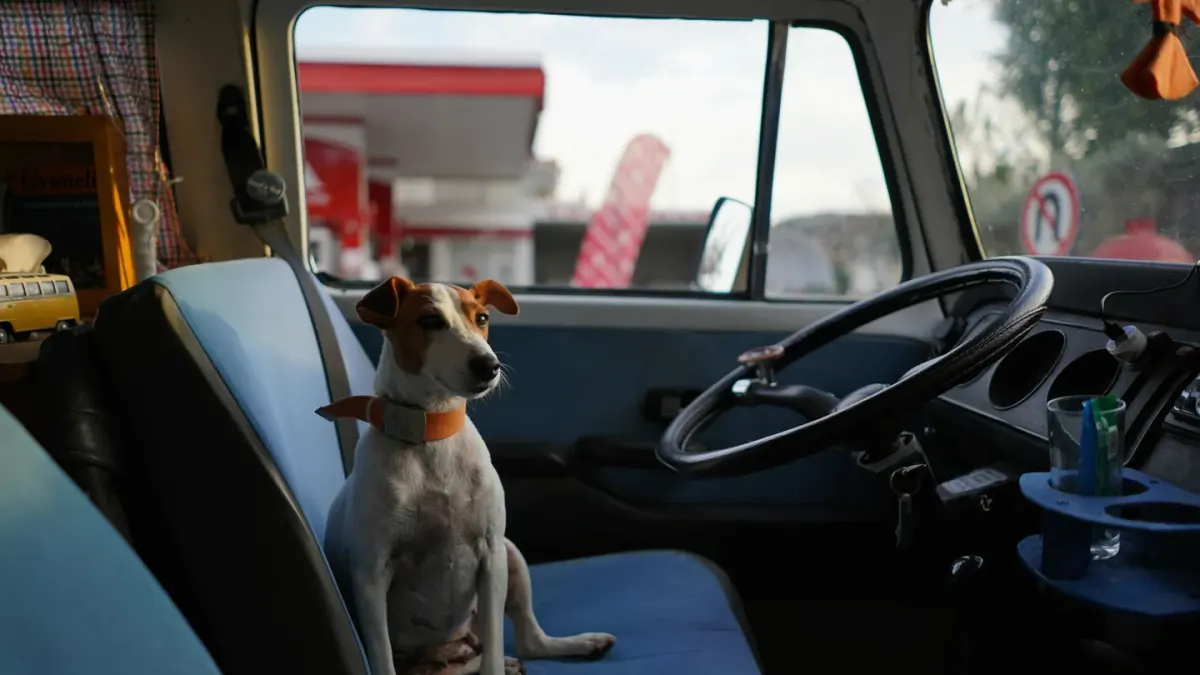
A nine-year-old terrier mix named Biscuit taught me most of what I know about this. His owners were driving four hours to a lake house every June, and every year Biscuit would drool through the entire first hour, refuse water at rest stops, and arrive so wound up he wouldn’t eat dinner. They’d tried a new harness, then a different crate, then just letting him ride loose on the seat because he seemed “less panicked” that way. None of it addressed the actual problem: he had never been rewarded for calm behavior in a moving vehicle, only ever loaded into the car for the vet or for a nine-hour drive with no in-between. We rebuilt his tolerance from five-minute driveway loops that summer, and by the following June the drooling had dropped to the first fifteen minutes instead of the first hour.
Why some dogs unravel in a moving vehicle
Motion sickness and anxiety often get lumped together, but they’re not the same mechanism, and treating one like the other wastes a trip. A dog who is nauseated will drool, lip-lick, and sometimes vomit regardless of how calm the car ride is. A dog with situational anxiety shows the same drooling and lip-licking, but also pacing, panting unrelated to heat, whining, or trying to climb into the owner’s lap or footwell. Most of the anxious dogs I see are anxious specifically because the car predicts something aversive — usually the vet, or a total absence of any positive association with the vehicle at all.
What the restraint itself is doing to a dog’s stress level
Loose dogs are not calmer dogs, no matter how it looks from the driver’s seat. The American Veterinary Medical Association is direct about this: pets should be restrained with an appropriate harness, crate, or carrier because unrestrained animals can be thrown or crushed in a collision, and a crate should be large enough for the dog to stand, turn around, and lie down. Beyond the crash-safety argument, an unsecured dog sliding across the seat on every turn is adding physical unpredictability on top of whatever emotional stress already exists. A well-fitted crate or harness, introduced gradually at home, gives a dog a stable, enclosed space that most learn to associate with predictability rather than restriction — but only if that association is built before the trip, not during it.
The pheromone question, and why I don’t oversell it
Dog appeasing pheromone products are a reasonable low-risk add-on, not a fix on their own. A systematic review in Veterinary Evidence found the evidence for DAP reducing anxiety-related stress behaviors in dogs over six months old is still weak overall, with the strongest signal specifically around thunderstorm noise and hospitalization, and only mild evidence in shelter settings. Most behavioral change was observed while the dog was actively exposed to the pheromone, with little effect lingering afterward. I tell owners it’s fine to try a collar or spray for a road trip — it’s low-risk — but I don’t let anyone treat it as a substitute for crate conditioning or, when warranted, medication.
When medication is the honest answer, not the lazy one
For a subset of dogs, no amount of desensitization gets them to a workable baseline before a trip, and that’s where situational medication earns its place. A road-travel model published in Frontiers in Veterinary Science found that acute trazodone administration reduced both behavioral and physiological indicators of travel-induced anxiety in dogs. Gabapentin is commonly used alongside it, and the two are frequently combined for veterinary-visit and travel anxiety under professional guidance. What I insist on with clients is a trial dose given at home, days before the actual travel day, so we know how a given dog responds — some get calm and sleepy, a few get paradoxically wired, and you don’t want to discover that fact for the first time at highway speed.
I think about a Cavalier King Charles Spaniel named Willow, twelve years old and about eighteen pounds, whose owner called me the week before a cross-country move. Willow had developed stiffness in her hips over the previous year and had never traveled farther than the groomer. The owner’s worry wasn’t really about the anxiety symptoms themselves — it was the tradeoff between sedation and a dog who already had trouble getting comfortable on hard surfaces after long stretches of stillness. We built in extra stops specifically so Willow could move around and reposition rather than lie rigid in one spot for hours, padded the crate more heavily than we would for a younger dog, and used a trial dose of medication two days out to confirm it didn’t leave her too groggy to reposition herself. None of that showed up in a generic anxiety checklist. It came from treating the joint issue and the anxiety as two problems that had to be solved together, not sequentially.
Where I actually land
Anxiety in a travel context is mostly a training problem wearing a medical costume. If you only reach for medication or a pheromone product without ever conditioning the crate, the harness, and the car itself as neutral or positive spaces, you’re treating a symptom while the underlying association stays broken. My honest order of operations: condition the equipment and the vehicle first, layer in a low-risk pheromone product if you want, and bring medication into the conversation with your vet — trialed in advance — when the dog’s baseline stress is high enough that training alone isn’t going to close the gap before the trip you actually have planned.
If your travel plans involve more than a short drive, a few related pieces are worth reading before you go: How to Travel With a Puppy for the First Time if this is a young dog’s first real trip, Traveling With a Small Dog vs a Large Dog: What Actually Changes for size-specific restraint and crate sizing questions, and Collapsible Bowls and Feeding Gear for Traveling Dogs for keeping a stressed dog’s routine intact at rest stops. If flying is part of the itinerary, Airline Pet Policies: What to Check Before You Book covers the logistics that compound an already anxious dog’s stress load.
Frequently asked questions
Is it ever okay to let an anxious dog ride loose in the car if they seem calmer that way?
No. Being unrestrained doesn't address the anxiety and adds real crash risk; the American Veterinary Medical Association recommends a properly fitted harness, crate, or carrier for every trip regardless of how a dog behaves when loose.
How far in advance should I start crate or car conditioning before a trip?
At least a week of short, low-pressure sessions is a reasonable minimum for a dog with no prior negative association; dogs with an established fear of the car often need longer.
Should I try a calming pheromone product before reaching for medication?
It's a reasonable, low-risk first step, but the evidence for pheromone products is modest at best, so don't delay a conversation with your vet if a trial run shows your dog is still significantly distressed.
Sources
- Safe non-commercial transport of pets in motor vehicles — American Veterinary Medical Association
- Can dog appeasing pheromone ameliorate stress behaviours associated with anxiety in mature domestic dogs? — Veterinary Evidence
- Acute trazodone administration reduces behavioral and physiological indicators of travel-induced anxiety in dogs in a road travel model — Frontiers in Veterinary Science