Is It Safe for Your Dog to Ride in the Front Seat?
A vet explains why the front seat is riskier than owners think, what the airbag physics actually show, and how to set up a safer ride for your dog.
Short answer: no, not unrestrained and not near an active airbag — the back seat, properly restrained, is the safer default.
On this page
Quick answer, before the explanation
- No, the front seat is not the safer spot — an active passenger airbag can seriously injure or kill a dog in a crash.
- If you must use the front seat, disable the passenger airbag first (check your owner’s manual for how).
- The back seat, middle position, properly restrained, is the setup that consistently comes out safest.
- A restraint alone isn’t a guarantee — most products tested for crash performance still fail under real crash forces.
- Small dogs in laps are arguably the riskiest setup of all: unrestrained, close to the dash, and in the driver’s way.
Here’s the reasoning behind each of those, and where the evidence is strong versus where it’s still thin.
The scene that sticks with me
I once treated a nine-pound Yorkie named Biscuit whose owner had been rear-ended at a stoplight, maybe 15 mph, nothing dramatic by crash standards. Biscuit had been riding loose on the passenger seat, the way he always did, curled up on a folded towel. The airbag didn’t even deploy — the impact wasn’t hard enough. But the sudden stop threw him into the dashboard hard enough to fracture a rib and bruise his liver. He recovered fine after a few days of monitoring, but his owner kept saying the same thing in the exam room: “He rides up there every day. Nothing’s ever happened.” That’s the pattern I see most often — it’s not the dramatic highway crash that catches owners off guard, it’s the low-speed stop that still has enough force to turn an unrestrained dog into a projectile.
Why the front seat specifically is the problem
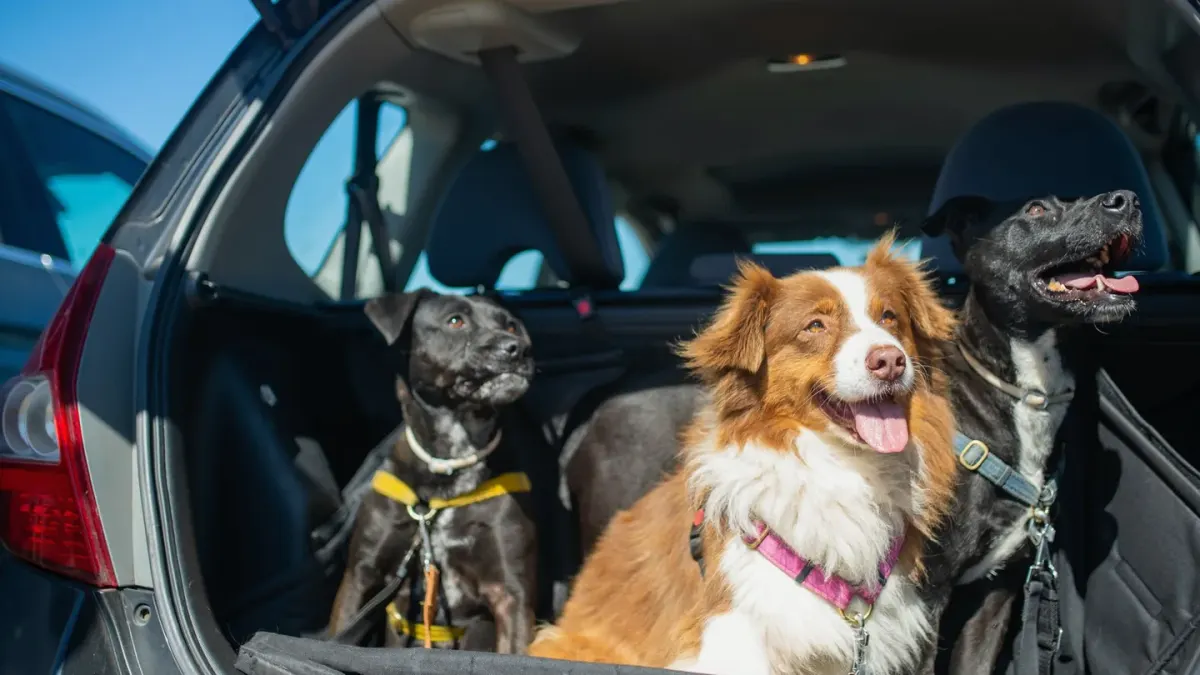
The front passenger seat sits directly in front of an airbag engineered for an adult human body, not a 20-pound dog. According to NHTSA, airbags deploy in a fraction of a second at forces that are greatest in the first two to three inches of inflation — enough to cause serious injury to anyone positioned too close to or on top of the bag when it fires. That calculus doesn’t change because the passenger has fur instead of a seatbelt sign warning. A dog on the front seat, in a lap, or riding in a carrier on that seat is sitting in the one place in the vehicle built around a very different-sized occupant.
What the crash-test evidence actually shows
This is where I want to be honest about the limits of what we know. The Center for Pet Safety has been crash-testing dog restraints since 2011, using the same federally contracted labs that test child safety seats, with dog-sized crash dummies scaled to different weights. Their early pilot testing found harnesses and restraints failing at a striking rate under real crash conditions — meaning the restraint itself, not just the seat position, matters enormously. A harness that isn’t crash-rated may keep a dog from becoming a projectile in a fender-bender but still fail in a higher-speed impact.
That’s a genuinely mixed picture. Seat position (back over front) is a well-supported recommendation. Which specific harness or carrier actually protects a dog in a serious collision is a much thinner, still-evolving body of evidence, and I don’t think owners should assume any restraint labeled “crash-tested” performs the same as another.
One short truth worth sitting with: no restraint on the market has been shown to fully eliminate crash risk for a dog.
What I actually tell owners in the exam room
In my practice, I walk clients through this the same way every time: seat position first, restraint second, airbag status third. If a dog has to ride up front for some reason — a very anxious traveler who does better next to their person, or a car with no usable back seat — the passenger airbag needs to be switched off, the same rule most manuals list for rear-facing child seats. If the back seat is available, that’s where the dog goes, ideally in the middle position, restrained with a harness attached to the seatbelt system or in a crate anchored so it can’t slide or tip.
I think about this differently for older dogs with joint stiffness, too. A dog with hip or elbow discomfort doesn’t self-correct in a sudden stop the way a younger, more agile dog might; a stiff dog can’t brace or reposition quickly, which means the restraint is doing more of the protective work, not less. If you’re already managing joint stiffness, that’s also a reason to look at gear that doesn’t require a dog to jump up onto the seat unassisted — a ramp or step reduces the number of hard landings and awkward twists before the car ride even starts.
I had a similar case a few years back with an 11-year-old Basset Hound named Gus, whose owner asked me point-blank whether the back seat crate was overkill for a 20-minute drive to the park. I told her what I tell most people: it’s not really about how long the drive is, it’s about what happens in the two or three seconds you don’t control. She switched him to a secured crate in the back that week, and it became routine within about ten days — he stopped whining at the car door once the crate became “his spot” instead of a cage.
Where this connects to your setup at home
If you’re weighing a harness versus a crate versus a barrier for daily driving, the comparison of restraint categories is worth reading before you buy anything — the right answer depends on your dog’s size and temperament as much as the product. For longer trips, the same seat-position logic carries over to puppies riding for the first time, where an anxious young dog is even more likely to end up loose on the front seat if you don’t plan ahead. And if road trips eventually turn into flights, the front-seat airbag risk goes away, but a carrier that’s actually airline-approved brings its own fit and structure questions worth understanding in advance.
The bottom line
No, the front seat isn’t the safer choice for a dog, mainly because of airbag physics that were never designed with a dog’s body in mind. The back seat, restrained, is the better default — but “restrained” is doing a lot of work in that sentence, since crash-test data shows plenty of products underperforming once real forces are applied. My practical next step for most owners: pick a back-seat setup, check whether the specific harness or crate has independent crash-test data behind it, and don’t assume “sold as a car harness” means “tested like one.”
Frequently asked questions
Is it illegal for a dog to ride in the front seat?
Laws vary by state, and most don't specifically ban dogs in the front seat, but several states have distracted-driving or unrestrained-animal statutes that can apply if a loose dog interferes with driving.
Can a dog ride in the front seat if the airbag is turned off?
Turning off the passenger airbag removes the deployment risk, but the dog is still unrestrained near the dashboard unless secured with a crash-tested harness or carrier.
Are crash-tested dog harnesses actually safer?
Independent testing from groups like the Center for Pet Safety has found a meaningful share of harnesses failing under real crash conditions, so a "crash-tested" label is a useful starting point, not a guarantee.
Sources
- Vehicle Air Bags and Injury Prevention — NHTSA
- 2011 Harness Pilot Study — Center for Pet Safety