Should You Board a Senior Dog or Hire a Sitter?
A vet explains what the stress data on boarding actually shows, when an in-home sitter is the safer call for an aging dog, and where a good kennel stay still works.
For most dogs past ten, with stiff joints or a foggier memory, a single trusted sitter who keeps their routine intact beats even the best boarding facility — a well-run in-home boarding stay is the honest exception worth knowing about.

On this page
Gus was thirteen, a Labrador mix with hips that had gotten noticeably stiffer that spring, and his owner, Marla, was standing in my exam room with a boarding kennel brochure in one hand and a sitter’s business card in the other. She’d booked the kennel already, a nice one, play yards and webcams and a staff that clearly loved dogs, and she just wanted me to tell her it was fine. I looked at Gus’s chart. He’d started needing help onto the couch that winter. He slept twenty hours a day now, mostly in one specific spot by the kitchen window, and he’d had two episodes of pacing at 2 a.m. that Marla had chalked up to a bad dream. I told her the kennel probably wasn’t fine, not for him, not that week. About one in five dogs past eight shows some degree of age-related cognitive impairment, and Gus had the early shape of it. That’s the number I lead with when owners ask me this question, because it changes the math more than almost anything else.
The short answer, stated plainly
For a healthy, social senior dog with no cognitive changes and no joint pain that limits mobility, a good boarding facility is a reasonable option, and some dogs genuinely do fine there. For a dog with arthritis, early cognitive decline, or any anxiety around new places, an in-home sitter who keeps meals, walks, and sleeping arrangements close to normal is the safer default. The exception worth knowing about is a small, quiet, in-home-style boarding setup with one caregiver and a routine built to mirror the dog’s own house — that middle option covers a lot of the gap between the two extremes.
I don’t land here casually. I land here because of what actually happens to a dog’s stress physiology when the environment changes, and because I’ve watched the difference play out in dogs I know well.
What actually happens to a senior dog’s body in an unfamiliar place
Boarding stress isn’t just a mood problem. A study published in the Journal of Veterinary Clinics tracked serum cortisol in dogs across five days of boarding and found that kennel-boarded dogs showed significantly elevated cortisol for the entire stay, in both puppies and mature adults, and that the normal circadian rhythm of cortisol release — the daily rise and fall that keeps a dog’s stress hormones on a predictable clock — flattened out and disappeared under kennel conditions. Dogs boarded in a more free, less confined setup still showed a cortisol spike, but it tapered by day two or three, and their circadian pattern held.
That distinction matters more for an older dog. Chronic pain, from arthritis especially, already puts a strain on the same stress-hormone system. Layer an unfamiliar environment and disrupted rhythm on top of that, and you’re asking an already-taxed system to work harder for the whole trip, not just the first day.
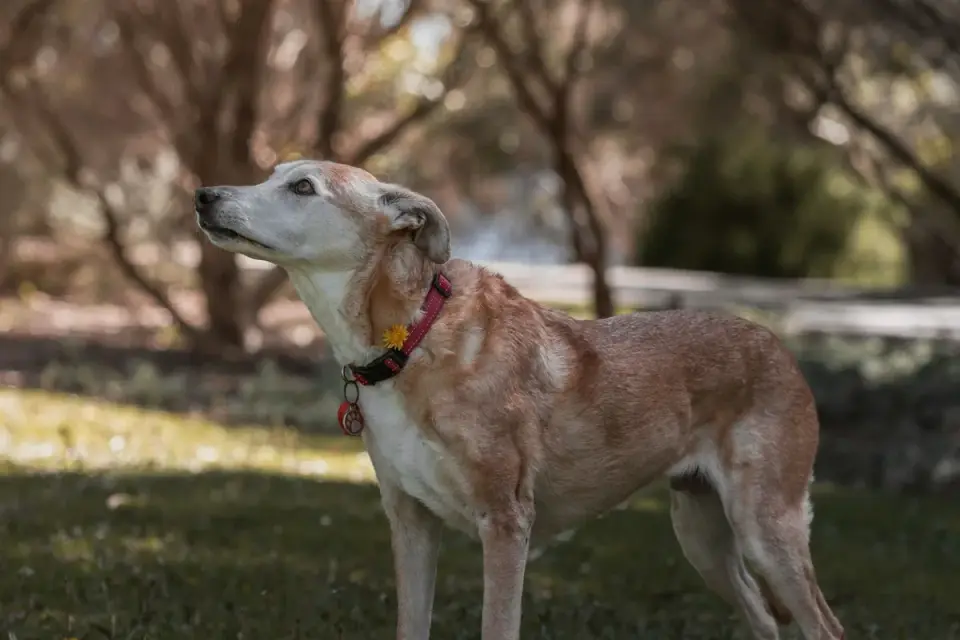
To be fair to boarding kennels, the picture isn’t uniformly grim. Research out of the University of Lincoln and collaborating UK institutions, reported by ScienceDaily, measured cortisol-to-creatinine ratios in dogs at home versus in boarding kennels and found levels were higher in the kennel setting, but the researchers were careful to note that cortisol also rises with exercise and excitement, not just distress — meaning some of that elevation could reflect stimulation rather than suffering. Short kennel stays, for a dog who handles novelty well, may not be the crisis owners fear.
That’s a real caveat. It just doesn’t apply as cleanly once cognitive decline enters the picture.
Where cognitive decline changes the calculus
I had a client a few years back with a fourteen-year-old beagle named Sadie who’d been boarded at the same kennel her whole life without issue. That year, the owners came back from a wedding to a dog who’d stopped eating for two days, was disoriented in her own backyard for the first afternoon home, and needed nearly a week to get back to her normal nighttime sleep pattern. Nothing about the kennel had changed. Sadie had. She’d developed early canine cognitive dysfunction over the preceding year, the kind of slow shift owners often miss because it looks like “just getting old” — more confusion after dark, some house-training lapses, less interest in play. A brain that’s already working harder to interpret a familiar world does not handle an unfamiliar one gracefully.
Predictable routines and consistent human connection are specifically called out in the guidance from the American Animal Hospital Association’s work on senior dogs as tools that help reduce anxiety in dogs with cognitive changes, alongside physical, sensory, and social enrichment kept as close to the dog’s normal pattern as possible. A sitter who comes to the house, feeds at the usual times, walks the usual route, and sleeps under the usual roof is, functionally, an extension of that routine. A kennel — even a good one — is the opposite of that by design.
If you’re already managing a senior dog’s transitions carefully, the same caution applies to other routine changes; see our guide on changing a senior dog’s food without wrecking digestion for the same slow-and-steady logic applied to diet.
The counterargument I hear most, and why I still land where I do
The pushback I get most often is cost and guilt in the same breath: a sitter costs more per day than a kennel run, and owners worry a sitter alone in the house can’t handle an emergency the way a staffed facility can. Both concerns are legitimate. A solo overnight sitter genuinely has less backup than a kennel with staff on-site around the clock, and for a dog with a serious, actively unstable medical condition, that’s a real tradeoff worth weighing with your vet before you book anything.
But for the far more common case — a stiff, slower, slightly more anxious senior dog without an acute medical crisis — the stress-physiology data points one direction, and my own casework backs it up. The dogs who come home from a week with a familiar sitter tend to eat on schedule again by day two. The dogs who come home from a kennel stay, especially the ones with any cognitive fog, often take longer to settle, and I see more soft stool, appetite loss, and disrupted sleep in that group in the days after pickup. None of that is a formal outcome measure, it’s a pattern from my own exam room, but it lines up with what the cortisol research would predict.
What I actually tell clients
I tell them to start with the dog, not the calendar. If your senior dog still greets new people at the door with real enthusiasm, tolerates the vet visit without shaking, and has no cognitive red flags, a well-reviewed boarding facility that does short intro visits first is a legitimate option, and I’ll say so plainly in the exam room. If your dog has arthritis bad enough to need help with stairs, any signs of nighttime confusion, or gets clingy and unsettled just from a change in daily walk time, I steer them toward an in-home sitter, ideally one the dog has met before the actual trip. A short trial overnight, weeks ahead of the real one, tells you more than any brochure will. Keeping the walk schedule close to normal matters here too — our piece on how long a dog’s walk should be is a useful reference for a sitter who’s new to your dog’s routine. And if cognitive decline is part of the picture, it’s worth reading what the evidence actually says about supplements like MCT oil for senior dogs with cognitive decline before your dog’s next stay, since supplement timing and routine changes shouldn’t be stacked together right before travel.
Keep the decision preventive rather than reactive: ask what a sitter or kennel will actually change about your dog’s day before you need the answer, not while you’re already packing the car.
Frequently asked questions
Is boarding bad for all senior dogs?
No. A healthy senior dog without cognitive changes or significant joint pain can often handle a short, well-run boarding stay fine. The concern rises specifically with arthritis, anxiety, and early cognitive decline, where an unfamiliar routine adds real physiological stress on top of an already-taxed system.
How can I tell if my dog is developing cognitive decline before a trip?
Watch for nighttime pacing or disorientation, house-training lapses in a previously reliable dog, reduced interest in normal activities, and confusion in familiar spaces. These changes can be subtle and are easy to mistake for "just getting old."
Is a sitter always safer than boarding for a senior dog?
Not in every case. A solo in-home sitter has less backup than a staffed facility, which matters for a dog with an unstable medical condition. For most stiff, slower, or mildly anxious senior dogs without an acute medical crisis, though, the routine-continuity benefit of a sitter tends to outweigh that gap.
Sources
- Changes in Serum Cortisol Concentration Due to Boarding Stress in Dogs — Journal of Veterinary Clinics
- Some dogs could see a kennel stay as exciting — ScienceDaily